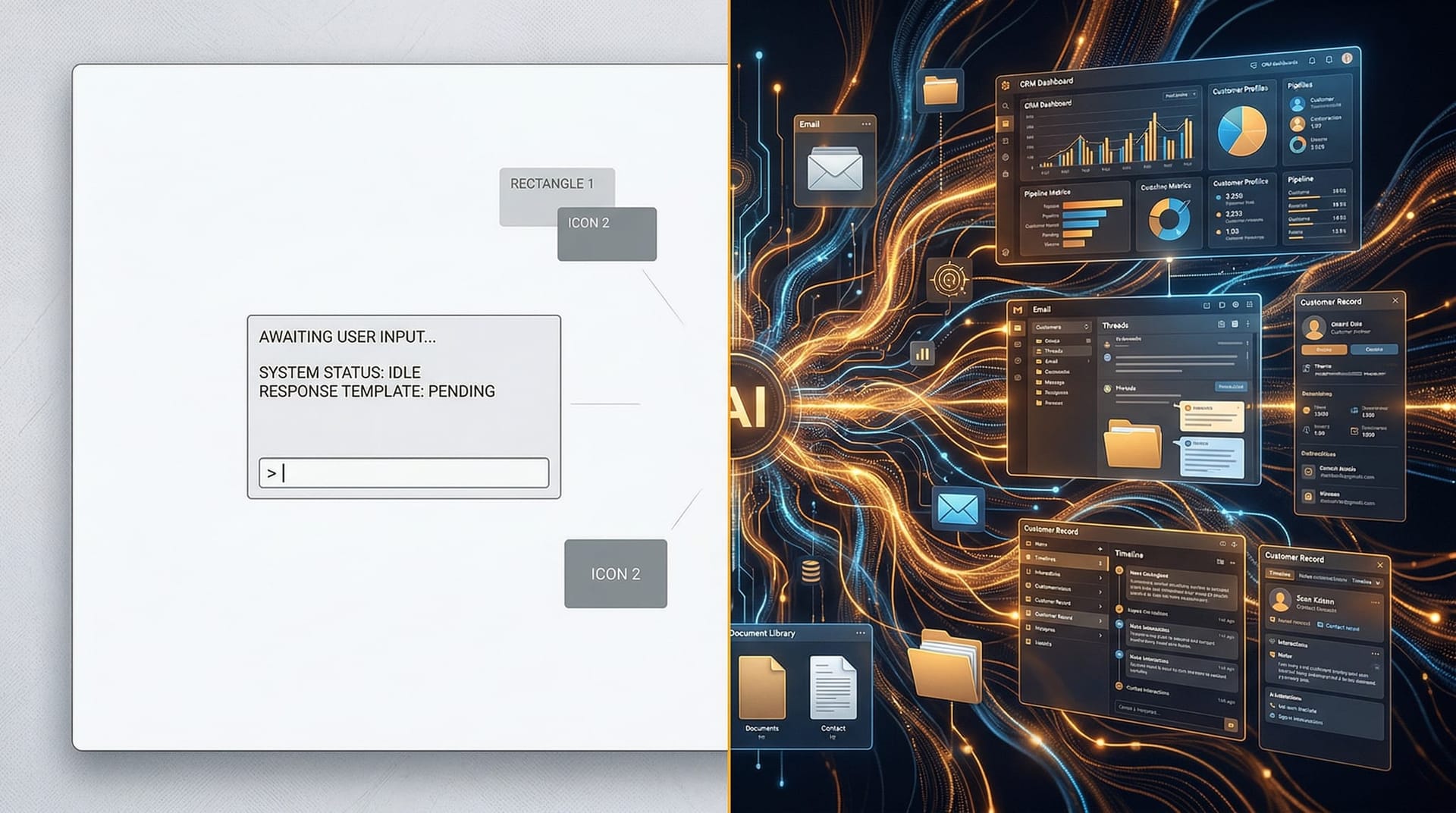
There is a strange fact hiding inside almost every business right now: you are already paying for AI capability you capture almost none of. The models your team touches every day can do far more than your team asks of them, and the distance between those two things — the AI capability overhang — is quietly the largest untapped return on investment you own.
Ethan Mollick gave that distance a name. In his essay “The Overhang”, he describes “the gap between what these models can do and what almost anyone is doing with them” — capability that is, in his words, “barely being used, and are often not even well understood.” His point is not that better models are coming (they are). It is that the frontier we already have — he points to systems like GPT-6 Astra and Fable 5.1 — sits mostly idle inside organizations that never gave anyone the job of operating it.
That reframing matters for how you spend the next year. If the binding constraint were model capability, the smart move would be to wait for the next release. But if the binding constraint is recognition and deployment — knowing what the tools can do and building a way to actually do it — then waiting is the most expensive choice available.
Key Takeaways
- The “overhang” is the gap between what current AI can do and what your business actually does with it — and it is almost entirely a deployment problem, not a capability problem.
- Independent surveys keep finding the same split: near-universal adoption, very little enterprise-level value. The bottleneck is organizational, not technical.
- Mollick names four human advantages that unlock latent AI capability: deep knowledge, wide knowledge, taste, and agency.
- Deep knowledge, wide knowledge, and taste stay firmly the human's job. Agency — the willingness to actually run a workflow end-to-end — is the piece you can delegate.
- Shallow “tool-poking” never closes the overhang, which is why so many pilots stall short of measurable results.
- A role-scoped AI Employee closes the gap between “the model could” and “our business does.”

What Is the AI Capability Overhang?
The overhang is the accumulated capability of AI systems that no one in your organization is actually using. It builds up because model capability compounds faster than human habits change. Every release adds new things the tools can do; almost none of those things automatically become things your business does. The stock of unused capability grows, and the overhang with it.
You can see the shape of it in the adoption data. Stanford HAI's 2025 AI Index reports that the share of organizations using generative AI in at least one business function more than doubled in a single year, from roughly a third to about 71%. Adoption, in other words, is nearly solved. Yet the same report notes that most organizations reporting cost savings put those savings below 10% — a rounding error against what the tools are theoretically capable of. The capability arrived; the value largely did not.
Mollick's framing is useful precisely because it refuses the comfortable explanation. The overhang is not the models' fault. It is not waiting on a smarter release. It exists because knowing a capability exists and building an organization that exercises it are two completely different projects, and most companies have only done the first. This is the same argument we made in Why AI Interfaces Matter More Than AI Models: the value lives in the deployment layer, not the model weights.
Why the Overhang Exists If the Models Are So Capable
Because capability is now abundant and cheap, while the ability to direct it is scarce. The frontier is also converging — Stanford's index found the performance gap between the top model and the tenth-ranked model narrowed dramatically in a year. When even mid-tier models are extraordinarily capable, the differentiator stops being which model you use and becomes whether anyone in your building is set up to use it well.
The evidence that this is an organizational problem, not a technical one, is remarkably consistent across the major surveys:
| Source | Finding | What it says about the overhang |
|---|---|---|
| McKinsey, State of AI 2025 | ~88% regularly use AI, but only 39% report enterprise-level EBIT impact; just 21% had fundamentally redesigned a workflow | Adoption is near-universal; transformation is rare |
| BCG, “Where's the Value in AI?” | 74% of companies struggle to achieve and scale value; only 4% create substantial value; leaders put ~70% of effort into people and process | The unlock is operational, not algorithmic |
| MIT NANDA, State of AI in Business 2025 | ~95% of generative-AI pilots delivered no measurable P&L impact | The failure is in integration and workflow, not model quality |
Read those three rows together and a single story emerges. Companies bought the capability. They deployed the chat window. And then the capability just… sat there. McKinsey's own read is blunt: most organizations have not embedded AI deeply enough into workflows to see material benefit. BCG found that the leaders who do capture value spend the overwhelming majority of their effort on people and process rather than the technology itself. The overhang is what's left over when you buy the engine and never build the car.

The Four Human Advantages That Close the Gap
Mollick argues the overhang gets closed not by the AI alone but by what humans bring to the collaboration. He names four advantages — and it's worth being precise about which ones are yours to keep and which one you can hand off.
- Deep knowledge. Specialized expertise that lets you spot what's wrong at a glance — the accountant who sees the spreadsheet error, the pro who reads the flawed swing. Mollick notes that expertise doesn't just help you judge AI output; it improves the output itself.
- Wide knowledge. Broad fluency across disciplines and traditions that tells you which approach fits a problem — knowing when a design principle applies, or when one tool should feed another.
- Taste. In Mollick's words, “the scarce resource is your ability to select among stuff using your own taste.” When AI can generate a hundred options, the value shifts to deciding what to keep, cut, or repurpose. Generative AI produces “slop,” he writes, but “slop can be defeated by taste.”
- Agency. The willingness to explore the tool's boundaries and actually run something end-to-end — to become, as he puts it, “an explorer” of the jagged frontier.
Here's the operational insight for a business owner: three of those four are irreducibly human. Deep knowledge, wide knowledge, and taste are your judgment, and you should not try to delegate them. But agency — the sustained willingness to actually operate the tool through a whole workflow, day after day — is exactly the thing that stalls inside busy organizations. Nobody has the time, and nobody has the job.
| Advantage | Whose job is it? | How it closes the overhang |
|---|---|---|
| Deep knowledge | Human (keep it) | Directs AI at the right problem; improves output quality |
| Wide knowledge | Human (keep it) | Chooses the right approach and connects tools |
| Taste | Human (keep it) | Selects and refines among abundant AI outputs |
| Agency | Delegable | Runs the workflow end-to-end so capability is actually used |
This maps onto what Anthropic's Economic Index has been tracking: the split between augmentation (AI helps a person work) and automation (AI completes a task with little human input). Most knowledge work still leans augmentative — which is fine for the three advantages you keep. The overhang lives in the automation-shaped work that never gets automated because no human has the agency to set it up and keep it running.
Why Shallow Tool-Poking Never Closes the Overhang
Because opening a chat window when you happen to remember to is not deployment — it's dabbling. And dabbling is exactly what the pilot-failure numbers describe. When MIT's researchers found that the overwhelming majority of pilots produced no measurable financial impact, the cause wasn't weak models; it was that generic tools boosted individual productivity in scattered moments without ever adapting to, or owning, a real workflow.
This is the shallow-adoption trap we covered in Why Generic AI Fails (And Custom AI Employees Don't): a general-purpose chatbot is flexible enough to feel useful to an individual and shapeless enough to never become a dependable part of the business. It waits to be prompted. It forgets last week. It has no role. Multiply that across a team and you get high “usage” statistics sitting directly on top of an enormous, untouched overhang.
There's an honest trade-off to name here. Chat tools are genuinely valuable for the augmentation work — brainstorming, drafting, quick research — where a human stays in the loop and applies deep knowledge and taste. The problem is that businesses mistake that augmentation for their whole AI strategy, then wonder why the promised transformation never arrives. It never arrives because the automatable, agency-heavy work is the part that got skipped. This is why, as we argued in Turning AI Pilots Into AI Employees, execution — not strategy decks and not a better model — is the real differentiator between the companies capturing value and the 95% who aren't.

How a Role-Scoped AI Employee Actually Closes the Overhang
By supplying the one advantage you can delegate — agency — and pointing it at a defined job. An AI Employee is not another chat window your team has to remember to open. It's an autonomous operator with a role: a defined workflow it runs end-to-end, on its own schedule, without waiting to be prompted. That shift — from a tool you use to an operator that acts — is the move from the chatbot era to what we described in Proactive AI Agents in 2026: The End of the Chatbot Era.
Think about how this splits the four advantages cleanly. You and your team keep deep knowledge, wide knowledge, and taste — you define the role, set the standards, and judge the output. The AI Employee supplies the relentless agency: it monitors the inbox, drafts and files the report, qualifies the lead, runs the nightly audit, makes the follow-up call. The capability was always there in the model. What was missing was something whose job was to exercise it, over and over, without a human having to initiate every single time.
This is also, to be clear, Cloud Radix's editorial extension of Mollick's argument, not a claim he makes. Mollick describes the overhang and the human advantages; he doesn't prescribe AI Employees. But the logic follows directly. If the overhang exists because agency is the scarce, delegable input, then the highest-leverage thing a business can build is a role-scoped operator that supplies exactly that. Ethan Mollick has written elsewhere about humans and AI as collaborators rather than replacements — a theme we explored in Co-Existence, Not Co-Intelligence — and a well-designed AI Employee is that collaboration made concrete: it takes the tireless execution, you keep the judgment.
Local Angle: Auditing the Overhang in a Northeast Indiana Business

You don't need a research lab to find your own overhang — you need an honest hour. For the operations leaders we work with across Fort Wayne, Auburn, DeKalb County, and the broader Northeast Indiana market, the exercise is the same regardless of industry. List the work your team does that is repetitive, rules-based, and currently done by a person only when they get to it: the leads that don't get called back until tomorrow, the report someone assembles by hand every Friday, the inbox that piles up overnight. Each of those is overhang — capability the tools already have, waiting on agency no one has assigned.
The reason this matters more here than in a coastal enterprise is that a Midwest professional-services firm, clinic, or manufacturer rarely has spare headcount to throw at “AI experimentation.” The overhang isn't going to close because someone finds free time to poke at a chatbot; it closes when a defined role gets handed to an operator that runs it. If you want a structured way to start, our 2026 Practical Adoption Playbook for Fort Wayne Business Owners walks through how to pick the first workflow worth handing off.
Ready to Close Your Overhang?
The models you already pay for can do more than your business asks of them today — that's not a prediction, it's the current state of things. The question is whether you'll keep leaving that capability on the table or give it a job. Cloud Radix builds AI Employees that take on a defined role and run it end-to-end: research, content, phone calls, lead management, security auditing, and more. You bring the deep knowledge and the taste; we build the operator that supplies the agency. If you're ready to turn “the model could” into “our business does,” let's map your first role together.
Frequently Asked Questions
Q1.What is the AI capability overhang?
It's the gap between what today's AI models can do and what a business actually does with them. Ethan Mollick describes it as capability that is “barely being used, and often not even well understood.” It accumulates because model capability grows faster than organizational habits change.
Q2.Is the overhang a model problem or a deployment problem?
Overwhelmingly a deployment problem. Surveys from McKinsey, BCG, and MIT all find near-universal AI adoption paired with very little enterprise-level value — the failure is in integration, workflow redesign, and ownership, not in model quality. Waiting for a smarter model does not close a gap that a smarter model didn't cause.
Q3.What are the four human advantages Mollick names?
Deep knowledge (specialized expertise), wide knowledge (broad cross-disciplinary fluency), taste (the ability to select among AI outputs), and agency (the willingness to explore and run work end-to-end). The first three are human judgment you should keep; agency is the piece a business can effectively delegate.
Q4.Why do so many AI pilots fail to deliver results?
Because most “adoption” is shallow tool-poking — opening a chat window occasionally rather than embedding AI into a real workflow. MIT's 2025 research found roughly 95% of generative-AI pilots produced no measurable financial impact, largely due to weak integration rather than weak models.
Q5.How is an AI Employee different from a chatbot?
A chatbot waits to be prompted and forgets context between sessions. An AI Employee has a defined role and runs a workflow end-to-end on its own — supplying the sustained agency that shallow tool use never does. That's the difference between a tool you use and an operator that acts.
Q6.How do I find the overhang in my own business?
List the repetitive, rules-based work that only gets done when a person has time for it — delayed lead follow-ups, manual weekly reports, overnight inbox backlogs. Each is capability the tools already have, waiting on agency no one has assigned. Those tasks are the strongest candidates for a role-scoped AI Employee.
Sources & Further Reading
- One Useful Thing (Ethan Mollick): oneusefulthing.org/p/the-overhang — The essay that names the capability overhang and the four human advantages.
- McKinsey & Company: mckinsey.com/capabilities/quantumblack/our-insights/the-state-of-ai — The state of AI in 2025: near-universal adoption, rare enterprise-level impact.
- Forbes (reporting on MIT NANDA): forbes.com/sites/jasonsnyder/2025/08/26 — MIT finds 95% of GenAI pilots fail because companies avoid friction.
- Anthropic: anthropic.com/research/anthropic-economic-index-september-2025-report — The Anthropic Economic Index on uneven AI adoption and augmentation vs. automation.
- Boston Consulting Group: bcg.com/press/24october2024-ai-adoption-in-2024 — 74% of companies struggle to achieve and scale AI value.
- Stanford HAI: hai.stanford.edu/ai-index/2025-ai-index-report — The 2025 AI Index Report on adoption rates and frontier-model convergence.
Give Your Idle AI Capability a Job
We will help you find the repetitive, rules-based work hiding inside your Fort Wayne or Northeast Indiana business, then build a role-scoped AI Employee that runs it end-to-end — so the capability you already pay for finally goes to work.
Map Your First RoleNo contracts. No pressure. Just an honest conversation about the work worth handing off.