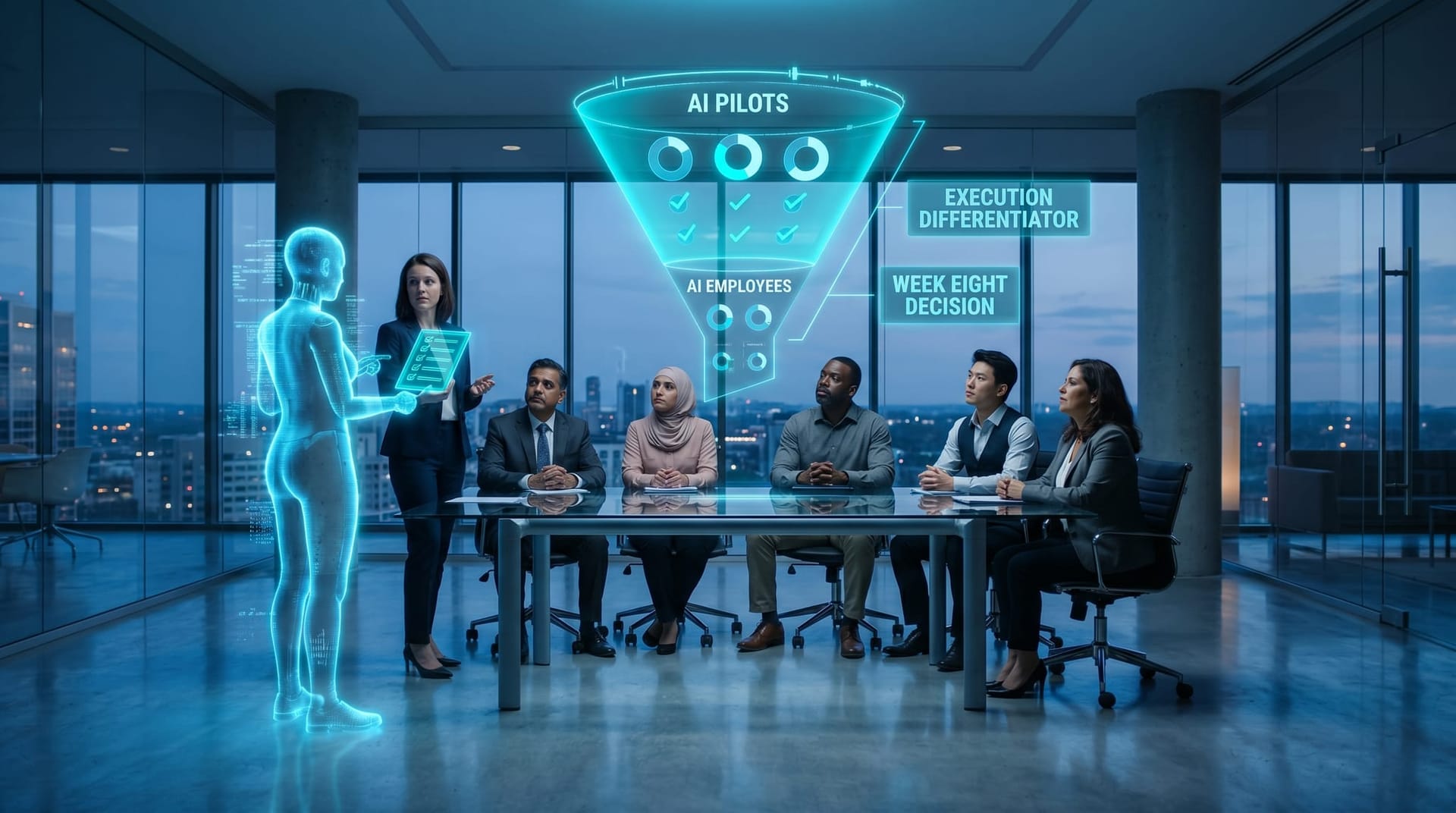
When Ethan Mollick reframes how to think about AI, it's worth paying attention — his “co-intelligence” framing became one of the most widely adopted mental models for the last era of generative AI. So when he argues that we're moving past it, that's a signal about where the whole field is heading. In a June 2026 essay, Co-Existence and the End of Co-Intelligence, Mollick makes the case that the cooperative model many of us got comfortable with — human at the center, AI as a helpful assistant you prompt back and forth — is giving way to something different: AI that sometimes outperforms us, still isn't reliable, and increasingly acts on its own alongside us rather than waiting to be asked.
From where we sit at Cloud Radix, this isn't a far-future abstraction. It's a precise description of the product thesis we've been building on: autonomous AI Employees doing real work, around the clock, without a human prompting each step. Mollick's framing is useful because it names the shift honestly — including the uncomfortable parts. Co-existence doesn't mean AI is now your reliable superior. It means you have to figure out how to work alongside something that is sometimes better than you and sometimes wrong, and that increasingly doesn't wait for your input. That's a harder, more interesting problem than “AI as smart assistant,” and it has direct consequences for how you staff, supervise, and set guardrails.
This is the forward-thinking lens, but we're going to keep it grounded — because the single most important thing about co-existence is the part the hype skips: it only works on top of governance, authorization boundaries, and human approval gates. Take those away and “AI acting on its own” becomes exactly the failure mode the security world has spent this year documenting.
Key Takeaways
- Ethan Mollick argues we're shifting from “co-intelligence” (human-centered, prompt-driven AI assistance) to “co-existence” — working alongside AI that sometimes outperforms us, often acts autonomously, and still isn't fully reliable.
- This maps almost one-to-one onto the AI Employee thesis: autonomous agents doing real work continuously, not a chatbot you steer turn by turn.
- The shift is already visible — Anthropic now reports the majority of its code is AI-authored, and labs openly describe building “highly autonomous systems.”
- Co-existence is not the same as AI being reliably better than you. A controlled study found AI can even slow experts who assume it speeds them up — judgment about when to trust, delegate, or refuse becomes a core skill.
- The honest caveat: co-existence only works on top of governance — authorization limits, audit trails, and human approval gates. Without them, “autonomy” is just unmanaged risk.
- For businesses, this changes how you staff, supervise, and guardrail — you start managing AI workers, not just using AI tools.
What does Mollick mean by “co-existence” — and how is it different from “co-intelligence”?
The distinction is about who's at the center and who's waiting on whom. Co-intelligence, the framing from Mollick's earlier work, describes a cooperative relationship: the human stays central, the AI serves as a capable assistant, and the value comes from the back-and-forth of prompting and refining. You're the pilot; the AI is the very good co-pilot you direct.
Co-existence describes a messier reality. Here, the AI sometimes outperforms the human at the task at hand — but it remains imperfect, so you can't simply hand over the controls. Mollick captures the new dynamic in a memorable line: the change comes when the AI is “no longer just your assistant, but your reader, your critic, and the gatekeeper standing between your work and its audience.” And he's clear that this isn't a one-time adjustment. Working with AI that is sometimes better than you, as he puts it, “is not a problem you solve once.” It's an ongoing negotiation about when to lean on it, when to override it, and when to refuse its help altogether.
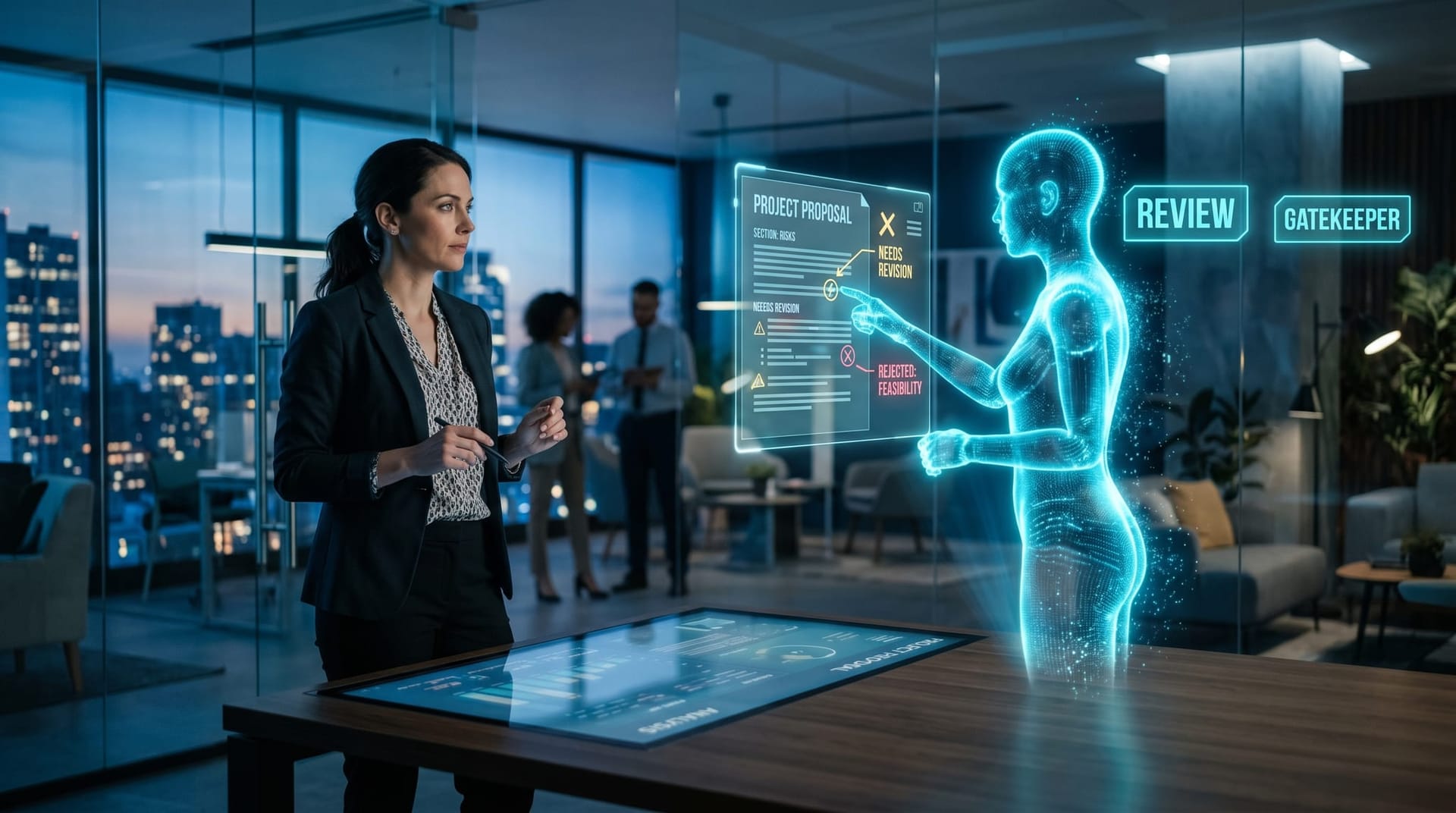
That ongoing negotiation is the whole game. In a co-intelligence world, the human skill was prompting — asking well. In a co-existence world, the human skill becomes judgment — knowing when the autonomous system is right, when it's confidently wrong, and where to put the boundaries. This is a meaningful upgrade in what we're asking of people, and it's why we've argued elsewhere that this moment requires rethinking org design for agentic AI rather than just bolting AI onto the existing org chart.
Why is this shift happening now?
Because autonomous capability stopped being a demo and started being a default in real production environments. The clearest single data point is Anthropic's own engineering: the company now reports that more than 80% of the code it merges into production is authored by Claude, with the typical engineer shipping roughly eight times as much code as in 2024. Mollick cites this same shift, alongside reports of coding agents driving on the order of seventeen times more code being written. The human role in that workflow has already moved from author to reviewer and decision-maker — which is co-existence in miniature.
It's also where the labs say they're going on purpose. Mollick points to OpenAI's stated mission of building “highly autonomous systems that outperform humans at most economically valuable work” — language that's been in the OpenAI Charter for years but now reads less like aspiration and more like a roadmap. And the trajectory is accelerating: Anthropic's recent disclosures, reported alongside a call for a verifiable global “pause” mechanism, describe rising success rates on complex, open-ended engineering problems and explicitly map a path toward recursive self-improvement. When the people building these systems are simultaneously shipping autonomy and asking for a brake pedal, you're watching co-existence arrive in real time.
The business-facing version of this is the same story told from the demand side. VentureBeat's framing of onboarding the AI workforce and how digital agents will redefine work itself treats autonomous agents not as features but as workers you bring into the org — which is exactly the mental model co-existence demands.
The honest counterweight: co-existence is not “AI is now better than you”
This is where the Cloud Radix voice insists on sobriety, because the hype version of co-existence is dangerous. “AI sometimes outperforms humans” is not the same claim as “AI reliably outperforms humans,” and treating the first as the second is how organizations get burned.
The cleanest evidence is a controlled trial by METR, which found experienced open-source developers were about 19% slower when using early-2025 AI tools on tasks in codebases they knew intimately — while those same developers believed AI had sped them up by roughly 20%. Read that gap carefully: not only did the autonomous help sometimes hurt, but the humans couldn't reliably tell. That is the core risk of co-existence in one study. When you work alongside something that's sometimes better and sometimes worse, and your own perception of which is which is unreliable, the differentiator becomes the system you build around the AI — the checks, the measurement, the boundaries — not the raw capability of the model.

So the forward-thinking position and the cautious position are the same position: co-existence is real and worth embracing, and it demands more discipline, not less. The future Mollick describes is one you walk into with guardrails, not blind faith.
What co-existence changes about how you run a business
If AI is moving from “tool you operate” to “agent you work alongside,” three concrete things change for any business adopting it.
How you staff. Co-existence doesn't simply delete roles; it reshapes them around judgment and oversight. The human value shifts toward reviewing, deciding, and handling the cases the agent can't. This has real distributional consequences — particularly for the kind of routine work that used to be where people started their careers, a dynamic we've examined in the entry-level squeeze and AI Employees. The teams that thrive will be the ones who consciously redesign roles around supervising autonomous work rather than pretending nothing changed.
How you supervise. You don't “use” a co-worker; you manage one. That means setting expectations, reviewing output, and knowing the agent's strengths and failure modes before you rely on it. We've made this practical with a framework for interviewing an AI Employee before you hire it — vetting an autonomous agent the way you'd vet a candidate, because in a co-existence model that's exactly what it is.
How you guardrail. This is the non-negotiable foundation. An autonomous agent acting on its own is only safe if it acts within explicit authorization boundaries, with an audit trail of what it did and human approval gates on the consequential decisions. Co-existence without governance isn't the future; it's the incident report. Every autonomous-agent failure the security community has documented this year traces back to the same root: an agent given more authority than its guardrails could contain.
From thesis to execution: where most businesses actually are
Here's the sober truth underneath the thought leadership: most organizations are not living in co-existence yet, and the gap is rarely about model capability. It's about execution. Plenty of companies ran an impressive AI pilot and never crossed into having an autonomous agent reliably doing real work — because the hard part was never the demo, it was the governance, integration, and operating model around it. That's the argument we've made in detail about why execution separates AI pilots from AI Employees: co-existence is earned through the unglamorous work of boundaries, review loops, and measurement, not unlocked by buying a better model.

It's also worth keeping the economics in perspective. As we noted in our look at a Nobel economist's three things to know about AI, transformative technologies tend to deliver their gains slowly, unevenly, and through organizational change rather than overnight. Co-existence is a genuine shift in kind — but for most businesses it will arrive as a series of deliberate decisions about what to delegate, how to supervise, and where to draw the lines, not as a sudden handover. The companies that get there first won't be the ones with the flashiest model. They'll be the ones who built the discipline to trust an autonomous agent because they could verify what it was doing.
Which work is ready for co-existence today — and which isn't?
The honest answer to “should I let an autonomous agent do this?” is rarely yes or no across the board. It depends on two things: how reversible the consequences are, and how cheaply you can verify the result. Co-existence works best where both are favorable, and it's dangerous where neither is.
Work that's ready now tends to share a profile: high volume, well-bounded, and easy to check. Drafting first-pass content, triaging and routing inbound requests, summarizing documents, monitoring for defined conditions, and generating routine analysis are all good candidates — the agent does the bulk of the work, a human reviews the output, and a mistake is cheap to catch and undo. This is exactly the reader-critic-gatekeeper loop Mollick describes, run in the direction that favors you: the human stays the gatekeeper on anything that ships.
Work that isn't ready yet shares the opposite profile: consequential, hard to reverse, and expensive to verify. Moving money, making binding commitments to customers, taking irreversible actions on production systems, or anything touching regulated data without controls belongs behind firm approval gates — not because the agent can't do it, but because the cost of the cases where it's confidently wrong is too high to absorb. The METR finding is the cautionary note here: when you can't reliably tell good output from bad, you do not want the bad output to be irreversible.
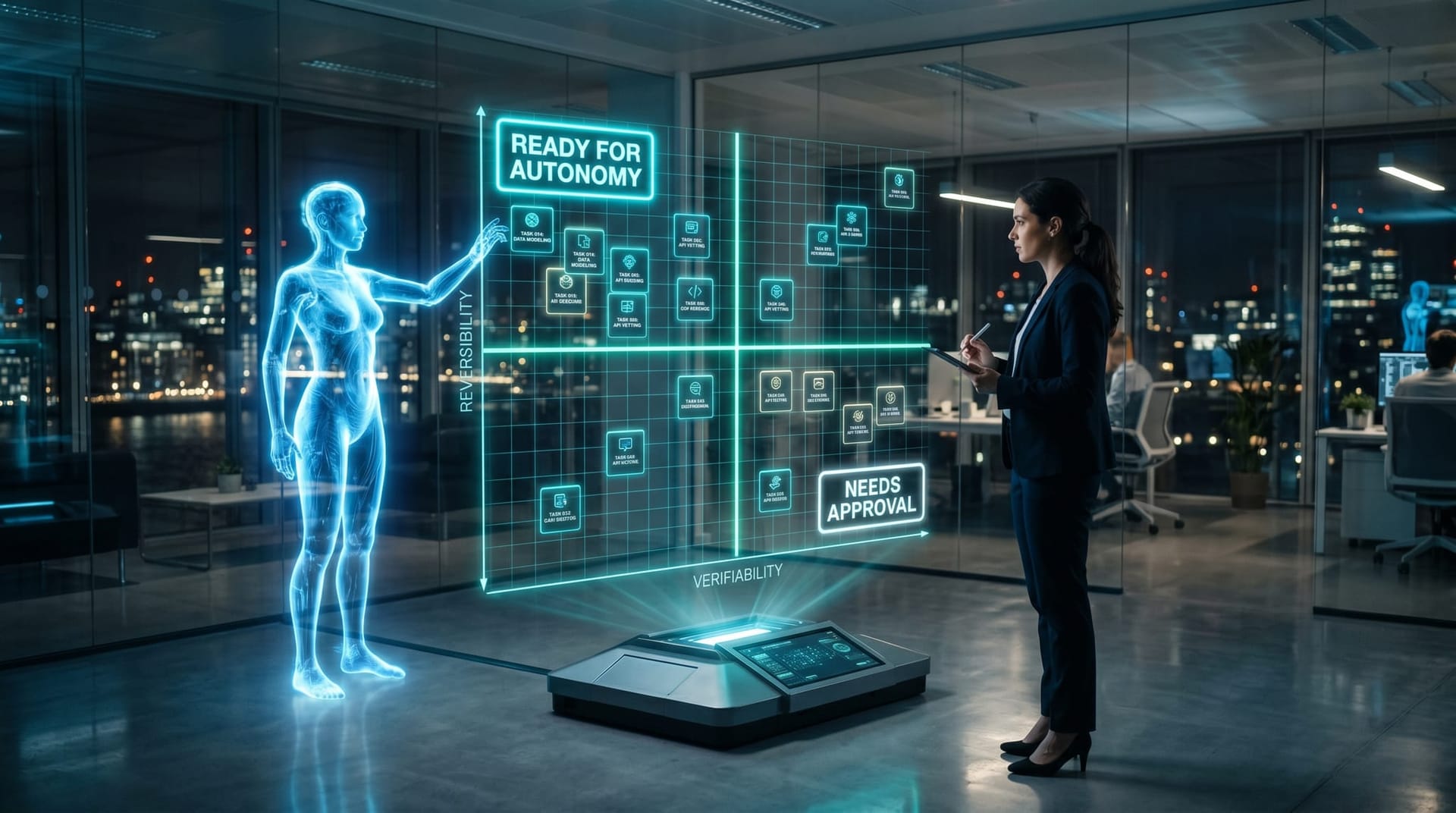
The practical move is to sort your processes along those two axes and let co-existence advance one category at a time, widening the agent's autonomy as your ability to verify its work improves. That's how you capture the upside of autonomy without betting the business on it — and it's a sorting exercise any leadership team can do in an afternoon.
Living in the future, responsibly
Mollick's “co-existence” is the most useful name yet for the era Cloud Radix builds for: autonomous AI Employees doing real work alongside your team, 24/7. We think that future is worth moving toward — and we think the only responsible way to move toward it is on a foundation of authorization boundaries, audit trails, and human approval gates, so autonomy is an asset rather than a liability. If you're ready to explore what an AI Employee could do in your business — and you want it deployed by people who treat governance as the prerequisite, not an afterthought — talk to Cloud Radix. We're already living in the future. We'd like to show you how to do it safely.
Frequently Asked Questions
Q1.What is the difference between co-intelligence and co-existence?
Co-intelligence, Ethan Mollick's earlier framing, describes a human-centered relationship where AI is a helpful assistant you prompt and refine in a back-and-forth. Co-existence describes working alongside AI that sometimes outperforms you, often acts autonomously rather than waiting to be prompted, and still isn't fully reliable — so the key human skill shifts from prompting well to judging when to trust, delegate, or override.
Q2.Is "co-existence" just hype, or is it really happening?
It's grounded in concrete developments. Anthropic reports that the majority of its production code is now AI-authored with engineers shipping far more than before, and AI labs openly describe building highly autonomous systems. At the same time, it's not a claim that AI is reliably better than humans — controlled research shows AI can still slow experienced people, so the honest version is "autonomous and powerful, but imperfect and in need of oversight."
Q3.Does co-existence mean AI is now better than humans at most work?
No. "Sometimes outperforms" is not "reliably outperforms." A METR study found experienced developers were actually about 19% slower using AI on familiar tasks, even though they believed it sped them up. The risk of co-existence is precisely that AI is inconsistent and people can't always tell when it's wrong — which is why governance and measurement matter more, not less.
Q4.How does co-existence change how a business should operate?
It changes three things: staffing shifts toward judgment and oversight roles rather than routine execution; supervision shifts from "using a tool" to "managing a worker" with expectations and review; and guardrails become foundational — autonomous agents need explicit authorization limits, audit trails, and human approval gates on consequential decisions.
Q5.How does co-existence relate to Cloud Radix's AI Employees?
It's essentially the same thesis. Cloud Radix's AI Employees are autonomous agents that do real work continuously rather than chatbots you steer turn by turn — which is co-existence in practice. The difference is that we treat governance, authorization boundaries, and human approval gates as the prerequisite for autonomy, so the agent's independence is an asset rather than an unmanaged risk.
Q6.What's the biggest risk of moving to autonomous AI agents?
Granting autonomy without adequate guardrails. Nearly every documented autonomous-agent failure traces back to an agent given more authority than its boundaries could contain. The mitigation is to pair autonomy with explicit authorization scopes, complete audit trails of what the agent did, and human approval gates on high-consequence actions — so you can verify behavior rather than simply trusting it.
Sources & Further Reading
- Ethan Mollick / One Useful Thing: oneusefulthing.org/p/co-existence-and-the-end-of-co-intelligence — Co-Existence and the End of Co-Intelligence.
- VentureBeat: venturebeat.com/technology/anthropic-says-80-of-its-new-production-code-is-now-authored-by-claude — Anthropic says 80% of its new production code is now authored by Claude.
- METR: metr.org/blog/2025-07-10-early-2025-ai-experienced-os-dev-study — Measuring the Impact of Early-2025 AI on Experienced Open-Source Developer Productivity.
- OpenAI: openai.com/charter — OpenAI Charter.
- The Next Web: thenextweb.com/news/anthropic-claude-recursive-self-improvement-code — Claude writes 80% of its code, calls for AI pause.
- VentureBeat: venturebeat.com/ai/onboarding-the-ai-workforce-how-digital-agents-will-redefine-work-itself — Onboarding the AI workforce: How digital agents will redefine work itself.
Ready to Work Alongside an AI Employee?
Co-existence is real — and it only pays off on a foundation of governance. We deploy autonomous AI Employees with authorization boundaries, audit trails, and human approval gates built in from day one.
Talk to Cloud RadixWe're already living in the future. We'd like to show you how to do it safely.