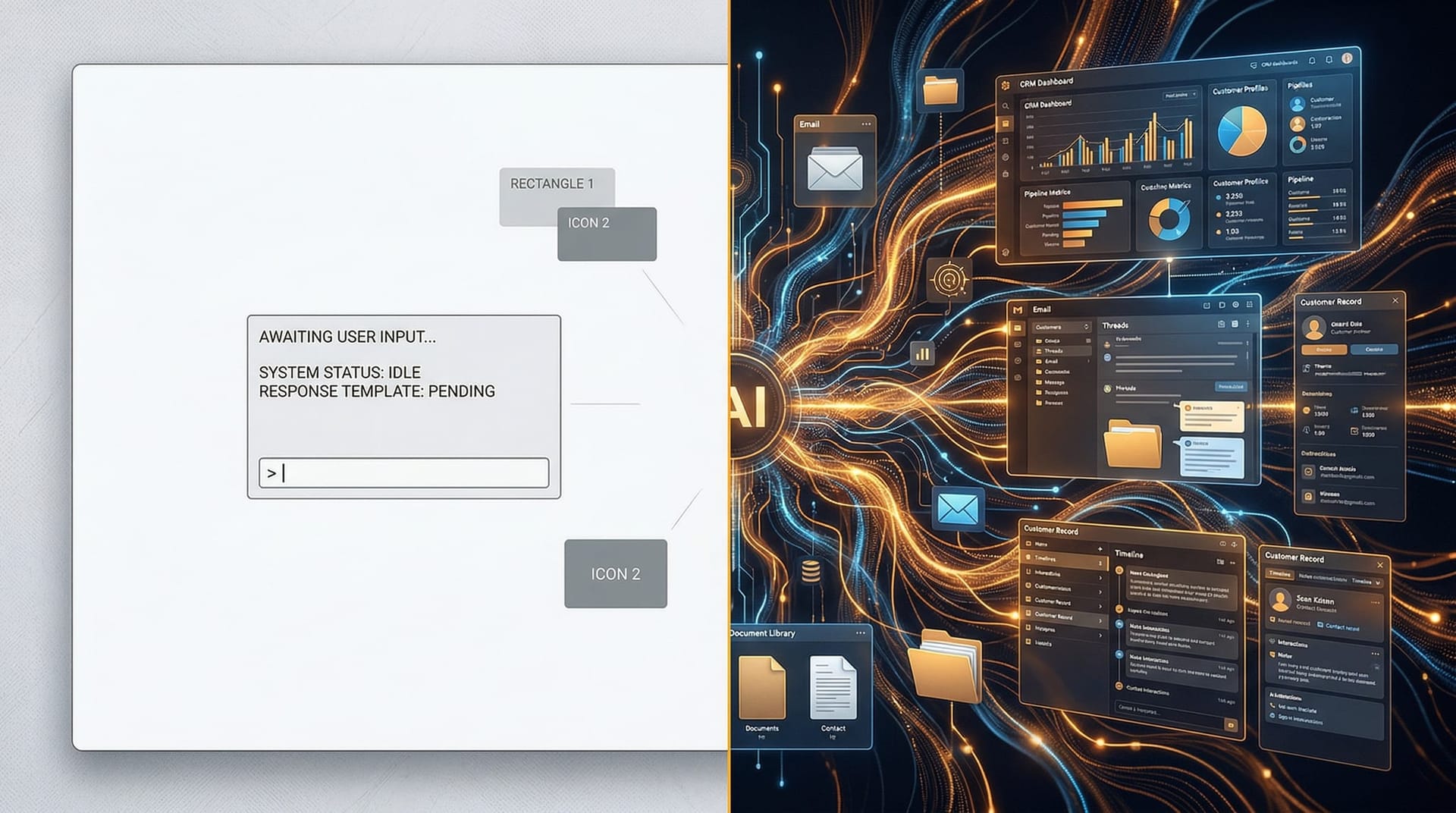
Here is the uncomfortable truth behind most stalled AI projects in Northeast Indiana: the business did not pick the wrong model, the wrong vendor, or the wrong price. It picked the wrong task. Someone in the office said “let's automate the intake forms” or “let's have AI handle the scheduling,” a tool got bought, and three months later the thing quietly stopped getting used — because the task that looked simple from the corner office turned out to be twelve steps, four systems, and a dozen judgment calls that nobody had ever written down.
The missing first step in an AI Employee project is not choosing a model. It is seeing the work — the swivel-chair steps between systems, the copy-paste chains, the “quick” tasks that somehow eat a whole afternoon. You cannot automate, redesign, or train what you have never actually looked at. This post is a diagnostic playbook: how a lean DeKalb County or Allen County operation can inventory its own workflows — without a seven-figure enterprise platform — and find the two or three tasks where an AI Employee genuinely pays for itself.
Key Takeaways
- The expensive mistake is automating a task you only think you understand; the real workflow is almost always longer and messier than the org chart says.
- “Process intelligence” — software that watches how work actually gets done — just drew a $63M funding round, signaling that even the largest enterprises now treat work discovery as the missing layer before automation.
- You do not need an enterprise platform to do this. A structured week of shadowing, timing, and inventorying surfaces the same hidden work for a small firm.
- The strongest first automation targets are high-frequency, rules-heavy tasks with structured inputs and a measurable output — not the flashiest process, the most repetitive one.
- Govern the automation from day one by routing it through a gateway, so the AI Employee has scoped access and an audit trail before it touches live data.
- Discovery is the step before redesigning or training anything — do it first, or you will pay for the shortcut later.
What Is “Process Intelligence,” and Why Did It Just Raise $63 Million?
On August 12, 2026, process-intelligence company Skan AI announced a $63 million Series C round, reported first by VentureBeat. According to the company's Series C announcement, the round was co-led by Cathay Innovation and Dell Technologies Capital, with participation from Citi Ventures, Bloomberg Beta, State Farm Ventures, and Wipro Ventures — bringing the company, founded in 2018, to roughly $120 million raised in total. Skan reported growth of more than 300% year over year, average net dollar retention of 150%, and more than 25 billion “work signals” logged across a customer base that it says includes seven of the ten largest U.S. banks and a quarter of the Fortune 50.
Strip away the enterprise scale and the pitch is refreshingly simple. As SiliconANGLE reported, the technology installs on employee desktops, captures screenshots that are processed locally, and sends back only anonymized metadata — which applications were used, in what order, and where decisions got made. From that stream it builds a map of how work actually flows, as opposed to how a process document claims it flows. CEO Avinash Misra framed the bet this way: “Everyone is obsessed with building a better car. We think the bigger opportunity is building a better navigation system.”

The reason a company can raise this kind of money selling “watch how people work” is that the gap it targets is real and expensive. In Unite.AI's analysis, only a small fraction of enterprises have AI agents running in production, and a large share of early implementations get rebuilt because they were pointed at a poorly understood process. Cathay Innovation partner Simon Wu, quoted in Yahoo Finance's coverage, argued that “enterprise work context is becoming the foundational infrastructure layer for enterprise AI, the same way CRM became the system of record for customer relationships.” Whether or not that framing holds, the underlying lesson travels all the way down to a five-person shop in Auburn: if you automate a workflow you have not mapped, you are automating your assumptions, not your work.
A note on the numbers, in keeping with how we write here: these are the vendor's own figures and, as The Next Web observed in its coverage, they have not been independently audited. Treat them as directional evidence that discovery matters — not as a promise about your results.
Why Do So Many AI Pilots Fail Before They Start?
Walk the failure back to its origin and you almost always find the same moment: a task was chosen based on what it looks like from the outside. “Invoice processing” sounds like one step. In practice it is: open the email, download the PDF, cross-check the PO number in one system, flag exceptions in a spreadsheet, key the approved lines into the accounting package, and — the part nobody mentions — email the three vendors every month whose invoices never match. That last 20% is where the real time goes, and it is invisible on the org chart.
This is the discovery gap, and it is a different problem from the execution gap we have written about in the context of why AI pilots stall before they become AI employees. A pilot can have flawless engineering and still fail because it automated the clean, documented 80% of a task while the messy, undocumented 20% still lands on a human's desk — which means you now maintain a tool and do the work. The perceived process and the real process diverge, and the divergence is exactly where automation breaks.

There is a second, quieter reason pilots die: the task chosen was genuinely well understood, but it was rare. Automating something that happens twice a month is a hobby, not a return on investment. The math of an AI Employee only works when the task repeats often enough that shaving minutes off each instance compounds into real hours. That is also why bolting a general-purpose chatbot onto a specialized job disappoints so consistently — a theme we covered in why generic AI tools miss the real work. The generic tool does not know your PO format, your exception rules, or which three vendors always break the pattern. It cannot, because nobody ever mapped them.
Discovery fixes both failure modes at once. Map the real work and the hidden 20% becomes visible; count how often each step runs and the high-frequency targets separate themselves from the vanity projects.

Which Tasks Actually Pay Off — and How Do You Pick the Two or Three?
Once you have the inventory, resist the urge to automate the most annoying task or the one the loudest person complains about. Score candidates against four practical criteria instead:
| Criterion | Green light | Red flag |
|---|---|---|
| Frequency | Runs many times a day or week | Happens occasionally |
| Rules over judgment | Follows a repeatable pattern, even an unwritten one | Requires real expertise or negotiation |
| Structured inputs | Data arrives in a predictable format | Every instance is a one-off exception |
| Measurable output | You can tell instantly if it was done right | Success is subjective or invisible |
A task that lands in the green column on all four is a strong first target. Notice what this framework quietly rules out: the glamorous, complex, high-stakes process is usually a bad first choice, because it is low-frequency and judgment-heavy. The boring, high-volume, rules-based chore is the one that pays. Skan's own reported deployment illustrates the pattern at enterprise scale — SiliconANGLE described a bank where the platform observed 11.2 million context switches across 1,500 finance staff, identified about $37 million in operational friction, and the resulting agents reportedly cut cost per transaction by 32% and lifted throughput by 41%. You will not see those numbers. But the shape holds: the value was hiding in high-frequency, repetitive work, and it was invisible until someone measured it.
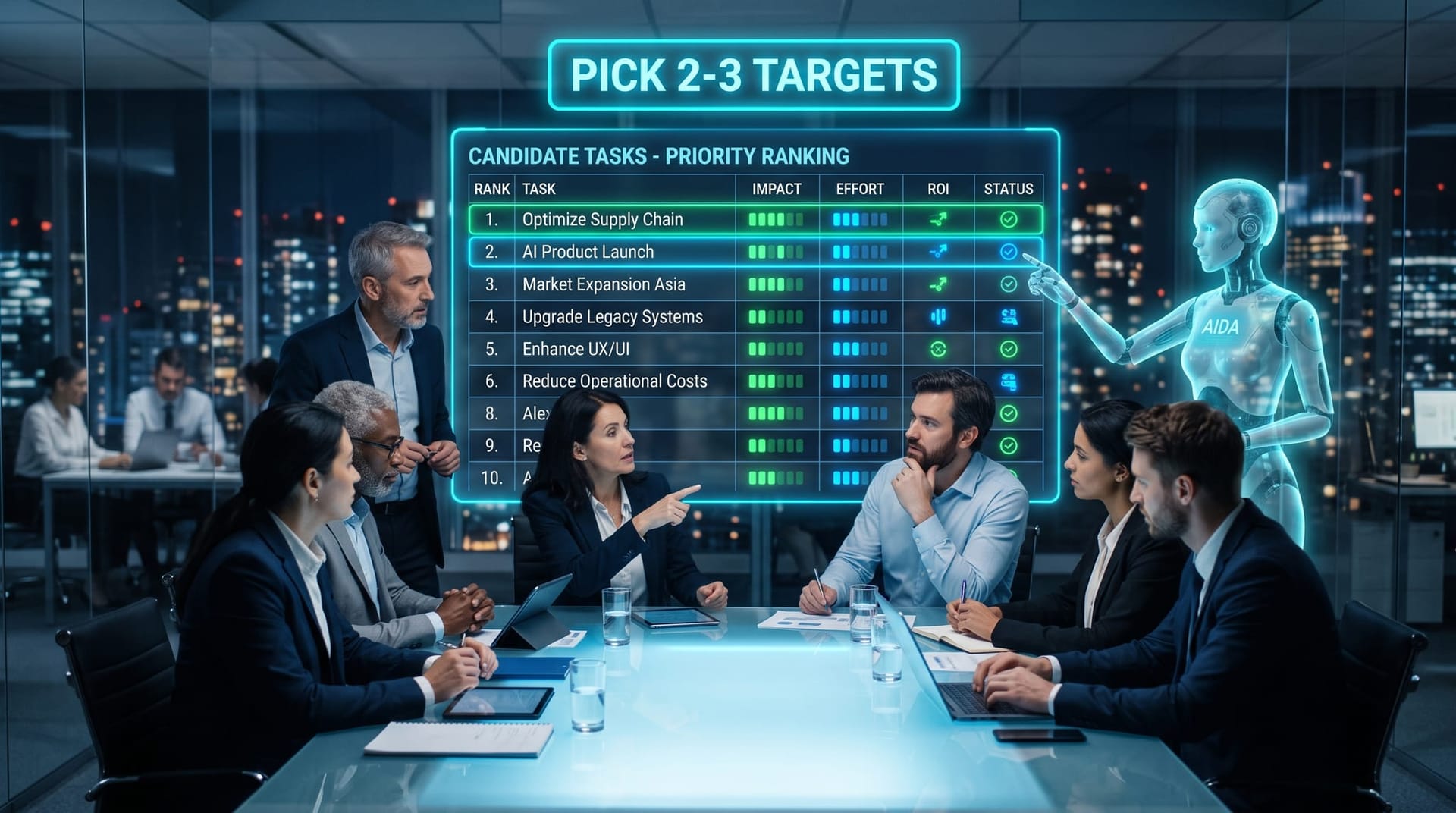
Pick two or three targets, not ten. A narrow first deployment is easier to govern, easier to measure, and easier to walk back if it misbehaves. Once it is running, you will want to prove it actually helped — which is a discipline of its own, covered in measuring AI employee performance. “It feels faster” is not a metric; hours saved per week, error rate, and turnaround time are.
Where Does Governance Come In — and Why From Day One?
Here is the mistake even careful operators make: they treat governance as something to add after the automation proves itself. By then the AI Employee has already been handed broad access to live systems, and nobody can say exactly what it can touch or reconstruct what it did last Tuesday.
Route the automation through a Secure AI Gateway from the first day instead. The gateway sits between the AI Employee and your systems, so the automation gets scoped access — only the applications and data the mapped task actually requires — plus a log of every action it takes. This is the practical answer to the honest concern The Next Web raised about desktop-observation tools: once software has a complete record of how your staff work, the question of who can see it and what it is allowed to do is not optional. The reporting noted real-world friction — one bank scaled back monitoring after staff objections, and another deployment required works-council approval — which is exactly why scoping and auditing belong at the start, not the retrofit.

Governance-first is also what keeps a small deployment from quietly sprawling. When the AI Employee can only reach what its task needs, “let's have it also handle X” becomes a deliberate decision with a new access grant and a new audit trail — not a silent expansion of what an ungoverned tool can already reach.
What This Looks Like for a DeKalb County Operator
Make it concrete for three businesses within a short drive of Auburn.
A manufacturing back office in DeKalb County spends afternoons reconciling shipping confirmations against purchase orders across an ERP, a carrier portal, and email. Shadow it for a week and the copy-paste chain jumps out: someone re-keys tracking numbers by hand, every day, dozens of times. High frequency, rules-based, structured inputs, measurable output — a textbook first target.
A law or accounting practice in Allen County thinks its bottleneck is document review. Map it, and the real time sink turns out to be intake: pulling client details from an email into the case-management system, then into the billing system, then into a conflict-check spreadsheet. The expertise (the actual legal or financial judgment) stays with the professional; the routing of structured data between three systems is what an AI Employee absorbs.
A home-services dispatcher in Northeast Indiana believes scheduling is the hard part. Watch a shift and the hidden work is the after-hours triage — reading voicemails and web-form requests, categorizing urgency, and drafting the “we'll be there Tuesday” confirmation. Repetitive, pattern-driven, and measurable in response time.
None of these firms could justify an enterprise process-intelligence platform. All three can run a one-week discovery, find their two or three real targets, and deploy a governed AI Employee against them. Cloud Radix is based in Auburn precisely because we think this Midwest, mid-market operator is underserved by the enterprise-first AI industry — the discovery work that costs a Fortune 50 company a seven-figure platform can be done by hand, well, at DeKalb-County scale.
You do not need to guess which task to automate — you need to look. Cloud Radix runs the discovery for Northeast Indiana businesses: a structured walkthrough of a role's real workflow, an honest inventory ranked by frequency and friction, and a shortlist of the two or three tasks where an AI Employee actually earns its keep. We deploy that automation behind a Secure AI Gateway so it is governed, scoped, and auditable from day one — not bolted on after something goes wrong. If you operate in Auburn, Fort Wayne, DeKalb County, or anywhere in Northeast Indiana and you have a nagging sense that your team spends too many hours on work nobody can quite describe, that feeling is the signal.
Frequently Asked Questions
Q1.What is process intelligence, in plain terms?
Process intelligence is software — or, at small scale, a disciplined manual method — that observes how work actually gets done across the applications people use, then turns that observation into a map of the real workflow. It surfaces the swivel-chair steps and copy-paste chains that process documents leave out, so you can automate what the work is rather than what you assumed it was.
Q2.How do I know which task to automate first?
Score your candidates on four things: how often the task runs, whether it follows rules rather than requiring real judgment, whether its inputs arrive in a predictable format, and whether you can measure if it was done correctly. The strongest first target is boring and frequent — a high-volume, rules-based chore — not the most complex or high-stakes process.
Q3.Do I need an expensive platform like the one Skan AI sells?
No. Enterprise process-intelligence platforms make sense at Fortune 50 scale with thousands of employees. A small or mid-market business in Northeast Indiana can get the same core insight from a structured week of shadowing one role, timing each task, and inventorying the results. The method matters more than the software.
Q4.Isn't watching how employees work invasive?
It can be, and that concern is legitimate — reporting on desktop-observation tools notes cases where staff pushed back and deployments required formal approval. The lightweight approach we recommend is done transparently and with consent, focuses on tasks rather than individuals, and aims to remove tedious work from people's plates, not to surveil them. Be upfront with your team about why you are mapping and what you will do with what you find.
Q5.How is this different from redesigning or training an AI model?
Discovery is the step that comes before both. You cannot redesign a process you have not mapped, and you cannot train a custom model without a clear specification of the work it should do. Mapping the real workflow first is what makes redesign and training accurate instead of speculative.
Q6.How long does a discovery take for a small business?
For a single role, plan on roughly a week: a few days of shadowing or screen review, then a day or two to inventory the tasks, count frequencies, and total the time. The output is a ranked list of automation candidates you can act on immediately — a small investment that prevents the far larger cost of automating the wrong thing.
Sources & Further Reading
- VentureBeat: venturebeat.com/data/skan-ai-raises-63-million — Skan AI raises $63 million betting that watching how employees actually work is the missing layer of enterprise AI.
- PR Newswire: prnewswire.com/news-releases/skan-ai-raises-63-million — Skan AI's Series C announcement and investor detail.
- SiliconANGLE: siliconangle.com/2026/08/12/skan-ai-raises-63m — Skan AI raises $63M to give AI agents a map of enterprise work.
- Unite.AI: unite.ai/skan-ais-series-c-bets-enterprise-ai-needs-a-map-of-real-work — Analysis of why enterprise AI needs a map of real work.
- The Next Web: thenextweb.com/news/skan-ai-63m-series-c-workplace-observation-enterprise-agents — Coverage of workplace-observation tooling and its real-world friction.
- Yahoo Finance: finance.yahoo.com/technology/ai/articles/skan-ai-raises-63-million — Investor commentary on enterprise work context as infrastructure.
Ready to Find Your Hidden Work?
We run a structured discovery of a role's real workflow, hand you an honest inventory ranked by frequency and friction, and shortlist the two or three tasks where an AI Employee actually pays for itself — governed behind a Secure AI Gateway from day one.
Let Us Map ItAuburn, Fort Wayne, DeKalb County, and all of Northeast Indiana.