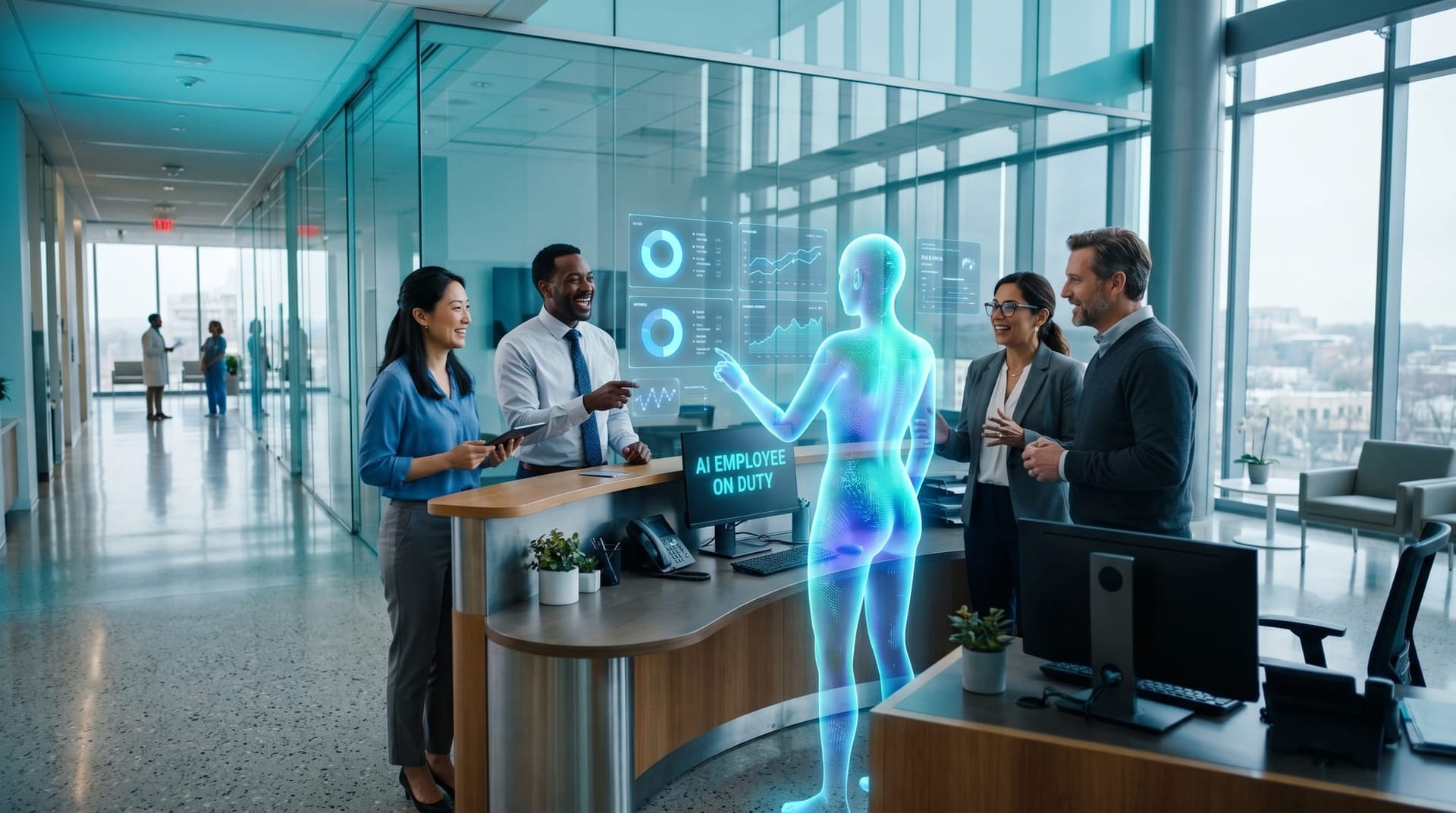
There is a comfortable story about healthcare AI that goes like this: the models keep getting smarter, so at some point one of them will be smart enough to run your back office. It is a comforting story because it means you can wait. Just hold on until the next release, and the administrative grind — the eligibility checks, the prior-auth chases, the denied-claim rework — will dissolve on its own.
According to MIT Technology Review's analysis of healthcare AI's next test, that story has the problem backward. Leading models can already read a long patient record, interpret dense clinical terminology, and produce a clean summary. That is not where the work breaks down. Healthcare breaks down at the seams between systems — the EHR that does not talk cleanly to the billing platform, the billing platform that does not know what the payer portal decided yesterday, the scheduling system that is a world unto itself. The piece's blunt framing is that leaders should not confuse model capability with operational capability. The next phase of healthcare AI will be won on integration, not on whose model scored highest on a benchmark.
For a Fort Wayne or Northeast Indiana practice administrator, that reframe is not academic — it is a buying guide. It tells you what to stop shopping for (a smarter chatbot) and what to actually evaluate (an AI worker that plugs into your existing stack, carries your payer-specific rules, and produces output you can audit). This is a back-office and revenue-cycle piece, not a diagnostic-AI piece. We are going to stay squarely in the administrative lane, because that is where the money is quietly leaking and where a well-integrated AI Employee earns its keep.
Key Takeaways
- The bottleneck in healthcare AI is operational, not model-based. Today's models can already read and summarize records; they stumble on fragmented EHR, billing, scheduling, and payer systems that were never designed to reason together.
- The revenue cycle — scheduling through payment — is the proving ground: high volume, mixed structured and unstructured data, and payer rules that change constantly. Traditional rule-based automation breaks here.
- The prescribed approach is agentic orchestration: language models paired with structured knowledge bases, deterministic validation, and a governance layer — not a smarter model bolted onto a portal.
- Durable advantage comes from your proprietary operational data, your workflow context, and your governance — the things a generic tool cannot replicate.
- For a Fort Wayne practice, the right questions are integration (“does it work with our systems?”), traceability (“can we audit every output?”), and governance (“whose rules, and what happens when a payer changes them?”).
Why Isn't a Smarter Model Enough for Healthcare Administration?
The instinct to wait for a better model assumes the problem is intelligence. It is not. The problem, as the MIT Technology Review piece describes it, is fragmentation — fragmented information, fragmented workflows, and fragmented accountability. A single administrative decision, like whether a scheduled procedure will be reimbursed, depends on data scattered across the EHR, the practice-management system, the clearinghouse, and a specific payer's current policy. No model, however capable, can reason across that chain if it cannot reach the pieces.
This is the same lesson we keep relearning outside healthcare, which is why we wrote at length about why generic AI tools fail where custom AI Employees don't. A general-purpose model is trained on the world's knowledge; it is not trained on your payer mix, your documentation quirks, or the fact that one regional plan quietly changed its prior-auth requirement for a common imaging code last month. Baseline medical and administrative knowledge is becoming a commodity. What is not a commodity is the operational context that turns a plausible answer into a correct one.
There is also a hard limit that gets ignored in demos: a model that produces a beautiful summary but cannot act — cannot post the corrected claim, cannot check eligibility against the live payer response, cannot escalate the denial to the right human — has not touched the actual workload. The administrative burden is not a knowledge problem. It is an execution problem, and execution requires wiring into the systems where the work lives.

Why Is the Revenue Cycle Healthcare AI's Real Proving Ground?
The MIT Technology Review analysis names the revenue cycle — everything from scheduling through payment collection — as one of healthcare AI's proving grounds, and the reasoning is sound. The revenue cycle has high transaction volume, mixes structured and unstructured data, and produces measurable outcomes. A single claim touches multiple systems and processes, and a breakdown in any one of them can surface as a denial or a write-off weeks or months later, long after the root cause is easy to find.
The numbers around the specific chokepoints are not subtle. According to the 2024 CAQH Index, only about 35% of medical prior authorizations were conducted fully electronically, and CAQH estimates the industry could save on the order of hundreds of millions of dollars annually on prior authorization alone by moving the remaining volume off manual and partially manual workflows. The same index identifies eligibility and benefit verification as the single largest electronic-savings opportunity among medical transactions — billions of dollars, growing year over year. These are not exotic edge cases. They are the daily grind of every billing office in Fort Wayne.
The human cost is documented too. The American Medical Association's prior authorization physician survey reports that physicians and their staff complete an average of roughly 39 prior authorizations per week, spending about 13 hours on the process, and that a large majority of physicians say prior authorization delays patient care and contributes to burnout. When staff are drowning in that volume, the practice does not just lose hours — it loses revenue to authorizations that never get filed, and to denials that never get appealed before the timely-filing window closes.
Here is why the revenue cycle punishes traditional automation specifically. Robotic process automation and rules engines assume a stable environment: if the form field is here and the requirement is that, click this. But payer requirements and documentation expectations change constantly, and they are about to change by regulation. The CMS Interoperability and Prior Authorization Final Rule (CMS-0057-F) requires affected payers to stand up FHIR-based prior authorization APIs by January 1, 2027 — a genuine improvement, but also a large, moving target that every practice's tooling will have to absorb. A brittle script breaks the first time a payer shifts a field. Something that can reason about the change, apply the right current rule, and adapt is a different category of tool.

What Does Agentic Orchestration Actually Look Like?
The MIT Technology Review piece's prescription is not “a bigger model.” It is a hybrid architecture — language models combined with structured knowledge bases, symbolic logic, and deterministic validation, wrapped in governance and workflow context. The framing shift it uses is from automation to orchestration: instead of a script that does one rote step, you have a coordinated agent that follows the work across systems, applies the right rules, adapts when something changes, and keeps learning from outcomes.
In plain operational terms, an orchestrated AI worker for the revenue cycle looks like this:
- A language model for the messy, unstructured parts — reading a clinical note to find the documentation a payer wants, interpreting a denial reason that is written in near-English, drafting an appeal letter.
- A structured knowledge base that holds your current payer rules, your coding conventions, and your historical decisions — so the system is not guessing at what a plan requires, it is looking it up.
- Deterministic validation that checks the model's output against hard rules before anything is submitted: is this code payable for this plan, does the eligibility response actually confirm coverage, are the required fields present. This is the layer that keeps a confident-sounding but wrong model output from becoming a denied claim.
- A governance and audit layer so every action is traceable — who or what did it, on what basis, and can a human review it.
The knowledge-base and workflow-context piece is the part most vendors skip, and it is the part that compounds. The decisions that govern reimbursement do not live only in your EHR fields; they live in the back-and-forth — the note a biller made about how a specific plan handles a modifier, the pattern that certain denials always resolve one way. Capturing that is exactly the problem we described in our conversational context capture architecture work: the institutional knowledge that makes an AI worker useful is scattered across threads and side channels, and it has to be deliberately fed into the system, owned by you, not left in someone's head.
Deterministic validation deserves its own emphasis because it is where trust is won or lost. An output you cannot trace is an output you cannot submit to a payer or defend in an audit. That is the same principle behind citation-ready document extraction — a result is only trustworthy if it points back to where it came from. In a revenue-cycle context, that means the AI worker should be able to show the eligibility response it relied on, the payer rule it applied, and the note it pulled a fact from. Provenance is not a nice-to-have; it is the difference between an assistant and a liability.

How Does This Map to a Fort Wayne Practice Back Office?
Translate all of that to a specific building on a specific street in Allen or DeKalb County, and the picture gets concrete. Consider a mid-sized Northeast Indiana specialty practice — say a dozen providers, a five-person billing team, a common EHR, and a payer mix that runs from Medicare and Medicaid to the regional commercial plans and a couple of national ones. The team's day is not glamorous. It is eligibility checks before visits, prior-auth submissions and the follow-up phone calls, and the steady backlog of denied and underpaid claims that need rework before they age out.
An integrated AI Employee does not replace that team. It absorbs the repetitive, high-volume connective work between systems so the humans handle judgment and exceptions. Before a visit, it runs the eligibility check against the live payer response and flags the mismatches a busy front desk misses. When a service needs prior authorization, it assembles the documentation from the note, submits through the right channel, and tracks status so nothing sits in limbo. When a denial comes back, it reads the reason, checks it against your knowledge base of how that plan behaves, and either drafts the appeal with the supporting documentation attached or routes it to a biller with the context already gathered. Every one of those actions is logged and traceable.
This is a different post than our earlier one on Fort Wayne healthcare practices using agentic AI to give clinicians time back. That piece was about the clinical side — pulling documentation burden off physicians at the point of care. This one is deliberately about the administrative and revenue-cycle side, the back office rather than the exam room. They are complementary, and keeping the lanes separate matters: the governance and integration requirements are different, and a tool that is right for one is not automatically right for the other.
The reason a local, integration-first approach beats a “smarter model” for a Fort Wayne practice is that the advantage lives in the particulars — your systems, your payer rules, your history. A national SaaS chatbot does not know that a specific regional plan changed a requirement, and it has no path to act inside your billing system. An AI Employee built to plug into your stack, carry your rules, and route through governed access does. That is the operational-capability point, brought home to a practice manager's actual problem list.

What Should a Fort Wayne Practice Ask Before Buying?
Because the market is loud and every vendor now says “AI,” the useful move is to reduce the decision to a short list of questions that separate an integrated worker from a wrapper on a chatbot. Here is the checklist we walk local practices through.
| Question | What a good answer looks like | Red flag |
|---|---|---|
| Does it integrate with our EHR, billing, and payer systems? | Named, working connections to your actual stack, with a plan for read and write access where appropriate | “It works through copy-paste” or “your staff will paste results in” |
| Whose rules govern its decisions? | Your payer rules and conventions, held in a knowledge base you own and can update | The vendor's opaque, one-size model with no way to encode your specifics |
| Is every output traceable and auditable? | Each action shows its basis — the eligibility response, the rule applied, the source note — and is logged | Confident answers with no provenance and no audit trail |
| What happens when a payer changes a rule? | The system can be updated quickly, and it flags outputs affected by the change | A brittle script that silently keeps applying the old rule |
| How is access to patient data controlled? | Governed access through a single gateway, with least-privilege credentials and full logging | Direct model access with shared keys and no logging |
| Who is accountable when it is wrong? | Clear human-in-the-loop escalation and defined ownership of exceptions | “The AI handles it” with no defined fallback |
Two of those rows lean on infrastructure we consider non-negotiable for regulated data. Governed access is why we route AI workers through a Secure AI Gateway rather than handing a model direct credentials — the gateway is where identity, least-privilege access, data-classification, and logging are enforced, outside the application so it cannot be bypassed. And the governance discipline itself maps to a recognized framework: the NIST AI Risk Management Framework, with its Govern, Map, Measure, and Manage functions, gives a mid-market practice a defensible structure for saying how the program is run. For any workflow touching protected health information, the HIPAA Security Rule sets the baseline safeguards those controls have to satisfy — an AI program is not exempt from them, and a Business Associate Agreement with any vendor that touches PHI is table stakes.
Where Does This Leave Northeast Indiana Practices in 2026?
The honest summary is that the “wait for a smarter model” strategy is a slow way to keep losing money to denials and to keep burning out a billing team. The gains available right now are not from a better model — they are from wiring a capable-enough model into your systems, giving it your rules, validating its output, and governing its access. That is unglamorous, integration-heavy work, which is exactly why the MIT Technology Review framing lands: the advantage goes to whoever does the operational plumbing, not whoever has the flashiest demo.
For a Fort Wayne, Auburn, or greater Northeast Indiana practice, the practical starting point is small and measurable. Pick one high-volume, high-friction workflow — eligibility verification or prior-authorization follow-up are the usual first choices — and run it end to end through an integrated, governed AI Employee with a human reviewing the exceptions. Measure the before and after: hours reclaimed, denials prevented, authorizations filed on time. If the workflow holds up under audit and the numbers move, expand to the next one. That is how you get operational capability instead of a science project.
If you want help scoping that first workflow, our AI Employees for Fort Wayne healthcare practices do exactly this — integration, governance, and measurable outcomes for Northeast Indiana practices. We do not sell a smarter model; we build the worker that plugs into the systems you already run and produces output your compliance team can defend. Send us the one revenue-cycle task that costs your team the most hours this month, and we will map what an integrated AI Employee would actually do with it — and, honestly, whether it is a fit yet.
Frequently Asked Questions
Q1.Will a more advanced AI model eventually solve healthcare administration on its own?
Not on its own. As the MIT Technology Review analysis argues, the limiting factor in healthcare administration is operational, not the model's raw ability. Current models can already read and summarize records; the failures happen at the integration seams between the EHR, billing, scheduling, and payer systems. A better model does not fix fragmented systems it cannot reach or act inside. The durable gains come from integration, your proprietary rules, and governance — not from waiting for a smarter model.
Q2.What is the difference between automation and agentic orchestration in the revenue cycle?
Traditional automation follows fixed scripts — if a field is here, click there — which breaks the moment a payer changes a requirement. Agentic orchestration coordinates a language model with a structured knowledge base of your rules and a deterministic validation layer so the system can follow work across multiple systems, apply the current rule, adapt when something changes, and escalate to a human when needed. In a revenue cycle where payer rules shift constantly, that adaptability is the whole point.
Q3.Is this about clinical AI or administrative AI?
This is strictly about administrative and revenue-cycle work — eligibility, prior authorization, claims, and denials. It is not about diagnosis, treatment decisions, or clinical documentation quality, which sit in a separate lane with different governance requirements. Keeping the two separate is deliberate. Our companion article on giving clinicians time back covers the clinical-documentation side; this one stays in the back office.
Q4.How do we know the AI's output is correct and defensible in an audit?
Through deterministic validation and provenance. A well-built AI Employee checks its output against hard rules before acting — confirming a code is payable for a plan, that an eligibility response actually verifies coverage — and it records the basis for each action: the payer rule applied, the eligibility response relied on, the source note a fact came from. If an output cannot show where it came from, it should not be submitted. That traceability is what makes the work auditable rather than a liability.
Q5.Does an AI Employee for the revenue cycle create HIPAA risk?
It can, if it is deployed carelessly — which is why access has to be governed. Routing the AI worker through a secure gateway with least-privilege credentials and full logging, rather than giving a model direct access, keeps patient data controlled and auditable. The HIPAA Security Rule still sets the baseline safeguards, and any vendor whose system touches protected health information needs a Business Associate Agreement. Governance is part of the build, not an afterthought.
Q6.What is the smallest way a Fort Wayne practice can start?
Pick one high-volume, high-friction workflow — eligibility verification or prior-authorization follow-up are common first choices — and run it end to end through an integrated, governed AI Employee with a human reviewing exceptions. Measure hours reclaimed, denials prevented, and authorizations filed on time. If it holds up under audit and the numbers move, expand to the next workflow. Starting narrow keeps the risk low and the results measurable.
Sources & Further Reading
- MIT Technology Review: technologyreview.com/2026/09/10/1141421/healthcare-ais-next-test-is-integration — Healthcare AI's next test is integration.
- CAQH: caqh.org — 2024 CAQH Index Report — From Transactions to Trust; electronic adoption and savings opportunity across medical transactions.
- American Medical Association: ama-assn.org/system/files/prior-authorization-survey.pdf — AMA Prior Authorization Physician Survey.
- Centers for Medicare & Medicaid Services: cms.gov — Interoperability and Prior Authorization Final Rule (CMS-0057-F) — FHIR-based prior authorization API requirements.
- National Institute of Standards and Technology: nist.gov/itl/ai-risk-management-framework — AI Risk Management Framework (Govern, Map, Measure, Manage).
- U.S. Department of Health and Human Services: hhs.gov/hipaa/for-professionals/security — HIPAA Security Rule baseline safeguards.
Scope Your First Revenue-Cycle Workflow
Tell us the one revenue-cycle task that costs your Fort Wayne practice the most hours this month, and we will map what an integrated, governed AI Employee would actually do with it — and whether it is a fit yet.
Schedule a Free ConsultationIntegration, governance, and measurable outcomes for Northeast Indiana healthcare practices.