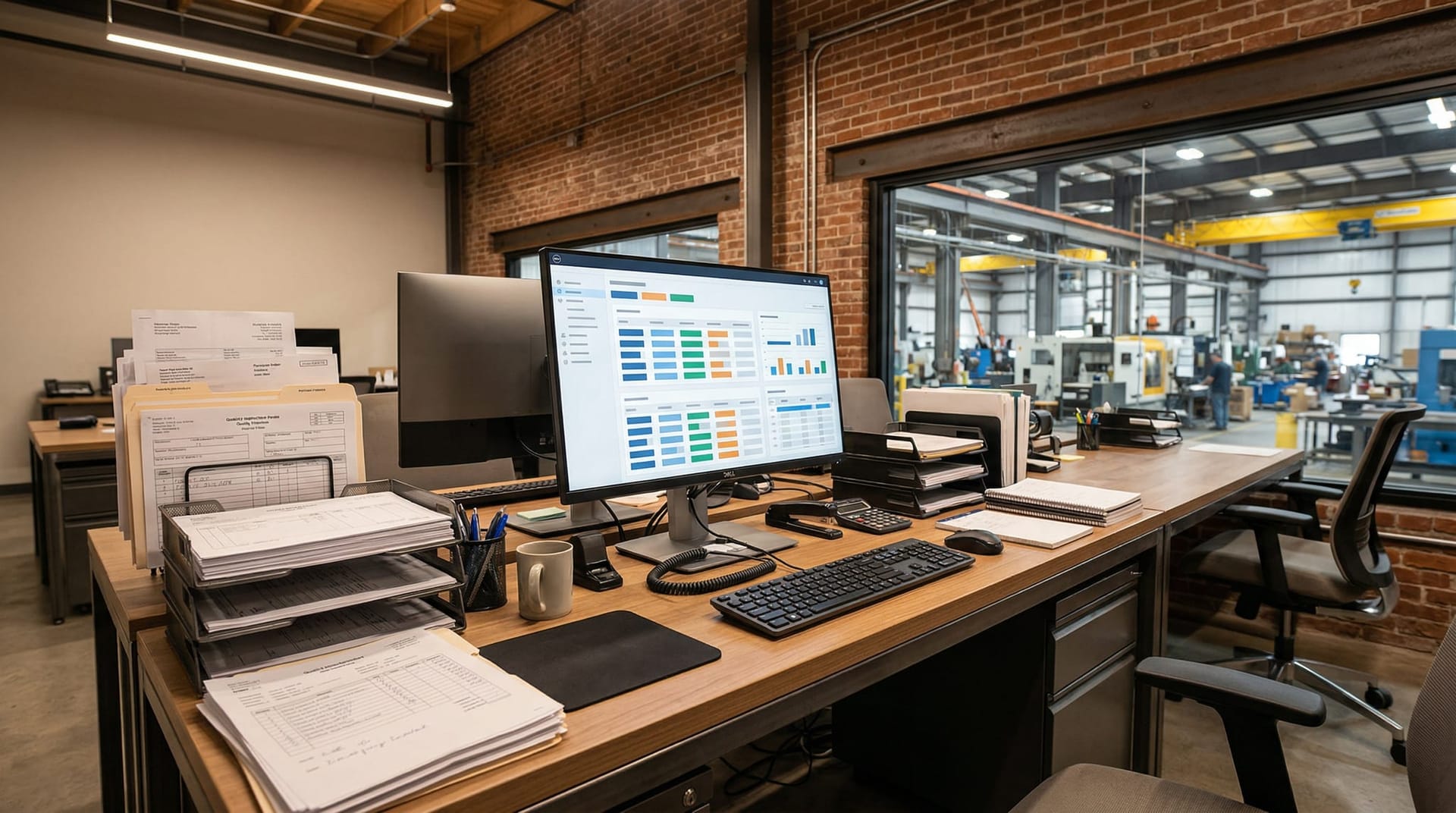
Ask most business leaders why their first AI pilot stalled and you'll eventually arrive at the same place: the system gave a confident answer, someone checked it, the answer was wrong, and trust never recovered. The model didn't malfunction. It was asked to reason over a pile of PDFs, scans, and intake forms that nobody could trace — and when it couldn't find a fact, it produced a plausible one.
Mistral's release of OCR 4 reframes document extraction as something bigger than cleaning up scanned text. According to VentureBeat's coverage, the launch turns extraction into a full enterprise AI play — and the feature that matters most isn't accuracy on a benchmark. It's that every extracted block comes back citation-ready: localized to where it lives in the source document, typed, and scored for confidence. That's not a paperwork story. It's a grounding-and-trust story, and grounding is the step most AI projects skip and then fail on. This piece explains what citation-ready means, why it matters more than raw OCR accuracy, and the buyer's framework to apply before any extraction layer touches a real workflow.
Key Takeaways
- “Citation-ready” extraction returns each field or passage with a pointer to where it came from in the source document — a bounding box, a block type, and a confidence score — not just clean text.
- Provenance matters more than raw OCR accuracy, because an AI Employee is only as trustworthy as its ability to show its work.
- Most enterprise AI hallucination traces back to ungrounded data: the model fills gaps in inaccessible documents with confident fabrication.
- Before adopting any extraction layer, demand three things: provenance, structured schema output, and a human checkpoint on low-confidence fields.
- Citation-ready extraction is the ingestion front door to a real knowledge architecture — not a replacement for one.
- Route document data through a control point so sensitive fields stay scoped, and remember the vendor's own scope limits.

What does “citation-ready” actually mean?
Older OCR did one job: turn a page into text and tables you could search. Useful, but it threw away the thing a trustworthy AI system needs most — the link back to the source. As MarkTechPost reports, the newer generation returns a structured representation of the document instead: each block is localized with a bounding box, classified by type (titles, tables, equations, signatures, and more), and given inline confidence scores per page and per word.
That shift is the whole point. When extraction preserves where a value came from, an AI Employee can cite it back to you — “this contract end date came from the bottom of page 3, with 0.98 confidence” — instead of asserting it from nowhere. Mistral's own description frames the output as citation-ready content for semantic chunking, feeding RAG, agentic workflows like invoice processing, and enterprise search. The model also supports 170 languages across 10 language groups and is compact enough to deploy in a single container for self-hosting — which, as we'll discuss, matters for keeping regulated data in your own environment.
Here's the distinction that's easy to miss:
| Capability | Traditional OCR | Citation-Ready Extraction |
|---|---|---|
| Output | Clean text and tables | Typed blocks with bounding boxes |
| Provenance | None — text floats free of its source | Every block points back to its location |
| Confidence | Implicit, all-or-nothing | Explicit per-word and per-page scores |
| Downstream use | Search, basic data entry | Grounded RAG, citeable agent answers |
| Failure mode | Silent errors blend in | Low-confidence fields can be flagged |
On raw quality, Mistral reports strong benchmark numbers — an OlmOCRBench score of 85.20 and 93.07 on OmniDocBench — and says independent annotators preferred OCR 4 over competing systems with win rates averaging about 72% across 600-plus documents in 12-plus languages. Treat those as vendor-reported until third parties replicate them. But notice that accuracy is table stakes here. The differentiator is the provenance layer wrapped around the accuracy.
The economics have also moved into mid-market range, which is what makes this a practical conversation rather than an enterprise-only one. MarkTechPost cites early customers reporting large efficiency gains — one, Rogo, claiming roughly 8x lower cost and 17x lower latency versus competing agentic parsers, and another, Anaqua, reporting about 4x faster processing per page than its incumbent provider. Mistral lists API pricing around $4 per 1,000 pages, dropping to roughly $2 with a batch discount. Treat any single customer's numbers as that customer's, not a guarantee — but the direction is clear: provenance-rich extraction no longer carries an enterprise-only price tag, which is precisely why a regional firm can now justify a pilot.
Why is ungrounded document data the failure mode behind most business AI?
The confident-but-wrong answer isn't a quirk of a bad model. It's a predictable result of pointing a capable model at data it can't actually see. Contextual AI puts it plainly: models hallucinate not because they're unreliable, but because they're asked to answer questions without access to the information they need. A base model has no idea what your company does; when the underlying document is inaccessible or ungrounded, a missing field becomes a fabrication.
The same source makes the constructive point that matters here: retrieval is what enables attribution. When a system pulls specific documents and the model answers from them, you can show users exactly where the information came from — and that's what turns a hallucination-prone system into an accountable one. Citation-ready extraction is the front half of that loop. If the data going in already carries its source, the answers coming out can carry it too.
This is also why “data readiness,” not model choice, is the real bottleneck for most mid-market AI projects. IBM's review of 2026 adoption challenges puts data quality and readiness at the top of the list, echoing widely-cited Gartner warnings that a large share of AI initiatives stall for lack of AI-ready data. We've made the same argument locally in a data-readiness audit for financial services: the prerequisite for a useful AI Employee isn't a better model, it's data the model can stand on. Citation-ready extraction is one of the cleanest ways to make a pile of unstructured documents stand-on-able.
This complements, rather than replaces, the grounding work on structured data. We've written about how to mine the SQL query logs you already own to stop an AI Employee from hallucinating database joins. Documents are the unstructured mirror image of that problem: same goal — give the model a verifiable source — different raw material.

What should you demand of any document-extraction layer?
Before any extraction tool touches a live workflow, pressure-test it against three requirements. If a vendor can't satisfy all three, you're buying clean text, not trustworthy data.
1. Provenance on every field. Each extracted value should carry a pointer back to its location in the source — a page and region, not just a string. Without it, you can't audit an answer, and your AI Employee can't cite its work. This is the capability that separates a citation-ready system from a glorified scanner.
2. Structured schema output. Extraction should emit typed, structured data — fields with names and types you define — not a wall of text you then have to re-parse. Typed blocks (a signature is a signature, a table is a table) are what let downstream automation route, validate, and act on the data reliably.
3. A human checkpoint on low-confidence fields. Per-word and per-page confidence scores are only valuable if you wire them to a decision. The right pattern is confidence-gated routing: high-confidence fields flow through automatically; anything below your threshold gets held for a human to confirm. This is how you get throughput without surrendering accuracy on the fields that matter.
The Vendor's Own Scope Limit
This buyer's framework connects directly to a broader procurement question we keep returning to. Whether trust comes from model-native citations — where the model emits sources as it answers — or from document-native citations like these, the thesis is identical: defensible, traceable answers beat confident ones. It's the same principle that governs answer-engine optimization, where citeable, well-sourced content is what answer engines actually surface.
Where does citation-ready extraction sit in your AI architecture?
It's the ingestion front door, not the whole house. Citation-ready extraction turns documents into grounded, structured input — but that input still needs somewhere to live and a way to be retrieved. We've argued that the destination is the compilation-stage knowledge layer: the architecture that organizes grounded data so agents can reason over it reliably. Extraction feeds that layer; it doesn't substitute for it.
It also pairs with, rather than duplicates, throughput-focused document automation. We previously covered how to eliminate paperwork with vision AI — extracting structured data from invoices and forms to remove manual entry. That's a speed story. Citation-ready extraction is a trust story layered on top: the same documents, now carrying provenance, so the data isn't just faster to capture but defensible after the fact. Most businesses want both, in that order — get it out of the file pile, then make it citeable.
Governance is the connective tissue. The NIST AI Risk Management Framework organizes trustworthy AI around four functions — Govern, Map, Measure, and Manage — and provenance touches every one of them: you can't measure or manage what you can't trace. Citation-ready extraction gives you the traceability that a credible governance program assumes you already have.
A Northeast Indiana mid-market reality check
This isn't only an enterprise concern. Picture a mid-market manufacturer in Allen or DeKalb County drowning in RFQs and spec sheets. Quotes come in as PDFs and scanned drawings; an estimator keys the relevant fields into the ERP by hand, and the occasional transposed tolerance or missed revision turns into a costly rework downstream. Citation-ready extraction lets an AI Employee pull those fields with a pointer back to the exact line on the exact drawing — and route anything it isn't confident about to the estimator instead of guessing. The provenance is what makes a shop-floor team willing to trust it, because every value can be checked against its source in one click.
The same pattern fits a Fort Wayne CPA practice or law office processing intake documents. A legal assistant shouldn't have to re-read a fifteen-page engagement packet to confirm a date or a party name; an AI Employee can surface them with citations, flag the low-confidence ones, and leave the judgment to the professional. For these regional firms, the constraint isn't ambition — it's trust and compliance. Provenance plus a control layer is what lets a Northeast Indiana business put document AI into a real workflow without betting the practice on an unverifiable answer.

Keeping document data contained
Documents are where your most sensitive data lives — contracts, financials, medical records, case files. The moment you run extraction, you're deciding where that content flows. Mistral's single-container, self-hostable design exists precisely so organizations can keep documents in their own environment for residency and compliance, and that option is worth taking seriously for regulated workloads.
Whatever extraction engine you choose, route the resulting data through a control point. A Secure AI Gateway lets you scope which fields can leave your environment, mask sensitive values, log every exchange, and enforce retention — so citation-ready data stays as contained as it is traceable. Provenance tells you where a value came from; the gateway controls where it's allowed to go next. You want both.

Turning your file pile into trustworthy data
The takeaway isn't “buy this OCR model.” It's that the bar for document AI has moved: clean text is no longer enough, because an AI Employee you can't audit is an AI Employee your team won't use. Demand provenance, demand structured output, gate low-confidence fields to a human, and keep the data scoped. Do that, and the file pile you've been ignoring becomes the grounded foundation your AI Employees actually need.
Cloud Radix builds AI automation for your document workflows — citation-ready extraction wired into real processes, with the Secure AI Gateway controlling where regulated data flows. If you want to find the highest-trust place to start in your own document pipeline, get in touch and we'll map it to the documents your business already handles every day.

Frequently Asked Questions
Q1.What is citation-ready document extraction?
It's document extraction that returns each value with a pointer back to where it came from — a bounding box and block type in the source document — plus a confidence score, instead of just clean text. That provenance lets an AI system cite its source and lets you audit any answer. It's the difference between a model asserting a fact and a model showing you where the fact lives.
Q2.Why does provenance matter more than raw OCR accuracy?
Because accuracy without traceability still produces answers you can't verify. A highly accurate model that can't show its source will occasionally be confidently wrong, and you'll have no way to catch it. Provenance lets you flag low-confidence fields, route them to a human, and trust the rest — which is what actually makes document AI deployable in a real workflow.
Q3.Does citation-ready extraction stop AI hallucination?
It reduces a major cause of it. Much enterprise hallucination comes from ungrounded data — the model fills gaps in documents it can't fully access. Extraction that carries provenance gives the system verifiable source material to answer from, which is what enables source citations downstream. It's not a complete cure, but grounding the inputs is the highest-leverage place to start.
Q4.Is this safe to use on contracts, medical records, or financial documents?
It can prepare those documents, but it should not make the final call on them. The vendor itself states OCR 4 is not intended for medical diagnosis, legal judgment, or high-stakes financial decisions. The right pattern is to extract and cite the data, gate anything low-confidence to a qualified human, and route everything through a control layer so sensitive fields stay scoped. A person owns the judgment; the AI prepares the evidence.
Q5.How is this different from the document automation we already read about?
Earlier vision-AI document automation is mostly a throughput story — extracting structured data to eliminate manual entry. Citation-ready extraction adds a trust layer on top: the same data, now carrying provenance so it's defensible after the fact. Most businesses want both, usually getting documents out of the manual queue first, then making the resulting data citeable and auditable.
Q6.Where should a mid-market business start?
Start where trust matters most and volume is high — RFQ intake for a Northeast Indiana manufacturer, or client document intake for a Fort Wayne CPA or law firm. Pilot citation-ready extraction on that one workflow, wire confidence scores to a human checkpoint, and measure how many fields flow through cleanly versus needing review. That gives you a real trust baseline before you expand to the rest of your document pile.
Sources & Further Reading
- MarkTechPost: marktechpost.com/2026/06/23/mistral-ocr-4 — Mistral OCR 4 brings citation-ready structured output to RAG, agentic, and enterprise search pipelines.
- Mistral AI: mistral.ai/news/ocr-4 — Mistral OCR 4: SOTA OCR for document intelligence.
- VentureBeat: venturebeat.com/data/mistral-launches-ocr-4 — Mistral launches OCR 4, turning document extraction into a full enterprise AI play.
- Contextual AI: contextual.ai/blog/why-does-enterprise-ai-hallucinate — Why does enterprise AI hallucinate? Causes, solutions & prevention.
- NIST: nist.gov/itl/ai-risk-management-framework — AI Risk Management Framework.
- IBM: ibm.com/think/insights/ai-adoption-challenges — The biggest AI adoption challenges for 2026.
Turn Your File Pile Into Data You Can Trust
We'll find the highest-trust place to start in your document pipeline — citation-ready extraction wired into a real workflow, with the Secure AI Gateway controlling where regulated data flows.
Schedule a Free ConsultationNo contracts. No pressure. Just an honest conversation about what would help your business.