
Every business in Fort Wayne is already sitting on a pile of predictions it can't read. The sales history in QuickBooks. The customer list in the CRM. The invoice-aging report your bookkeeper exports every Monday. The job-and-quote log a home-services company keeps in a shared spreadsheet. All of it is tabular data — rows and columns — and buried inside it are the answers to the questions that actually keep an owner up at night: Which customers are about to leave? How many jobs will we book next month? Which quote is most likely to close? For most of the last decade, turning that data into a real forecast meant hiring a data scientist or commissioning a custom machine-learning build. As of this week, that barrier just moved.
On September 15, two research teams released new tabular foundation models — TabPFN-3.5 from Prior Labs and Causilo from Nums AI — that predict outcomes on ordinary spreadsheet data with default settings and no per-dataset training. One of them beat a Kaggle competition's winning, hand-tuned solution in about a minute. The short version for a Fort Wayne operator: the prediction layer your bigger competitors paid a specialist to build is becoming a capability you can point an AI Employee at instead.
Key Takeaways
- Tabular foundation models make predictions on spreadsheet/table data in a single forward pass — no model training, no tuning, often no data scientist.
- TabPFN-3.5 beat the winning 2015 Otto Kaggle solution using raw data and default settings, finishing in roughly one minute on a single GPU.
- Causilo tops the TabArena benchmark among single models, though the researchers note the lead over rivals is narrow.
- The practical unlock for SMBs: churn risk, demand forecasting, lead scoring, no-show prediction, and cash-flow forecasting move from “data-science project” to “AI Employee task.”
- These are not magic — they have real row, feature, and class limits, and commercial use requires a license.
- The safe path is a governed deployment that keeps your books inside a controlled gateway, not a raw upload to a public model.

What Is a Tabular Foundation Model — and Why Does It Matter Now?
You already know foundation models from chat: a single large model, pre-trained once, that handles new requests without being retrained for each one. A tabular foundation model applies that same idea to structured data — the tables in your spreadsheets and databases. Instead of training a fresh model on your specific sales history, it uses patterns it learned in advance and makes a prediction on your table in one pass.
The underlying approach isn't brand new. The original TabPFN work was published in Nature in January 2025 under the title “Accurate predictions on small data with a tabular foundation model”, and its headline result was startling: a single forward pass, completed in seconds, matched or beat traditional ensembles that had been tuned for hours across dozens of datasets. It works through in-context learning — the model treats your existing rows as context and predicts the answer for a new row directly, the same way a chat model uses your prompt as context.
What changed this week is the ceiling. According to Prior Labs' TabPFN-3.5 release, the new model grew to 220 million parameters (up from 53 million), handles up to a million rows, and recommends up to 6,000 features while supporting as many as 20,000. On the 2015 Otto Group Kaggle competition — a real contest that data scientists spent weeks tuning — TabPFN-3.5 scored a log loss of 0.375 on raw data with default settings, edging past the winning solution's 0.382, in about a minute on a single GPU. It had never seen the dataset before. For context, the release notes that AutoGluon, a leading automated-ML toolkit, climbed from rank 23 on that benchmark in 2020 to rank 9 by August 2026; the tabular foundation model landed at rank 1.
The same day, Nums AI's Causilo release showed the field is now a race, not a fluke. Causilo tops the TabArena leaderboard among single models with an overall Elo of 1792.9, and does especially well on regression tasks. Both models share the same core promise — accurate predictions on your table without a training project. That “no training project” part is the whole story for a small business, and it's why this belongs in the same conversation as any other Fort Wayne business automation decision you're weighing this year.
What Can Fort Wayne Businesses Actually Predict With Their Own Data?
Strip away the benchmarks and the practical question is simple: what would you do with a model that reads your spreadsheet and returns a prediction column? Here are the use cases that map directly onto data Northeast Indiana businesses already keep.
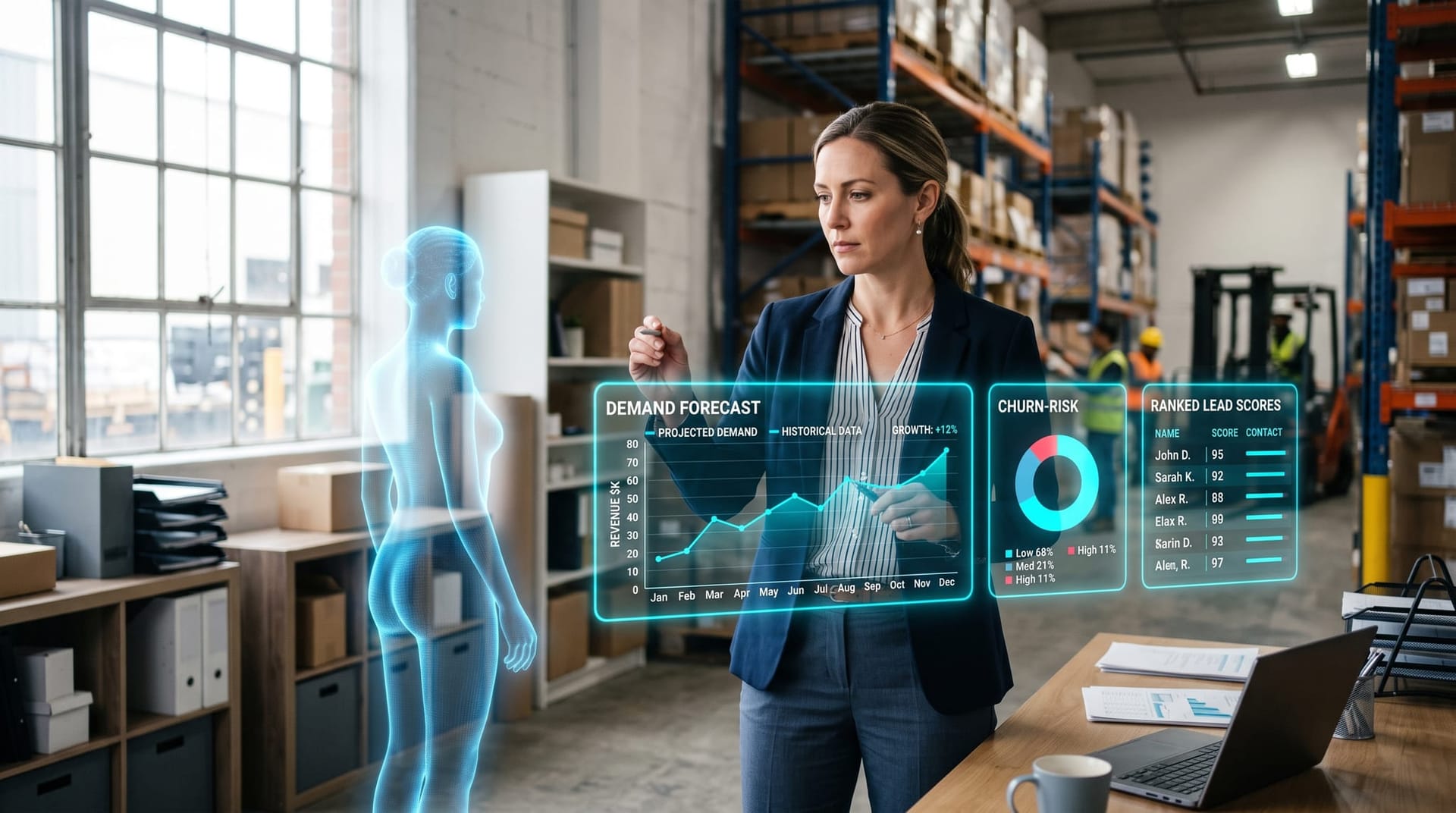
- Churn / retention risk. Feed a model your customer list with columns like last purchase date, visit frequency, and support tickets, and it can flag which accounts look most like ones that left before. That's the difference between a dental practice noticing a patient has quietly gone dormant versus finding out when they don't rebook.
- Demand and inventory forecasting. A distributor or retailer can predict next month's unit demand from sales history and seasonality columns. This is the best-studied payoff: IBM's overview of AI demand forecasting frames it as one of the clearest operational wins for structured-data AI, and Appinventiv's 2026 analysis reports organizations moving from traditional to AI models often see forecast-accuracy gains in the 8–20% range, with product-unavailability drops of up to 65% in the cases they cite.
- Lead scoring. Score inbound leads by how closely they resemble past deals that closed. A deep-research AI Employee can enrich the record; a tabular model can rank it.
- No-show / cancellation prediction. Clinics, salons, and home-services schedulers can predict which appointments are most likely to no-show and overbook or confirm accordingly.
- Cash-flow and invoice-aging forecasting. Predict which open invoices are most likely to slip past 60 days, so collections effort goes where it matters.
The common thread: none of these require you to label a special dataset or stand up a pipeline. They require the tables you already export, plus a model that reads them.
How Is This Different From Hiring a Data Scientist or Buying a Custom ML Build?
This is the part that changes the math for a business under 50 people. The traditional path to any of the predictions above ran through a specialist. KORE1's 2026 hiring guide puts contract data-scientist rates north of $100 an hour, and a full-time hire — plus the tooling, the data plumbing, and the months of model development and tuning — quickly becomes a five- or six-figure commitment before you see a single usable forecast. That's a rational spend for a company running a dedicated analytics function. It's a non-starter for a Fort Wayne HVAC contractor or a two-office dental group.
Here's the same work under the two models, side by side:
| Dimension | Traditional data-science build | Tabular foundation model |
|---|---|---|
| Setup | Hire/contract specialist, build pipeline | Point the model at an existing export |
| Time to first prediction | Weeks to months | Minutes to hours |
| Per-use-case training | New model tuned per problem | Same model, default settings |
| Who operates it | Data scientist | An AI Employee with a defined workflow |
| Typical cost | Five to six figures + ongoing | Software/API + governance |
| Best fit | Large, novel, high-stakes problems | Everyday SMB tabular predictions |
The point isn't that data scientists are obsolete — they absolutely still win on large, novel, high-stakes problems, and someone still has to decide which prediction is worth acting on and whether the numbers are trustworthy. The point is that the baseline prediction capability, the one that used to gate everything behind a hire, is now cheap enough to be a standing feature of your operation. When you measure it the way we recommend measuring any automation — in dollars of value per agent — the barrier that mattered wasn't the model's accuracy. It was the cost of getting to a first result. That barrier is the thing that just fell.
What Are the Real Limits and Trade-offs?
Confident is not the same as careless, so here's the honest boundary line. Tabular foundation models are powerful within a defined envelope, and they fail — or simply don't apply — outside it.
- They have hard size limits. TabPFN-3.5 recommends up to 6,000 features and handles up to a million rows; Causilo caps classification at 10 classes. If your problem has hundreds of outcome categories or tens of thousands of columns, you're outside the design range.
- Benchmark leads can be narrow. Nums AI is refreshingly candid that Causilo's Elo confidence intervals at the top of TabArena overlap with its rivals, meaning the “best single model” claim is real but slim. Treat leaderboard rank as a starting point, not proof it will win on your data.
- “No training” is not “no thinking.” The model won't tell you whether your columns are the right ones, whether your historical data is biased, or whether last year's pattern still holds. Garbage columns still produce confident garbage predictions.
- Predictions need verification. A forecast is an input to a human decision, not a verdict. This is exactly why we keep insisting on grounding AI outputs in your real records — the same discipline behind grounding AI Employees in your SQL query logs so a model reasons from your actual data instead of inventing plausible numbers.
- Licensing matters. Open weights are available for research and evaluation, but both TabPFN-3.5 and Causilo require a commercial license or the vendor's API for production use. Budget for it.
None of this cancels the opportunity. It defines the job: use these models for the everyday predictions they're built for, verify the output against reality, and keep a human on the decision.

How Should You Deploy This Safely — Governed AI Employee vs. Raw Public Model?
There's a tempting shortcut here, and it's a mistake: exporting your customer list or your books and pasting them into whatever public model has a free tier this week. Your tabular data is your most sensitive asset — it is your customers, your revenue, and your margins. Handing it to an uncontrolled endpoint is how confidential data ends up somewhere you can't retrieve it.
The Cloud Radix approach is to treat prediction as an AI Employee capability that runs behind a governed gateway, not as a one-off upload. In practice that means the data path is controlled — the model sees what it needs through a secure connection rather than living on a public server — and it means the same hybrid approach we use to keep confidential files off the public cloud applies here. It also means the prediction is wired into a workflow: the AI Employee pulls the export, runs the model, flags the top-risk accounts or the demand spike, and routes the result to a person who decides what to do. You get the forecast without turning your books into someone else's training data.
That governance layer is the difference between “we tried an AI forecast once” and “prediction is now part of how we run the shop.”
The Fort Wayne and Northeast Indiana Angle

Here's why this lands harder in DeKalb and Allen County than it might in a coastal enterprise. The businesses that anchor Northeast Indiana — home services, dental and medical practices, manufacturers, contractors, professional firms — are exactly the operations that generate rich tabular data and never had the scale to hire an analytics team for it. A Fort Wayne manufacturer has years of job and quote logs. An Auburn home-services company has a full history of seasonal demand. A DeKalb County practice has appointment and rebooking patterns going back years. All of that was, until now, a locked asset.
Tabular foundation models change the local calculus specifically because they remove the fixed cost that made prediction an enterprise-only feature. The Fort Wayne operator's decision is no longer “can we afford a data scientist?” — it's “which of our existing spreadsheets is worth a forecast first, and how do we deploy it without handing our data to a stranger?” That's a much smaller, much faster decision, and it's one a local business can make this quarter. The competitors who move first won't be the biggest ones. They'll be the ones who realized the prediction layer became table stakes.
Put a Prediction Layer to Work Without Hiring for It

If you've got the spreadsheets but not the specialist, that's now a solvable problem. Cloud Radix deploys AI Employees for Fort Wayne and Northeast Indiana businesses that can pull your existing exports, run tabular predictions behind a governed gateway, and route the results to a real person for the call. We'll help you pick the first use case that actually moves money — churn, demand, or cash flow — and stand it up without turning your customer data into a public-model upload. Let's find the forecast worth running first.
Frequently Asked Questions
Q1.What is a tabular foundation model in plain terms?
It's a pre-trained AI model that makes predictions on spreadsheet or database tables — rows and columns — without being trained on your specific data first. It reads your existing rows as context and predicts an answer for a new row in a single pass, similar to how a chat model uses your prompt.
Q2.Can a small business really do predictions without a data scientist?
For the common cases — churn risk, demand forecasting, lead scoring, no-show and cash-flow prediction — yes, increasingly so. Models like TabPFN-3.5 and Causilo run on default settings with no per-dataset training. You still need someone to choose the right problem, sanity-check the data, and decide what to do with the forecast, which is where an AI Employee workflow and human oversight come in.
Q3.Is it safe to upload my customer data to one of these models?
Not to a random public endpoint. Your tabular data is highly sensitive, and commercial-grade deployments run the model behind a governed gateway so the data path is controlled rather than uploaded to an uncontrolled server. Treat data governance as a requirement, not an afterthought.
Q4.How accurate are tabular foundation models compared to traditional machine learning?
On standard benchmarks they're competitive with or better than hand-tuned pipelines — TabPFN-3.5 beat a Kaggle competition's winning solution on raw data, and Causilo leads TabArena among single models. That said, benchmark leads can be narrow, and accuracy on your data depends on data quality, so verify results before acting on them.
Q5.What can't these models do?
They have real limits: feature and row ceilings, a cap on the number of outcome categories, and no built-in judgment about whether your data is representative. They won't replace a specialist on large, novel, high-stakes problems, and they don't remove the need for human verification of any prediction.
Q6.How would Cloud Radix set this up for a Fort Wayne business?
We identify the highest-value prediction hiding in your existing spreadsheets, deploy an AI Employee to pull the data and run the model behind a secure gateway, and route the output to the right person for a decision — measured in dollars of value, not novelty.
Sources & Further Reading
- MarkTechPost: marktechpost.com/2026/09/15/prior-labs-releases-tabpfn-3-5 — Prior Labs Releases TabPFN-3.5, a Tabular Foundation Model That Beats the Winning Otto Kaggle Solution With Default Settings (2026-09-15).
- MarkTechPost: marktechpost.com/2026/09/15/nums-ai-releases-causilo — Nums AI Releases Causilo, a Tabular Foundation Model That Tops TabArena Among Single Models (2026-09-15).
- Nature: nature.com/articles/s41586-024-08328-6 — Accurate predictions on small data with a tabular foundation model (2025-01-08).
- Appinventiv: appinventiv.com/blog/ai-for-demand-forecasting — AI for Demand Forecasting 2026: Improve Accuracy & Reduce Waste.
- KORE1: kore1.com/cost-to-hire-data-scientist-2026 — Cost to Hire a Data Scientist (2026 Guide).
- IBM: ibm.com/think/topics/ai-demand-forecasting — What is AI demand forecasting?
Find the Forecast Worth Running First
You've got the spreadsheets. We'll help you pick the first prediction that actually moves money — churn, demand, or cash flow — and deploy an AI Employee to run it behind a governed gateway, with a real person on the decision.
Schedule a Free ConsultationNo data scientist required. Just your existing exports and a prediction layer that respects your data.