The headline of VentureBeat's coverage of IBM Bob reads like a thesis statement for production AI in 2026: multi-model routing plus human checkpoints, packaged together to turn AI coding into a system you can actually run in production. The product itself is interesting. The design pattern it represents is more interesting still — because it is the pattern most mid-market businesses are about to need from every AI vendor they evaluate.
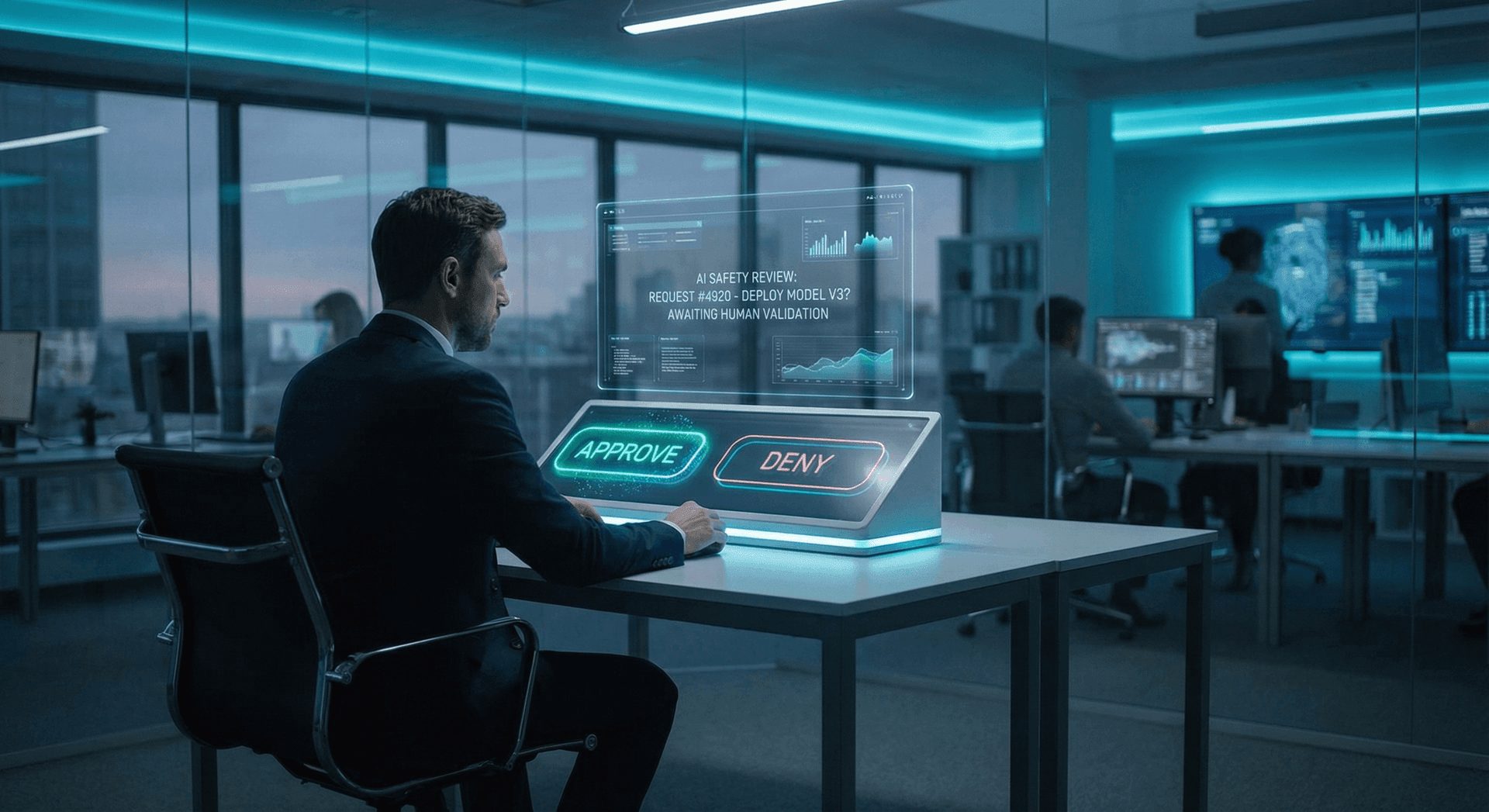
For a 100-person law firm in Fort Wayne, a 250-person Allen County manufacturer, or a 400-person regional services business, the question is not whether IBM Bob is the right tool. The question is whether your current AI deployment has the architectural properties Bob is built around. Multi-model routing means no single model dictates the outcome of a high-stakes task. Human checkpoints mean a person approves the irreversible step before it happens. Both are governance patterns first and product features second.
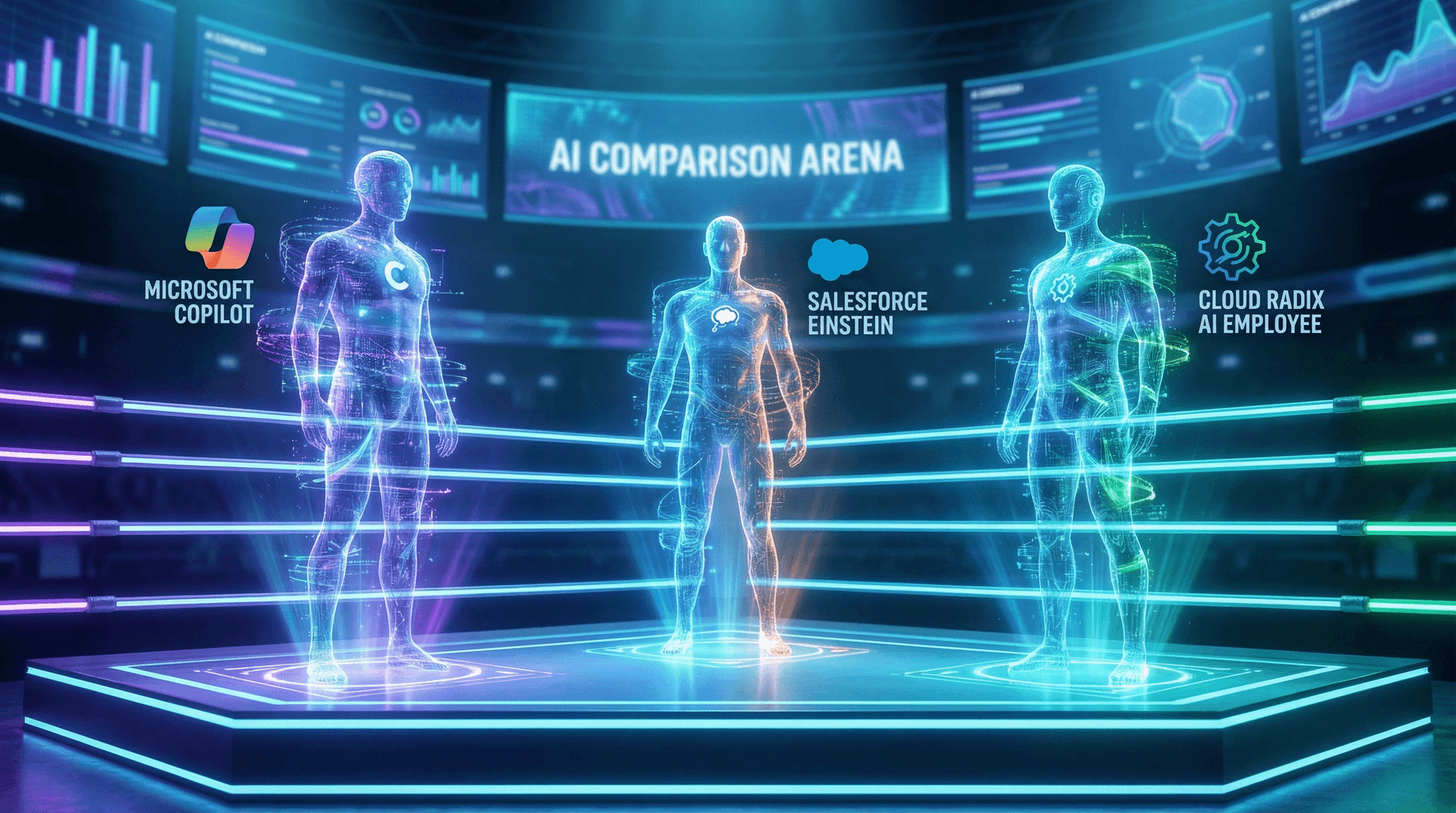
This piece translates the IBM Bob announcement into the procurement and architecture conversation a mid-market buyer should be having right now. We have written before about how AI Employees compare to Microsoft Copilot and Salesforce Einstein and about the human approval gate as a governance pattern. What follows is the production-readiness frame that ties them together.
Key Takeaways
- VentureBeat reports IBM Bob combines multi-model routing with human checkpoints to make AI coding production-ready
- The design pattern matters more than the product — multi-model routing and human-in-the-loop are now table-stakes for revenue-touching workflows
- No single AI model wins every task; routing across models is risk management, not optimization
- Human checkpoints are the integrity gate that converts a useful agent into a defensible business system
- Most SMB AI deployments today are still single-model and zero-checkpoint — fine for low-stakes work, dangerous for revenue-touching processes
- A four-question vendor evaluation closes the gap: multi-model support, audit trail, human-checkpoint workflows, and a vendor-exit pathway

What Does IBM's Bob Actually Do?
We are not going to invent details VentureBeat did not publish. The structural claims IBM has made about Bob are the part worth holding onto: it routes tasks across multiple models rather than committing to one, and it inserts human approval steps at key decision points rather than running end-to-end autonomously. According to VentureBeat's coverage, the framing is that these two properties together are what convert AI coding from a developer productivity tool into a system that can plausibly be operated in production.
The design pattern is the right one regardless of which vendor ultimately ships a market-leading implementation. The reasoning works like this. A single AI model has uneven strengths — strong on some task types, mediocre on others, occasionally wrong on outputs that look confidently correct. A workflow that depends on a single model inherits that unevenness. A workflow that routes between several models, with each model handling tasks it is genuinely good at, smooths the unevenness. It also produces a built-in second opinion: a different model can validate the first model's output before any irreversible action is taken.
The human checkpoint completes the integrity loop. Multi-model routing reduces the variance of the AI's output. The checkpoint provides the final accountability gate where a human reviews the high-stakes action before it is committed. This is not a nostalgic preference for human oversight. It is currently the most reliable technique for surviving the audit requirements of frameworks like the NIST AI Risk Management Framework and ISO/IEC 42001 for production systems.
The companion VentureBeat piece on Mistral's Workflows orchestration engine is worth reading alongside the Bob announcement. It points in the same direction — durable orchestration with explicit step boundaries, retry semantics, and observability — and reinforces that the production-AI conversation has shifted from “how good is the model” to “how reliable is the workflow that runs the model.”
Why Is Multi-Model Routing Now Table-Stakes for Production AI?
Two years ago the dominant procurement question was which model is best. That question is now the wrong one. The current question is which models, in what combination, for which task types.
The reasoning is empirical. The Stanford 2026 AI Index report tracks per-task performance across leading models and consistently shows that no single model dominates across all task categories. A model that leads on coding tasks may trail on long-document summarization. A model that excels at structured extraction may underperform on creative reasoning. The leaderboard rotates by category and by quarter.
A workflow committed to a single model inherits whatever weakness that model has on whatever task it is currently handling. A workflow that routes across models — choosing the right model for the right step — can usually outperform any single model on any single complex task. The trade-off is that routing requires orchestration plumbing, vendor-neutral abstraction, and careful prompt portability. None of that is free.
This is why we have argued in our coverage of the AI agent stack split between Google and AWS that the control plane and the execution plane are separating. Multi-model routing is a control-plane decision. Once a buyer commits to it, the question of which underlying models run is a tactical one that can change quarterly without disrupting the workflow.
For a mid-market business, the practical implication is not that you need to integrate ten models on day one. It is that the AI vendor you select should not lock you into one model with no migration path. Single-model lock-in is the procurement risk that kills your ability to take advantage of the next price drop or capability release. Bob's announcement is interesting partly because IBM is signaling that single-model commitment is over even at the platform level.
The risk side of multi-model routing is real and worth naming. Each additional model means another vendor relationship, another audit trail, another set of credential and security requirements that ties back to the credential-isolation problems VentureBeat documented in the recent six-exploit story on AI coding agents. The breadth of an AI agent's vendor surface is itself an attack surface.
Why Are Human Checkpoints the Integrity Gate?
Multi-model routing reduces the variance of AI output. It does not eliminate the possibility of confidently wrong output. For revenue-touching workflows — the kinds where a wrong action affects a customer, costs money, or creates a regulatory issue — the checkpoint is the gate that converts a useful agent into a defensible business system.
A human checkpoint does three things at once. It introduces accountability — a named person approved the action, and that approval is logged. It introduces a moment of friction — the human pause is sometimes long enough for the obvious mistake to be caught. And it provides a feedback loop — every override, every approval, every rejection is data that can refine the workflow.
This is not theoretical. Our piece on why every AI employee needs a human approval gate walks through the real-world incident that drove our own pipeline design — a single accident that taught the team why “the agent will not do anything that bad” is the precise belief that produces bad outcomes. The pattern Bob is shipping is a productized version of the same lesson.
The OWASP Top 10 for LLM Applications names “excessive agency” as a primary failure mode for AI systems — agents granted more autonomy than the workflow's risk profile justifies. The remediation is not better models. It is human checkpoints at the points where the cost of being wrong is asymmetric. The model can take the reversible action. The human approves the irreversible one.
The cost of human checkpoints is friction. The agent slows down. The human's attention is required at predictable moments. Throughput drops. These costs are real, and any vendor selling human-in-the-loop AI should be honest about them. The benefit is that the resulting system is auditable, defensible, and trustworthy at the points where trust actually matters. For mid-market businesses, that trade-off is almost always the right one for any process that touches customers, money, or regulatory exposure.

What Should a Mid-Market Business Require From an AI Production Vendor?
The Bob announcement is a useful procurement spec even if you never adopt the product. Here are the four questions a 100-500 person business should ask of any AI vendor pitching a production deployment.
1. Multi-Model Support
Can the workflow run across multiple model providers, or does it lock me into one? Is the abstraction layer honest — meaning, can I actually switch models without rewriting the workflow — or is “multi-model support” a marketing term that hides deep coupling? If the answer is unclear, assume single-model lock-in.
2. Action-Level Audit Trail
Does the system produce an audit log that records every tool call, every credential use, and every external action — not just session start and stop? Is the log append-only? Does it live outside the agent's execution environment? The Mend AI Security Governance Framework treats this as a baseline for production AI procurement, and so should any mid-market buyer.
3. Human-Checkpoint Workflows
Can a human approval step be inserted at any point in the workflow? Is the approval interface usable by a non-technical reviewer? Is the override pattern logged? Is it possible to require human approval for high-risk actions without degrading throughput on low-risk ones? If a vendor cannot show this clearly, the product is not production-ready regardless of how impressive the demo looked.
4. Vendor-Exit Pathway
If you stop paying the vendor in 18 months, what happens to your workflow, your prompts, your fine-tuned models, your audit logs, and the integrations you have built? Can you export everything in portable formats? Can you re-host on a different provider without starting over? The exit pathway is the negotiating leverage that prevents quiet annual price escalation.
Vendor Evaluation Quick Reference
| Requirement | Right Answer | Wrong Answer |
|---|---|---|
| Multi-model support | Genuine abstraction with switching tested | Single model with "multi-model" marketing |
| Audit trail | Action-level, append-only, off-box | Session-level, in-box, vendor-controlled |
| Human checkpoints | Configurable per workflow with logged approvals | All-or-nothing automation toggle |
| Vendor-exit | Portable workflow exports plus migration tooling | Proprietary format, no migration support |

What Is the Honest Picture for Most SMB AI Deployments Today?
Most small and mid-sized business AI use cases right now are still single-model and zero-checkpoint. A team uses Claude or ChatGPT for drafting. A salesperson uses a Copilot to summarize calls. An operations lead has automated a single weekly report through a no-code tool. None of these are wrong. For the workflows they cover, single-model and zero-checkpoint is fine.
The risk shows up when those same patterns get extended into revenue-touching workflows. A draft email is low-stakes. A draft email that gets auto-sent to a customer list is not. A summarized call is low-stakes. A summarized call that auto-generates a contract clause is not. The conversion point is when the AI moves from suggesting actions to taking them.
For Fort Wayne and Northeast Indiana businesses thinking about that conversion, the deciding question is whether the workflow touches money, customers, or compliance. If yes, the Bob-style design pattern — multi-model routing plus human checkpoints — is the architectural floor, not the ceiling. We have laid out the broader measurement framing in our piece on AI Employee performance metrics that actually matter. The metrics that prove a workflow is ready for production are the same metrics that surface when the multi-model and checkpoint patterns are missing.
What this is not: a recommendation that every AI use case needs IBM Bob's level of complexity. The honest take is that 80 percent of mid-market AI use cases right now are low-stakes work that does not need this architecture. The remaining 20 percent — the revenue-touching subset — needs it badly, and most current deployments do not have it. The risk is that the boundary between the two gets crossed without anyone noticing, because adding “send the email” to a workflow that already drafts the email feels like a small change. It is not.
The piece we have done on multi-agent versus single-agent AI architecture covers the architectural side of this conversation in more depth. Multi-model routing is one of the simplest forms of multi-agent design — different specialists for different steps — and the lessons there apply regardless of which vendor's product you are running.
How Cloud Radix Brings Production-Ready AI Into Northeast Indiana Businesses
Cloud Radix deploys AI Employees and AI workflows for Fort Wayne, Allen County, DeKalb County, and Northeast Indiana businesses with the architectural patterns this article describes built in from day one. Multi-model routing across the major providers, action-level audit logging, configurable human checkpoints at the points where the cost of being wrong is asymmetric, and explicit vendor-exit pathways — these are the production-readiness defaults, not the premium tier.
If your team has been running AI workflows that have started to touch customers, money, or compliance — or if you are evaluating an AI vendor that cannot answer the four-question framework above — that is the conversation to have. Our AI Employees service is built around the assumption that production AI requires production architecture. Contact Cloud Radix for a structured review of where your current AI workflows sit on the low-stakes versus revenue-touching boundary, and what the next architectural steps should be.
Frequently Asked Questions
Q1.What is multi-model routing in production AI?
Multi-model routing is the architectural pattern of running an AI workflow across multiple language models, with each model handling the task types it is genuinely good at, rather than committing the entire workflow to one model. It reduces the variance of output, provides built-in second opinions before high-stakes actions, and prevents single-model vendor lock-in.
Q2.What does IBM's Bob announcement actually signal?
VentureBeat reports that IBM is positioning Bob as a production-ready AI coding system built on multi-model routing and human checkpoints. The product itself matters less than the design pattern it represents — the same two properties (multi-model routing and human-in-the-loop) are becoming table-stakes for any mid-market business deploying AI in revenue-touching workflows.
Q3.When does a small business need human checkpoints in its AI workflows?
Whenever the workflow touches money, customers, or regulatory exposure, and especially whenever the AI moves from suggesting actions to taking them autonomously. For low-stakes drafting, summarization, or research work, human checkpoints are typically unnecessary friction. For workflows that auto-send messages, modify records, or commit actions on the business's behalf, they are the integrity gate.
Q4.What are the four questions to ask any AI production vendor?
(1) Does the system genuinely support multi-model routing or only single-model lock-in dressed up as multi-model? (2) Does it produce an action-level append-only audit log that lives outside the agent's execution environment? (3) Can configurable human checkpoints be inserted at any workflow point with logged approvals? (4) What is the vendor-exit pathway — can workflows, prompts, and audit logs be exported in portable formats?
Q5.Are most SMB AI deployments today missing this architecture?
Yes. Most current SMB and mid-market AI use cases are still single-model and zero-checkpoint. That is fine for low-stakes drafting and summarization work. The risk emerges when those same patterns get extended into revenue-touching workflows without the corresponding architecture upgrade.
Q6.Is multi-model routing always better than single-model?
For high-stakes production workflows, generally yes — no single model dominates across task categories, and routing reduces the variance of output. For low-stakes throwaway tasks, the orchestration overhead may not be worth the marginal quality gain. The right framing is to treat multi-model routing as risk management for the workflows where being wrong is expensive.
Q7.How does this connect to vendor lock-in risk?
Single-model commitment is one of the strongest forms of vendor lock-in in modern AI procurement. A workflow tuned to one provider's model often will not perform identically on another provider's model, and migration costs can absorb meaningful engineering time. Multi-model routing combined with portable workflow definitions is the architectural pattern that preserves vendor optionality across the inevitable price and capability shifts.
Sources & Further Reading
- VentureBeat: venturebeat.com/orchestration/ibm-launches-bob — IBM launches Bob with multi-model routing and human checkpoints to turn AI coding into a secure production system
- VentureBeat: venturebeat.com/technology/mistral-ai-launches-workflows — Mistral AI launches Workflows, a Temporal-powered orchestration engine already running millions of daily executions
- VentureBeat: venturebeat.com/security/six-exploits-broke-ai-coding-agents-iam-never-saw-them — Claude Code, Copilot and Codex all got hacked. Every attacker went for the credential, not the model.
- NIST: nist.gov/itl/ai-risk-management-framework — AI Risk Management Framework
- Stanford HAI: hai.stanford.edu/ai-index/2026-ai-index-report — 2026 AI Index Report
- ISO: iso.org/standard/81230.html — ISO/IEC 42001 AI Management Systems
- OWASP: genai.owasp.org/llm-top-10 — OWASP Top 10 for LLM Applications
Is Your AI Stack Production-Ready?
If your workflows are starting to touch customers, money, or compliance, the architecture beneath them needs to keep up. Cloud Radix builds AI Employees with multi-model routing, audit trails, and configurable human checkpoints by default.