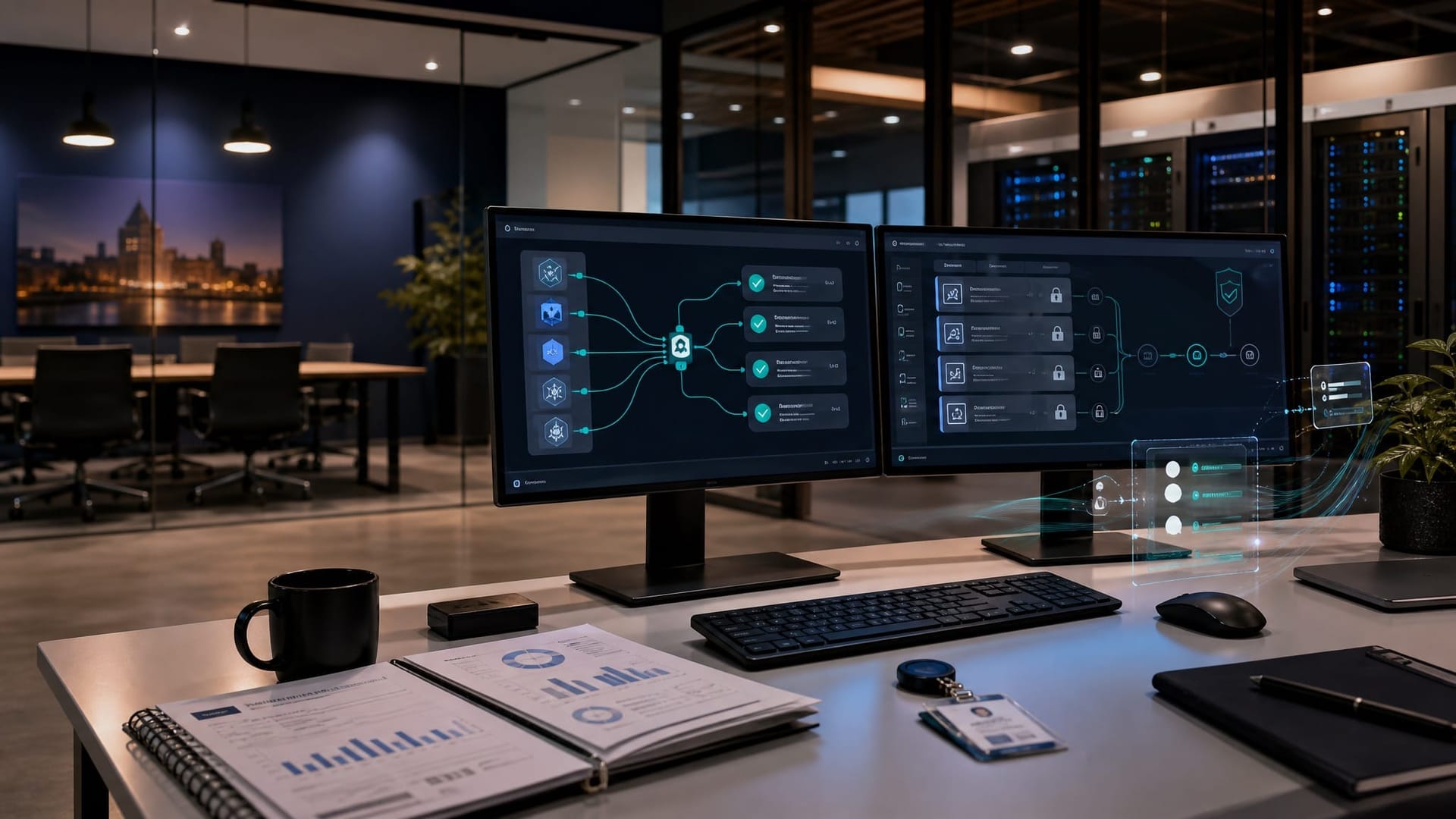
The line that should land for any mid-market business in the Mistral Workflows announcement is not the model. It is the execution engine. Mistral did not build a new chatbot or fine-tune a new frontier model in late April. It launched a public preview of an orchestration platform built on top of Temporal — the same durable execution engine that runs the order pipeline at Stripe, the streaming infrastructure at Netflix, and the customer-data plumbing at Salesforce. The pitch behind the announcement is straightforward: AI workflows now need the same kind of operational substrate that financial transactions and content delivery have always needed.
VentureBeat's reporting on the Mistral Workflows launch frames the news as a market signal rather than a single product release. Workflows is not a concept — Mistral says customers are already running the product in production, processing millions of executions daily across logistics, finance, and customer support. ASML, ABANCA, CMA-CGM, France Travail, La Banque Postale, and Moeve are among the named enterprises running it today. The announcement is also one of two production-orchestration moves in the same week: IBM's Bob platform, also covered by VentureBeat, launched on April 28 with multi-model routing, human checkpoints, and IBM's claim that 80,000 of its own employees are already using it with surveyed users reporting average 45% productivity gains. Two large vendors moving the same direction in the same week is a stronger signal than either announcement alone.
For a 200-to-2,000-person Fort Wayne or Northeast Indiana firm, this is the moment when AI orchestration stops being a research conversation and becomes a procurement conversation. The translation work — what Mistral Workflows actually is, why durable execution is now table stakes, and what mid-market firms should require from any orchestration vendor — is what the rest of this piece is about.
Key Takeaways
- Mistral launched Workflows in public preview in late April 2026, built on Temporal's durable execution engine — already running millions of daily executions in production
- Named enterprise customers include ASML, ABANCA, CMA-CGM, France Travail, La Banque Postale, and Moeve across logistics, finance, and customer support
- Durable execution adds retries, scheduling, timeouts, observability, and human-in-the-loop as platform features rather than application code
- IBM's Bob platform launched the same week with multi-model routing and human checkpoints, signaling that production AI orchestration is the 2026 procurement axis, not the model selection
- Mid-market firms should require five capabilities from any orchestration vendor: durability, observability, human checkpoints, multi-model support, and exit portability
- Honest tradeoff: orchestration platforms add operational complexity — only adopt with real workflow needs, not as a hedge against future scale

What Is Mistral Workflows and What Does Temporal Add?
The clean way to read Mistral Workflows is as two products in one announcement. The first is the AI-specific layer — Mistral's models, the SDK, the integrations into Le Chat and Studio, the human-in-the-loop primitives. The second is the substrate — Temporal's durable execution engine, the same one that orchestrates production-critical workflows at Netflix, Stripe, and Salesforce. Mistral built the AI layer; Temporal provides the substrate. The combination is what Mistral is pitching as production-grade.
Per Mistral's own announcement, developers define workflows in Python, combining components such as models, agents, and external connectors into structured processes. The Mistral SDK handles retry policies, tracing, timeouts, rate limiting, and human-in-the-loop through decorators and single-line configuration, so the developer writes business logic and the platform handles execution. The deployment model is split: Mistral hosts the orchestration infrastructure — the Temporal cluster, the Workflows API, and Studio — while customers deploy workers on their own Kubernetes environment, so data and business logic stay within their perimeter. Once a workflow is built, it can be published to Le Chat — Mistral's chatbot platform — so anyone in the organization can trigger it. Every step remains tracked and auditable in Studio.
The substrate part is what mid-market buyers should pay attention to. Temporal's durable execution model treats workflows like long-running, fault-tolerant state machines: every step is checkpointed, every failure is retried under explicit policy, and the workflow can survive a process restart, a network partition, or a service outage without losing its place. That is a different operational posture than the typical AI workflow from 2024, which was a script that called an API, parsed the response, and either succeeded or threw a stack trace. The script worked fine in a demo. It failed badly in production the first time the API timed out under load.
Mistral extended Temporal's core engine for AI-specific concerns: streaming, payload handling, multi-tenancy, and observability that the durable execution layer does not provide out of the box. Those additions matter because AI workloads have different shapes than the financial transactions Temporal was originally optimized for. A streaming response from a frontier model is not a single function call; it is a stream of tokens that needs to be checkpointed differently. A multi-tenant orchestration layer that serves dozens of customer workloads simultaneously needs payload isolation that Temporal's core does not enforce. The AI-specific extensions are where Mistral is doing the engineering work; the durable execution substrate is borrowed.
The Stanford HAI 2026 AI Index Report frames the broader shift as the year enterprise AI moved from prototype-grade workflow code to production-grade orchestration substrates. Mistral Workflows is one data point in that shift. So is IBM Bob. So is the broader move toward agentic workflows that we covered in AI as an Operating Layer for Fort Wayne Businesses. The category is consolidating around a small number of approaches, and durable execution is one of them.
Why Is Durable Execution Now Table Stakes for Production AI?
The intuition that long-running AI workflows are different in kind from short request-response patterns is not new. The procurement implication is. For most of 2024 and 2025, mid-market AI deployments were short workflows: a chatbot answering a question, a summarization pipeline processing a document, a quick classification job. Those patterns ran fine on simple application code. The 2026 shift is that the workflows that actually deliver business value are increasingly long-running, multi-step, and stateful — and the simple application code does not survive contact with production conditions for those workflows.
Consider a customer-onboarding workflow at a 500-person firm: pull customer data from a CRM, classify the profile against three risk dimensions, generate a personalized welcome plan with a frontier model, route it to a human reviewer for approval, send the approved plan via email, and log the chain to a compliance system. Six stages, two external API calls that can fail, one human approval that can take hours or days, and three steps that need to remain auditable indefinitely.
Built as a script, that workflow has predictable failure modes: the API timeout produces an exception, the approval step blocks the entire process, retry logic gets implemented inconsistently, and the observability story is “check the application logs.” Built on durable execution, the same workflow gets retries, timeouts, scheduling, and observability as platform features. The approval step pauses without consuming compute, then resumes when the approval lands. The audit trail is built into the substrate.
The orchestration layer increasingly determines whether an AI workflow survives in production, not the model selection. A frontier-model workflow on a brittle substrate will fail more often than a smaller-model workflow on durable execution. We covered the related compounding-quality dynamic in Google ReasoningBank: The Compounding AI Employee.
Three failure modes show up most often in mid-market AI deployments. Transient failures in external APIs — durable execution gives the platform a place to retry without re-running upstream work. Long-running human approvals — the workflow pauses and resumes cleanly without holding compute idle. Post-mortem investigations after a workflow misbehaves — the platform has a structured audit trail of inputs, outputs, retries, and timing for every step. Each is a feature mid-market firms can build themselves; few build them well, on time, and consistently across a portfolio.

What Five Capabilities Should Mid-Market Firms Require From Any AI Orchestration Vendor?
Mistral Workflows is one example of an emerging category, not the only credible vendor. The right procurement question for a mid-market firm is not “should we adopt Mistral Workflows” — it is “what capabilities should we require from any orchestration vendor we evaluate, including Mistral, IBM, the open-source options on top of Temporal directly, and the workflow features built into other platforms.” Here are the five that matter most for a 200-to-2,000-person firm.
1. Durable Execution as a Platform Feature
The workflow should survive process restarts, network partitions, and service outages without losing state. Retries should be a configuration choice with named policies, not custom application code. Long-running steps — including ones that pause for human approval — should not consume compute while paused. This is the single most important capability and the one that separates production-grade orchestration from glorified scripts. Mistral Workflows gets this from Temporal directly. IBM Bob has its own durable substrate. Vendors that cannot articulate their durability model in detail are not yet production-grade.
2. Observability and Auditability
Every step of every workflow run should be recorded with inputs, outputs, retries, errors, and timing. The audit trail should be queryable — by workflow ID, by step type, by customer, by failure mode. This matters for two reasons: production debugging is impossible without it, and compliance posture (HIPAA, SOX, ISO/IEC 42001) requires it. Both NIST's AI Risk Management Framework and ISO/IEC 42001 treat traceability as a foundational requirement, not an optional add-on. A workflow vendor without serious observability is not a workflow vendor a regulated mid-market firm should adopt.
3. Human-in-the-Loop Primitives
A non-trivial fraction of business AI workflows include a human approval step — a manager reviewing a generated proposal, a compliance officer signing off on a customer communication, a senior engineer approving a code change before deployment. The orchestration platform should treat human approval as a first-class workflow step, not an external system the developer wires in. The platform should pause the workflow, route the approval request to the right human, time it out if no response arrives, and resume cleanly when the response lands. IBM Bob's approval model lets developers configure checkpoints by task type or manual approval — that pattern is what mid-market firms should look for. We mapped the broader human-in-the-loop dynamic in AI Employee vs Chatbot: What Fort Wayne Businesses Need, where the architectural difference between a chatbot and a workflow-driven AI Employee is partly the human-in-the-loop substrate.
4. Multi-Model Support
A workflow that locks every step to a single model vendor takes the model vendor's outage, price increase, or capability gap as the workflow's outage, price increase, or capability gap. The orchestration platform should treat the model as a workflow input, not a hard-coded dependency. IBM Bob's multi-model routing — across Anthropic Claude, Mistral open-source models, IBM Granite, and specialized fine-tuned models — is the explicit version of this capability. Mistral Workflows' default position is more constrained (it is, after all, Mistral's own platform), but the workflow definitions should still let developers swap model providers without rewriting business logic. Mid-market firms should treat multi-model support as a procurement requirement, not a future feature. We covered the procurement-level dynamic of vendor-lock concerns in our Microsoft and OpenAI deal restructure analysis.
5. Exit Portability
The workflow definitions should be portable. If the firm decides in 2027 that the orchestration vendor is not a good fit, the workflows should be migratable to another vendor — or to self-hosted Temporal directly — without rewriting from scratch. Vendors built on open standards like Temporal are structurally easier to exit than vendors built on proprietary engines. The exit-cost question should be on the architecture decision record from day one. Both NIST and ISO treat exit portability as a governance concern; mid-market procurement should treat it as a contractual concern.
Capability Summary
| Capability | What It Looks Like in Production | What to Require From the Vendor |
|---|---|---|
| Durable execution | Workflows survive restarts, retry under named policy, pause for hours without compute | Detailed durability model, named retry semantics, paused-step compute economics |
| Observability | Every step queryable by ID, step type, customer, failure mode | Structured audit trail, queryable history, integration with existing observability tools |
| Human-in-the-loop | Approval steps as first-class workflow primitives, clean pause/resume | Native approval primitives, configurable checkpoints, timeout behavior |
| Multi-model support | Model is workflow input, not hard-coded dependency | Provider-agnostic SDK, multi-vendor routing or migration story |
| Exit portability | Workflow definitions portable across vendors or to self-hosted | Open-standard substrate, documented migration path, contractual clarity |
A vendor that delivers four of five is a credible candidate. A vendor that delivers fewer than four is not yet production-grade for a regulated mid-market workload, regardless of how good the model behind it is.

How Should Mid-Market Firms Decide: Adopt, Build on Temporal Direct, or Wait?
There are three serious options for a 200-to-2,000-person mid-market firm, and the right answer depends on the firm's existing engineering substrate and workflow portfolio.
Adopt a vendor platform — Mistral Workflows, IBM Bob, or one of the credible competitors. The advantage is speed-to-production: durable execution, observability, human-in-the-loop, and SDK ergonomics come pre-integrated. The cost is vendor lock-in, per-execution pricing, and dependency on the vendor's roadmap. Right answer for firms that need durable workflows in production this quarter and do not have the engineering bandwidth to operate Temporal directly.
Build on Temporal directly, without the AI-vendor wrapper. Temporal is open-source under a permissive license, well-documented, and has a strong community. The engineering team writes the AI integrations, gets full control over the substrate, and avoids the per-execution premium. The cost is engineering time — roughly six to twelve months to reach feature parity with what Mistral or IBM offers out of the box. Right answer for firms with strong platform engineering and a long-term commitment to AI workflows.
Wait. Most mid-market firms do not yet have workflows that justify durable execution. A short summarization pipeline does not need it. A daily batch job does not need it. A frontline chatbot does not need it. The substrate is real, the announcements are real, the category is consolidating — but adopting before workflows require it is operational complexity without operational benefit. Wait until at least one workflow has hit a production failure mode that durable execution would have prevented.
The honest answer for many Fort Wayne and Northeast Indiana mid-market firms is option three for the next quarter, with a hard pivot to option one when the first real failure mode lands. The forcing function is a workflow that fails in a way that hurts the business — an onboarding pipeline that lost a state transition, a compliance review that did not pause cleanly, a multi-step generation pipeline that retried inconsistently and produced duplicate outputs. Until then, the procurement work is reading the announcements and updating the architecture decision record.
Fort Wayne and Northeast Indiana: How Should a 100-to-500-Person Business Approach AI Orchestration?
A 100-to-500-person business — the typical Fort Wayne professional services firm, Allen County manufacturer, or DeKalb County regional services company — does not need an enterprise orchestration platform on May 1. The firms in this size range that we work with typically have between zero and three production AI workflows, most of which are short-running and stateless enough that the simple-application-code pattern is adequate. The procurement work in 2026 is to be ready for the first workflow that breaks that adequacy.
Three things change in 2026 for a firm in this range.
First, the architecture decision record now needs a row on AI workflow orchestration. The right answer for most workflows is “no orchestration substrate yet — single-step calls are sufficient.” That is a defensible answer when it is documented and reviewed quarterly. It is an undefensible answer when it is implicit and unreviewed. The discipline is documenting the choice, not making a particular choice.
Second, the next workflow that involves human approval, multiple model calls in sequence, or a long-running step is the trigger for revisiting the orchestration decision. The first such workflow in the door of a mid-market firm is usually a customer-onboarding pipeline, a compliance review process, or a multi-stage content generation workflow. The procurement evaluation should happen before the workflow goes to production, not after the first failure. We covered the related measurement framework in AI Employee Performance Metrics That Actually Matter, and the same dollars-per-business-outcome math applies to the orchestration choice.
Third, the regulated industries in Northeast Indiana — healthcare practices, financial services firms, professional services with HIPAA or SOX exposure — should treat orchestration vendor selection as a governance decision, not just a technical one. The audit trail, the data residency story, the human-in-the-loop primitives, and the exit portability terms all matter for compliance posture. We covered the broader sovereignty conversation in Fort Wayne Air-Gapped AI: Sovereign Gemini for NE Indiana, and the related discipline applies to orchestration substrate decisions: in regulated industries, the substrate decision is bound by the same governance constraints as the model decision.
The practical work for a 300-person Fort Wayne firm in May is not to adopt Mistral Workflows. It is to add a row to the architecture decision record, define the trigger for revisiting that row, and assign a named owner for that review. That is one afternoon of work and meaningful procurement leverage when the first orchestration-needing workflow shows up.
What Is the Honest Tradeoff Mid-Market Firms Should Weigh?
It would be wrong to read this piece as an endorsement of orchestration platforms for every mid-market AI deployment. The tradeoff is real.
Orchestration platforms add operational complexity. Even a good vendor SDK requires engineers to learn new concepts — workflow definitions, activity boundaries, retry policies, signal handling, durable timer semantics. The platform adds a service to operate (or a vendor to depend on). Durability guarantees come with constraints on how application code is structured. None of these are dealbreakers for firms with real workflow needs. All are friction for firms that adopt before the workflows justify it.
The right diagnostic is one question: “do we have at least one workflow in production that has failed in a way durable execution would have prevented?” If yes, the tradeoff is worth taking. If no, the right move is to wait for the first real failure mode.
A second qualification: this quarter's announcements are early signals, not mature procurement options. Mistral Workflows is in public preview. IBM Bob is generally available but has not yet been deployed at scale outside IBM. The vendor landscape will look different in six months. Firms that adopt the first credible vendor on the day of the announcement take on roadmap, pricing, and capability risk. The mitigation is exit portability and treating the orchestration choice as reversible.
A third qualification on the market signal: two large vendors moving into production AI orchestration in the same week is a strong category signal, but not a guarantee that durable execution becomes universal in mid-market AI by year-end. The market may consolidate around a different approach. Track the category, document the architecture decisions, adopt when the first workflow justifies it.
How Cloud Radix Helps Mid-Market Firms Navigate Production AI Orchestration
Cloud Radix deploys AI Employees and AI workflows for mid-market businesses across Fort Wayne, Allen County, DeKalb County, and Northeast Indiana with the architecture discipline this article describes. We treat orchestration substrate as a tracked governance decision, not an architectural default. We document workflow patterns on the architecture decision record from day one. We surface durable execution requirements when workflows need them, and we recommend the staged-adoption path when they do not.
If your firm is approaching its first long-running, multi-step, or human-approval-bearing AI workflow, the five-capability checklist is the conversation to have. Our AI consulting engagement is built around outcome-priced economics and explicit substrate-vendor risk tracking. Contact Cloud Radix for a structured review of your current and planned AI workflow portfolio and a 90-day plan for navigating the orchestration category deliberately.
Frequently Asked Questions
Q1.What is Mistral Workflows?
Mistral Workflows is a public-preview orchestration platform launched in late April 2026, built on top of Temporal's durable execution engine and extended for AI-specific workloads with streaming, payload handling, multi-tenancy, and observability. Developers define workflows in Python combining models, agents, and external connectors. The Mistral SDK handles retry policies, tracing, timeouts, rate limiting, and human-in-the-loop through decorators and single-line configuration. Mistral hosts the orchestration infrastructure; customers deploy workers on their own Kubernetes environment.
Q2.How is Mistral Workflows different from a chatbot or a simple AI script?
Mistral Workflows treats long-running AI workflows as durable, fault-tolerant state machines. A chatbot or a simple script handles short request-response patterns and fails ungracefully under network errors, API timeouts, or long-running steps that need to pause. Mistral Workflows checkpoints every step, retries failed steps under named policies, pauses cleanly for human approvals, and produces a structured audit trail. The substrate is built for production workloads that run for minutes, hours, or days rather than seconds.
Q3.How does Mistral Workflows compare to IBM Bob?
Both launched in the same week in late April 2026 and address the same broad category — production AI orchestration. Mistral Workflows is built on Temporal and emphasizes the durable execution substrate with Mistral's own model integrations and a hosted-orchestration plus customer-deployed-workers split. IBM Bob emphasizes multi-model routing across Anthropic Claude, Mistral open-source models, IBM Granite, and specialized fine-tuned models, plus configurable human checkpoints, with IBM reporting 80,000 internal users and average 45% productivity gains. The procurement evaluation should compare both on the five-capability checklist rather than choosing on brand.
Q4.Should mid-market firms adopt Mistral Workflows now or wait?
For most 200-to-2,000-person Fort Wayne and Northeast Indiana firms, the right answer is wait, with a specific trigger for revisiting. The trigger is the first AI workflow that needs durable execution — typically a customer onboarding pipeline, a compliance review process, or a multi-stage generation workflow that includes a human approval step. Adopt when the workflow justifies the operational complexity, not before. The procurement work this quarter is to define the trigger, not to adopt the platform.
Q5.What does durable execution mean for AI workflows?
Durable execution means the workflow is treated as a long-running, fault-tolerant state machine. Every step is checkpointed, every failure is retried under explicit policy, and the workflow can survive process restarts, network partitions, or service outages without losing state. Long-running steps — including human approvals — pause without consuming compute and resume cleanly when the next event lands. The durability guarantees come from the substrate (Temporal, in Mistral's case), and the AI-specific extensions handle streaming, payload size, multi-tenancy, and observability that the generic substrate does not address out of the box.
Q6.What capabilities should we require from any AI orchestration vendor?
Five capabilities matter most for mid-market procurement: durable execution as a platform feature (with named retry semantics and paused-step compute economics), observability and auditability (with structured audit trails queryable by workflow ID, step type, and failure mode), human-in-the-loop primitives (with native approval steps and configurable checkpoints), multi-model support (treating the model as a workflow input rather than a hard-coded dependency), and exit portability (with workflow definitions portable across vendors or to self-hosted substrates). A vendor that delivers four of five is credible; fewer than four is not yet production-grade for regulated mid-market workloads.
Q7.What should a Fort Wayne or Northeast Indiana mid-market business do about AI orchestration in 2026?
For most 100-to-500-person businesses across Fort Wayne, Allen County, and DeKalb County, the right move in May is not to adopt Mistral Workflows or any other production orchestration platform. It is to add a row to the architecture decision record covering AI workflow orchestration, define the trigger that would force a re-evaluation (the first workflow with a long-running step, multi-step model calls, or human approval), and assign a named owner for that review. Regulated firms in healthcare, financial services, and professional services should treat orchestration vendor selection as a governance decision bound by HIPAA, SOX, or ISO/IEC 42001 constraints. One afternoon of work this quarter buys procurement leverage when the first orchestration-needing workflow shows up.
Sources & Further Reading
- VentureBeat: venturebeat.com/technology/mistral-ai-launches-workflows — Mistral AI launches Workflows, a Temporal-powered orchestration engine already running millions of daily executions
- VentureBeat: venturebeat.com/orchestration/ibm-launches-bob — IBM launches Bob with multi-model routing and human checkpoints to turn AI coding into a secure production system
- Mistral AI: mistral.ai/news/workflows — Workflows for work that runs the business
- Temporal Technologies: temporal.io — Durable Execution Platform
- NIST: nist.gov/itl/ai-risk-management-framework — AI Risk Management Framework
- ISO: iso.org/standard/81230.html — ISO/IEC 42001 AI Management Systems
- Stanford HAI: hai.stanford.edu/ai-index/2026-ai-index-report — 2026 AI Index Report
Plan Your AI Orchestration Posture for 2026
Most mid-market firms should not adopt Mistral Workflows in May. They should document the trigger that would force a re-evaluation and name an owner for the review. Cloud Radix builds that architecture decision record with your team.