
The central idea
A tool waits to be used. An operating system coordinates how work gets done. A well-built AI Employee does something even more valuable: it improves the operating system it works inside.
Most businesses are buying artificial intelligence the same way they bought software for the last 20 years: one tool for email, another for meetings, another for marketing, another for documents, and a chatbot sitting off to the side waiting for someone to type a prompt.
That is not an AI strategy. It is a new layer of tabs.
The more powerful approach is to install AI as an operating system for the business—a connected layer across the website, records, workflows, documents, communications, approvals, and institutional memory. This builds on the AI operating-layer architecture we have already mapped, but goes one step further: place an AI Employee inside that system with a clear job to perform work, keep the system current, learn from outcomes, and improve how the business operates over time.
This is the difference between buying an AI feature and building an AI-native company.
A tool waits to be used. An operating system coordinates how work gets done. A well-built AI Employee does something even more valuable: it improves the operating system it works inside.
Key takeaways
- An AI tool produces an output. An AI operating system maintains state, coordinates work, applies rules, records evidence, and connects one completed task to the next.
- The AI Employee is not merely a user of the system. It becomes a governed operator and continuous-improvement engine inside it.
- Continuous improvement does not mean unrestricted self-modification. It means a controlled loop of observation, measurement, proposed change, testing, approval, deployment, and rollback.
- The most valuable business asset is not a prompt or a model. It is the accumulated operating knowledge encoded in workflows, permissions, memories, evaluations, and records.
- Cloud Radix does not assemble AI Employees from a loose collection of rented tools. Every deployment is powered by Pistol Shrimp AI, our proprietary, security-first AI Employee operating system.
- Businesses should start with one bounded workflow, but the foundation should be designed to become a company-wide operating layer rather than another isolated pilot.
What does it mean to install AI as an operating system?
An operating system is the shared layer that makes separate capabilities work together.
On a computer, the operating system manages files, permissions, memory, applications, and communication between processes. In a business, an AI operating system plays a similar role across the systems where work lives:
- customer and case records;
- email, phone, chat, and web inquiries;
- calendars, deadlines, tasks, and handoffs;
- documents, templates, and knowledge;
- approvals, permissions, and escalation rules;
- measurement, logs, and proof of work.
This does not necessarily mean replacing every piece of software the company already uses. In many businesses, the right architecture connects the existing CRM, accounting platform, document storage, website, calendar, and industry software behind one governed operating layer. In others, the correct move is to build a custom platform because the business process itself is the competitive advantage.
The test is simple: when something happens in one part of the business, does the rest of the system know what changed and what should happen next?
If a new lead completes a form but the follow-up system has no context, that is a tool stack. If an intake is completed, the record is created, the appropriate person is notified, the next task is scheduled, the source is logged, and the outcome becomes measurable, that is an operating system.
OpenAI's practical guide to building agents makes the foundational distinction clear: conventional software helps users perform workflows, while agents can perform those workflows on the user's behalf. It defines an agent around three core components—model, tools, and instructions—and emphasizes that reliable agents operate within explicit guardrails. The operating-system approach adds the business architecture those agents need around them: persistent state, permissions, evidence, memory, and improvement loops.
Why another AI tool will not transform the business
Standalone AI tools can be useful. They can draft faster, summarize meetings, classify messages, or generate images. The problem is not that these tools do nothing. The problem is that their value usually ends at the edge of the task.
A meeting assistant produces notes. Who turns the commitments into assigned work? A writing tool produces copy. Who checks the claim, publishes it, monitors performance, and updates the article? An inbox assistant drafts a reply. Who confirms the customer record is current and the promise in the email is operationally possible? A chatbot answers a question. Who remembers the conversation and moves the customer toward resolution?
Every disconnected tool creates a new seam where a human must carry context from one system to another. That seam is where work stalls, records drift, promises get missed, and nobody can reconstruct what happened. The practical alternative is agent-first process redesign: redesign the complete path of work before automating isolated fragments of it.
An AI operating system reduces those seams. It turns isolated outputs into governed state changes.
That phrase matters: state change.
The goal is not for AI to produce more words. The goal is for the business to become more accurate, responsive, measurable, and capable because the right record changed, the right person was informed, the next action was created, and the result was captured.
The AI Employee has two jobs
When Cloud Radix installs an AI Employee, that employee should eventually have two connected responsibilities.
Job one: operate the business system
The AI Employee performs bounded work inside the company's rules. Depending on the business, that may include:
- qualifying and routing new inquiries;
- preparing files before a professional reviews them;
- updating customer, case, or project records;
- monitoring deadlines and missing information;
- drafting communications from approved facts and templates;
- producing reports and surfacing exceptions;
- maintaining website content and structured business information;
- coordinating work between people and specialized agents.
This is the visible value: tasks completed, response time reduced, records maintained, and employees freed from repetitive coordination.
Job two: improve the system it operates
The second job is where the investment begins to compound.
As the AI Employee performs work, it encounters friction:
- a required field that is frequently missing;
- a handoff that repeatedly causes delays;
- a template that creates confusion;
- an approval rule that is too broad or too restrictive;
- a common customer question that the knowledge base does not answer;
- a recurring error that should become an automated check;
- a report nobody uses and a metric leadership actually needs.
A static automation repeats the workflow exactly as it was configured. A continuously improving AI Employee identifies the pattern, gathers evidence, proposes a better rule or interface, tests the change, and puts it through the correct approval path.
That is the important shift: the AI Employee is not just working in the system. It is helping the business work on the system.
What “continuously improving” should—and should not—mean
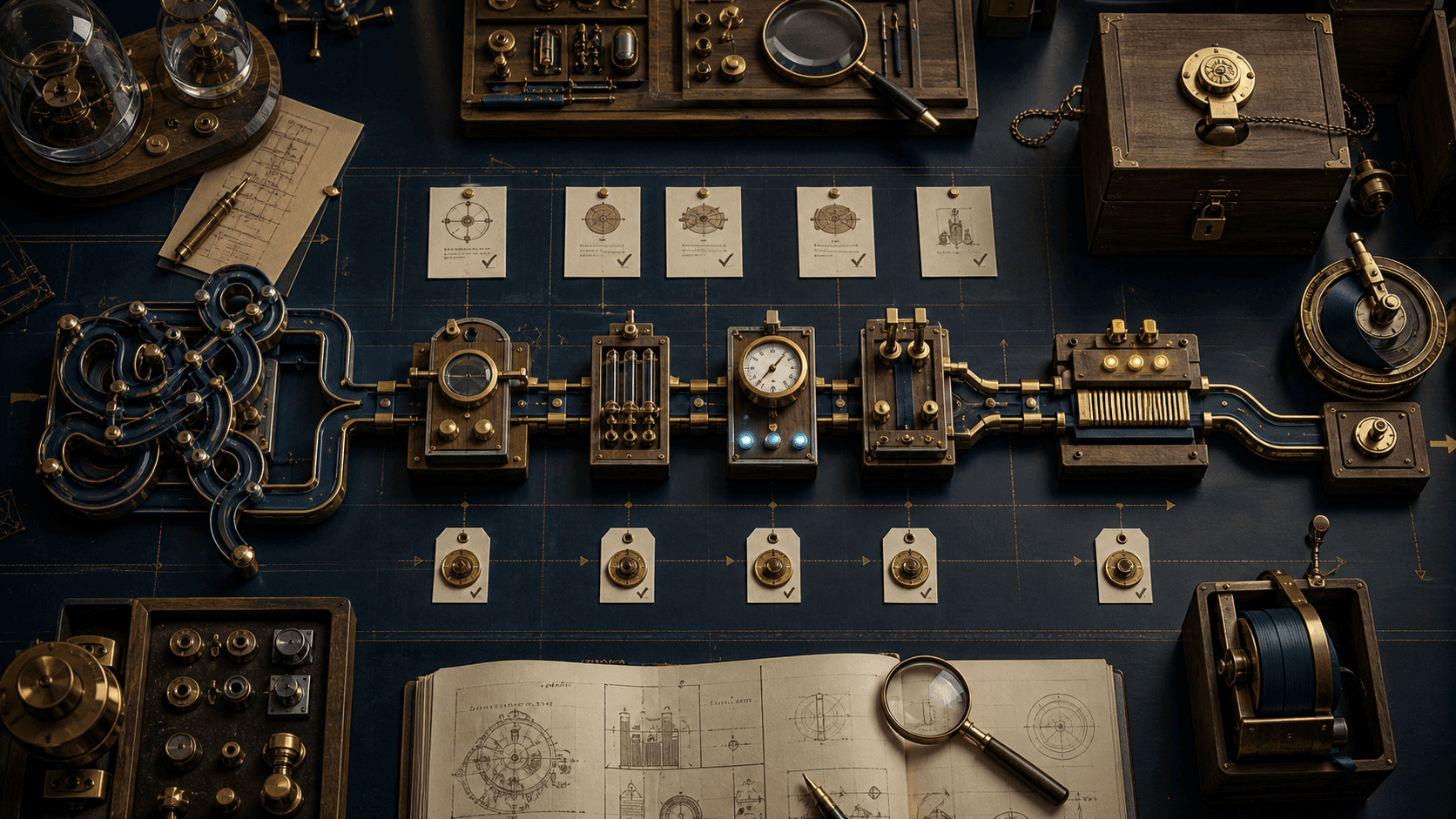
The phrase “self-improving AI” is often used carelessly. It can sound like software rewriting itself in production without supervision. That is not the standard a serious business should accept.
Continuous improvement should be governed like a strong operational discipline:
- Observe. Capture task outcomes, failures, corrections, delays, approvals, and exceptions.
- Diagnose. Separate a one-time anomaly from a repeated process problem.
- Propose. Produce a specific change with the evidence, expected benefit, affected systems, and risk.
- Test. Run the change against historical examples, synthetic cases, or a limited pilot.
- Approve. Route consequential changes to the person who owns that business process.
- Deploy. Release the approved change with versioning and a defined scope.
- Measure. Compare the new result against the previous baseline.
- Roll back or retain. Keep what works. Reverse what does not. Preserve the evidence either way.
Google Research's ReasoningBank paper points toward the learning architecture behind this model. The research describes agents that distill generalizable strategies from both successful and failed experiences, retrieve relevant lessons for future tasks, and integrate new learning back into memory. The principle is powerful, but production use requires governance around it: provenance, review, versioning, evaluation, and rollback. Our analysis of ReasoningBank and compounding AI Employee memory explains what that looks like beyond the research environment.
In other words, an AI Employee should be allowed to learn. It should not be allowed to turn every lesson into policy by itself.
The seven layers of an AI business operating system

The model is easier to evaluate when the architecture is visible. A durable AI operating system has seven layers.
1. System of record
The business needs an authoritative home for customers, cases, projects, tasks, documents, commitments, and outcomes. Chat history is not a system of record. Neither is an AI model's context window.
2. Identity and permissions
The AI Employee needs its own identity, scoped credentials, and role-based access. It should not borrow an owner's unrestricted login. Read, draft, approve, send, delete, publish, and pay are different permissions and should be treated differently. This is the core of the AI agent identity and IAM gap most businesses discover only after an agent reaches production.
3. Tools and connectors
The employee needs tested ways to read and act across business systems. Anthropic introduced the Model Context Protocol as an open standard for secure, two-way connections between AI applications and data sources. MCP can reduce fragmented one-off integrations, but a protocol is not a permission policy. Every connector still needs a defined owner, scope, health check, and failure behavior.
4. Operating procedures
The company's real procedures—rules, scripts, templates, checklists, definitions of done, escalation paths, and exceptions—must be made explicit. An AI Employee cannot reliably improve a process nobody can describe.
5. Memory and knowledge
The system must distinguish durable facts, temporary task state, approved policy, user preference, and lessons learned. Corrections should supersede bad assumptions. Every consequential memory should have provenance: where it came from, when it was learned, and who approved it.
6. Governance and evidence
High-impact actions need approval gates. Every run needs a trace. Costs need budgets. Failures need escalation. Changes need versioning and rollback. NIST's AI Risk Management Framework provides a useful discipline for incorporating trustworthiness into the design, development, use, and evaluation of AI systems; governance belongs inside the operating system, not in a policy document nobody consults. The Cloud Radix AI Employee governance playbook turns that principle into practical roles, gates, and evidence requirements.
7. Improvement engine
Finally, the system needs a controlled mechanism for turning operational evidence into a better workflow. This layer includes evaluations, retrospectives, bottleneck detection, proposed changes, test cases, release notes, and outcome measurement.
Remove any one of these layers and the weakness appears quickly. Without records, the employee forgets. Without permissions, it becomes dangerous. Without tools, it can only talk. Without procedures, it improvises. Without memory, it repeats mistakes. Without evidence, it cannot be trusted. Without an improvement engine, it never compounds.
Pistol Shrimp AI: the operating system behind Cloud Radix AI Employees
This architecture is not just a diagram Cloud Radix recommends to clients. We built it into Pistol Shrimp AI, our proprietary AI Employee platform and operating system.
That distinction matters. Many AI agencies resell access to the same collection of third-party tools, wrap them in a few automations, and call the result an AI Employee. The client is left with a fragile chain of rented accounts, disconnected memory, unclear security boundaries, and a provider whose real product is configuration labor.
Pistol Shrimp AI is the orchestration layer Cloud Radix owns and continuously develops. It coordinates specialized agents and approved tools, maintains persistent business memory, enforces permissions and security policies, routes work to the right AI model, records evidence, and gives the AI Employee a governed path for improving workflows over time. The underlying models can change as the market changes; the operating intelligence, controls, and business-specific system remain.
Every Cloud Radix deployment combines three things:
- Pistol Shrimp AI—the brain. Our proprietary software platform provides orchestration, memory, security, integrations, model routing, governance, and the continuous-improvement loop.
- The AI Employee Box—the body. Dedicated, security-hardened hardware runs the platform at the client's location, behind the client's firewall.
- The trained AI Employee—the operator. The employee is configured around the client's actual records, workflows, standards, permissions, and goals—not a generic demo prompt.
This is what separates installing an AI operating system from renting another AI tool. Cloud Radix controls the platform layer, the business retains its operating knowledge, and the system is designed to become more useful as the AI Employee performs real work. Explore how Pistol Shrimp AI powers every Cloud Radix AI Employee.
A concrete example: from legal website to legal operating system

Consider a personal injury law firm—the kind of environment where our personal injury AI platform must coordinate intake, records, deadlines, evidence, and attorney approvals rather than merely answer questions.
The conventional website project ends when the pages are published and the contact form works. The AI operating-system project begins there.
A new web inquiry becomes a potential-client record. The source and consent are captured. Conflict-check information is gathered. The attorney receives a structured consultation brief rather than a forwarded email. If the matter becomes a case, the system creates deadlines, documents, contacts, providers, insurance records, expense tracking, and the appropriate folder structure.
As records arrive, the AI Employee can organize them, identify missing items, draft chronology entries, prepare summaries for attorney review, and keep the case record synchronized. The same employee can maintain the public website, publish source-backed educational content, monitor broken links or outdated information, and report what work was completed.
Now add the improvement loop.
If consultations repeatedly stall because one fact is missing, the AI Employee can show the pattern and propose an intake change. If demand packages require the same manual reconciliation, it can propose a new validation step. If clients repeatedly ask the same question, it can propose a portal explanation and an approved communication template.
That is not “a chatbot for a law firm.” It is an AI Employee working inside—and helping improve—the firm's operating system.
The same pattern applies to a dental practice, contractor, manufacturer, CPA firm, auction company, or dealership. The records and permissions change. The architecture does not.
Why the business gets more valuable over time
Most software subscriptions depreciate into overhead. The company pays every month, employees learn the interface, and the vendor owns the roadmap.
A well-designed AI operating system can create a different asset: encoded operating intelligence.
Every approved workflow captures how the company prefers to work. Every exception adds nuance. Every correction removes ambiguity. Every evaluation makes quality measurable. Every connector turns another system into usable context. Every retrospective produces a better version of the process.
That accumulated layer becomes difficult for a competitor to copy because it is not a generic model. It is the company's own operating knowledge, implemented and improved through real work.
This is why model choice should remain replaceable. Models will change. Prices will fall. New vendors will appear. The durable asset is the harness around the model:
- the records;
- the permissions;
- the tools;
- the procedures;
- the memory;
- the evaluations;
- the proof logs;
- the improvement history.
Own that layer and the business can adopt better models without starting over. Rent every layer from one vendor and the company's intelligence compounds somewhere else. That is why a buyer-owned agent harness with persistent memory matters more than loyalty to any single model.
How to install the first version without boiling the ocean
“Operating system” sounds like a massive transformation. It does not need to begin that way.
The strongest deployments start with one workflow that is valuable, repetitive, measurable, and bounded. Examples include:
- new-client intake and follow-up;
- service-call qualification and dispatch preparation;
- document collection and missing-item monitoring;
- quote preparation and approval;
- recurring compliance or deadline checks;
- source-backed content production and website maintenance.
Then install the foundation beneath it. The AI Employee performance metrics should be chosen before deployment so the team can prove whether the workflow actually improved.
Phase 1: Map the work
Document the trigger, inputs, decisions, systems, owners, exceptions, approvals, and definition of done. Establish the current baseline: time, cost, delay, error rate, or conversion rate.
Phase 2: Build the governed path
Give the AI Employee only the tools and permissions needed for the pilot. Add a system of record, approval gates, logs, and a human handoff. Test ordinary cases and ugly edge cases.
Phase 3: Run beside the team
Operate in draft or supervised mode. Compare the AI Employee's work against human decisions. Capture corrections as structured evidence rather than burying them in chat.
Phase 4: Turn on bounded autonomy
Allow low-risk, reversible actions to run automatically. Keep financial, legal, reputational, and destructive actions behind a human approval gate. Monitor cost, quality, completion, and escalation.
Phase 5: Activate continuous improvement
Schedule operational retrospectives. Let the AI Employee surface repeated friction and propose changes. Test and approve improvements. Publish a monthly proof-of-work report showing what ran, what changed, what improved, and what requires a decision.
Only after the first workflow is reliable should the company expand into the next adjacent workflow. The operating system grows one proven capability at a time.
Seven questions to ask an AI Employee provider
Before buying, ask:
- Where does authoritative business state live?
- Does the AI Employee have its own scoped identity and credentials?
- Which actions are automatic, which require approval, and who can change that policy?
- Can every consequential action be reconstructed from an audit log?
- How are corrections, lessons, and memories reviewed, versioned, and rolled back?
- Can the underlying model or connector be replaced without rebuilding the operating system?
- How will you prove the system is better in month six than it was in month one?
If the answers are vague, the offering is probably an AI tool wearing an employee costume.
The real installation is organizational, not just technical
The technology matters, but the deepest change is managerial.
Installing an AI operating system forces a business to clarify how work should move. Who owns the decision? What information is required? What counts as complete? Which exceptions need judgment? What evidence should exist afterward? Which commitments may the AI Employee make?
Those questions improve the human organization even before the first autonomous task runs.
The goal is not to remove people from the company. It is to remove the invisible coordination tax that prevents good people from doing their best work. Humans should own judgment, relationships, accountability, and direction. The AI Employee should carry context, maintain the system, execute repeatable work, surface exceptions, and make the next improvement visible.
That is a workforce—not a tool collection.
The bottom line
The companies that win with AI will not be the companies with the most subscriptions. They will be the companies that turn their operating knowledge into a governed system and place an AI Employee inside it to do real work.
The first version will not be perfect. That is the point.
A real AI Employee is installed with the ability to observe, learn, propose, test, and improve—without being allowed to silently rewrite the rules of the business. The operating system becomes better because the employee works in it. The employee becomes better because the operating system preserves what the company learns.
That is the compounding loop.
Do not buy another AI tab and call it transformation. Build the system your AI Employee can help improve every day.
Cloud Radix designs and installs governed AI Employees for businesses in Fort Wayne, Auburn, and beyond. Every deployment is powered by Pistol Shrimp AI, our proprietary AI Employee operating system—not a generic collection of rented tools. We connect the employee to the workflows, records, permissions, and approval loops that make the business run, then build the evidence and continuous-improvement system that makes the investment compound. Talk with Cloud Radix about your first workflow.
Frequently Asked Questions
Q1.What is an AI operating system for a business?
An AI operating system is the connected layer that lets AI Employees work across business records, tools, procedures, permissions, memory, approvals, and audit logs. It turns isolated AI outputs into governed changes in the systems where work actually happens.
Q2.Is an AI operating system the same as replacing our CRM or ERP?
Not necessarily. It may connect existing systems behind a governed layer, extend them with custom workflows, or replace specific components when the current software cannot support the business process.
Q3.Can an AI Employee really improve its own workflows?
Yes, but the safe pattern is controlled improvement rather than unrestricted self-modification: identify friction, propose a change, test it, route it for approval, and measure the result after deployment.
Q4.How is this different from ordinary automation?
Traditional automation follows fixed rules. An AI Employee can interpret unstructured information, choose among approved tools, handle defined exceptions, and escalate when confidence or authority is insufficient.
Q5.What should a small business automate first?
Start with a frequent, measurable workflow with a clear definition of done. Intake, follow-up, document collection, dispatch preparation, quote drafting, and recurring deadline checks are strong candidates.
Q6.How do we prevent a continuously improving AI from learning the wrong lesson?
Use memory provenance, approval levels, versioning, evaluation sets, canary tasks, and rollback. The system must separate an observation from an approved business rule.
Q7.Who owns the operating knowledge the AI Employee creates?
The business should. Ownership, exportability, model portability, credential control, and data retention should be explicit in both the contract and the architecture.
Sources and Further Reading
- OpenAI: A Practical Guide to Building Agents — agent components, orchestration, and guardrails.
- Anthropic: Introducing the Model Context Protocol — the open standard for connecting AI applications to tools and data.
- NIST: AI Risk Management Framework — a practical framework for trustworthy AI governance.
- Google Research / ICLR 2026: ReasoningBank: Scaling Agent Self-Evolving with Reasoning Memory — learning reusable strategies from successful and failed agent experiences.
Build the system—not another AI tab.
Cloud Radix installs governed AI Employees inside the workflows, records, permissions, and approval loops that make your business run—and builds the improvement system that makes the investment compound.
Talk With Cloud Radix