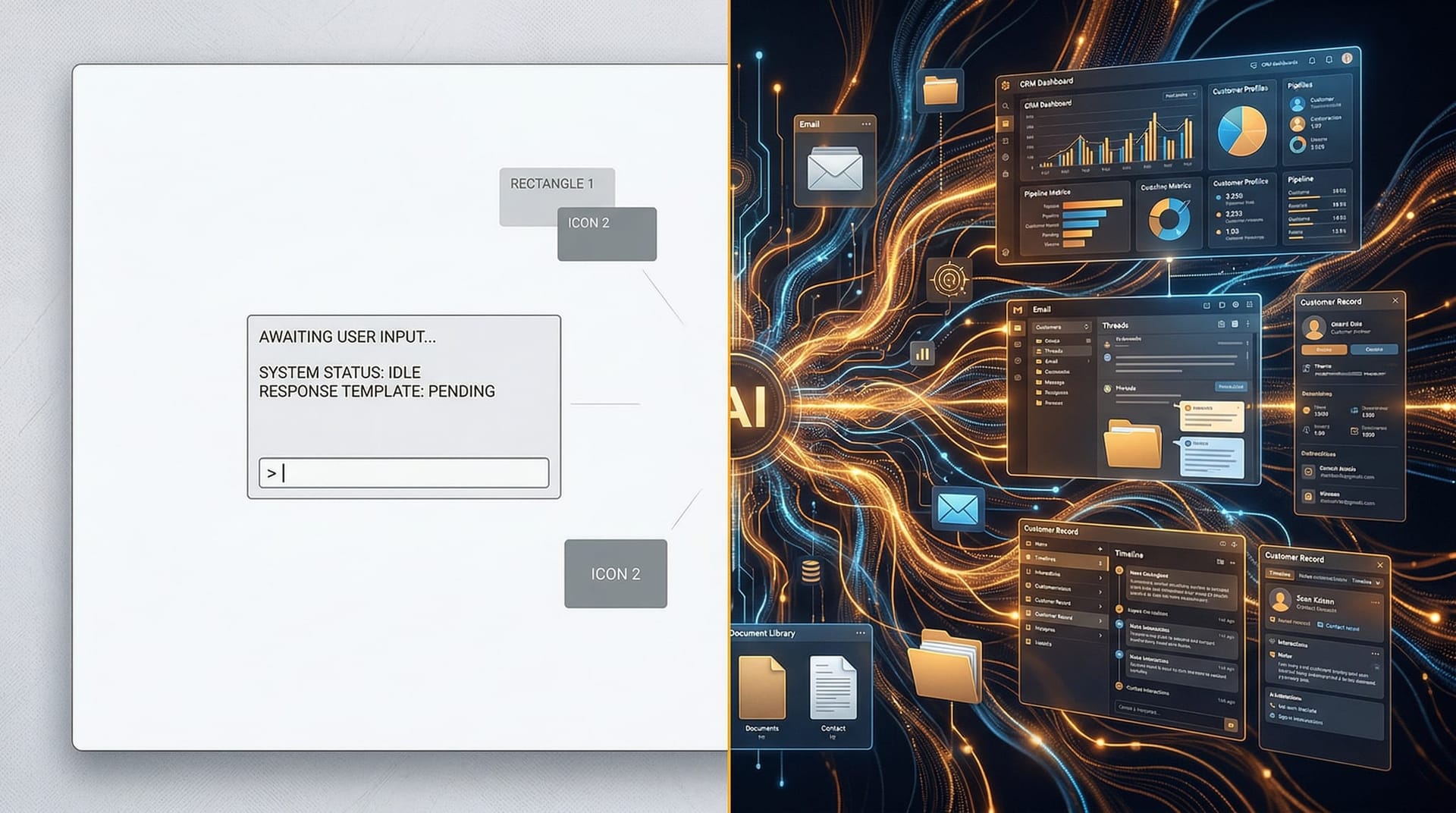
If you run a small or mid-sized business, you have almost certainly “started using AI.” Someone on your team drafts emails in ChatGPT, someone else summarizes meeting notes, and you've probably paid for a tool or two. That's the easy part — and it's also where most companies stall. The gap between touching AI and running on it is now the difference that separates the firms pulling ahead from the ones generating a lot of motion and very little leverage.
The encouraging news is that this stopped being a big-enterprise game. MIT Technology Review's recent look at how small businesses can leverage AI makes the case plainly: small businesses that can't afford specialists across accounting, design, and market research can now get “good enough” help from AI on the administrative and secretarial work that eats their week — as long as the owner is honest about where AI excels and where human expertise still has to stay in charge. That last clause is the whole game, and most of this playbook is about getting it right.
Our job at Cloud Radix is to turn that general truth into an operator's sequence: which functions a 5-to-50-person business should hand to an AI Employee first, in what order, and how to do it without the shadow-AI and credential mess that quietly sinks DIY adoption.
Key Takeaways
- “Using AI” and “leveraging AI” are different. Roughly two-thirds of small businesses use AI, but only an estimated 15–20% do so strategically with defined workflows and measured outcomes.
- Leverage means governed, sequenced, and measured. Liability means staff quietly pasting client data into personal tools your IT function can't see.
- Start where the manual cost is high and the accuracy bar is forgiving — intake, scheduling, first drafts, summaries — and keep a human checkpoint where accuracy is non-negotiable.
- The honest ROI is real but not instant: typical payback runs months, not days, and AI's “true cost” includes training and workflow time, not just the subscription.
- Smaller firms are the ones standing still in the adoption data — which is exactly why a deliberate sequence is a competitive edge in markets like Northeast Indiana.
- AI isn't always the answer. For some functions, off-the-shelf software beats a custom build, and humans should keep the wheel where mistakes are costly.
What separates AI leverage from AI liability?
Before any tool decision, draw one line: leverage versus liability. Leverage is a governed AI Employee operating defined workflows, with its access controlled and its output measured. Liability is the same capability running ungoverned — an employee pasting a client's financials into a personal chatbot because it's faster, with nobody watching what leaves the building.
That distinction isn't theoretical. The reporting on shadow-AI risk found that 31% of users get no employer training, that between a fifth and a third of workers already use AI outside the governance of the IT function, and that while about half of employees worry about accidentally leaking sensitive data, only 31% of IT leaders feel confident addressing the risk. In a small business, “the IT function” is often one overworked person or nobody at all — which means the ungoverned version is the default unless you choose otherwise. We wrote a whole field guide on this failure mode for professional firms: stop your staff from pasting client data into personal ChatGPT. The point isn't to ban AI; it's to route it through something accountable.

MIT's own guidance points the same direction. Their reporting stresses protecting sensitive information — even suggesting that for confidential work, businesses consider models that make inferences locally rather than shipping prompts to a third party — precisely because AI companies collect data and sensitive information can leak. The leverage move is to decide, deliberately, what an AI Employee is allowed to see and send before you scale it, not after an incident.
Where should a small business put AI first?
The instinct is to start with whatever's trendy. The better approach is to start where the manual cost is high and the accuracy bar is forgiving — and to keep a human checkpoint wherever a mistake is expensive. Here's the Small-Business AI Leverage Ladder we use to sequence a rollout:
| Function | Manual cost today | AI-Employee fit | First-90-days rank | Human checkpoint that stays |
|---|---|---|---|---|
| Inquiry intake & triage | High — interrupts everyone | Strong | 1 | Pricing/commitment approval |
| Scheduling & reminders | High — constant tab-switching | Strong | 2 | Conflicts and exceptions |
| Meeting notes & summaries | Medium — easily dropped | Strong | 3 | Anything client-facing before send |
| First-draft content (emails, posts) | Medium — slow to start | Strong | 4 | Final voice, claims, and facts |
| Data analysis & reporting | High — needs a specialist | Moderate | 5 | Interpretation and decisions |
| Invoicing & follow-up | Medium — leaks revenue when late | Moderate | 6 | Amounts and disputes |
| Bookkeeping & reconciliation | High — error-prone | Lower | Later | All numbers, always |
Notice the pattern: the top of the ladder is work where a draft or a first pass saves real time and a human still signs off, so an AI mistake is caught cheaply. The bottom is where accuracy is non-negotiable and AI plays a supporting role at most. This is the same discipline we describe in our back-office automation guide for small businesses — start with admin, keep judgment human. And it's why a generic chatbot underperforms a purpose-built AI Employee: the ladder isn't about a smarter model, it's about a governed worker doing a defined job in your actual systems.
What do small businesses actually do with AI today?
The data tells a consistent story about where adoption is real and where it's shallow. The U.S. Census Bureau's business data — which uses a strict “AI in production of goods or services” definition — shows national use hovering between 17% and 20%, with the smallest firms lagging hardest: fewer than 20% of firms with four or fewer employees reported using AI, and recent growth showed up only among firms with at least 20 employees. Broader self-reported surveys run much higher because they count any use at all.

When you look at what small businesses use AI for, the leverage ladder is reflected in the numbers. According to Capsule CRM's roundup of 2026 small-business AI statistics, the most common use cases cited in Thryv's research are data analysis (62%), content generation like emails and social posts (55%), and AI-powered customer engagement such as chatbots (46%), while a U.S. Chamber of Commerce figure puts AI marketing-tool use at 54%. The same roundup reports that 91% of SMBs using AI say it boosts revenue (Salesforce) and that 58% of small-business AI users save more than 20 hours a month (Thryv). Those are encouraging, but read them as adoption is easy where the work is forgiving — exactly the top rungs of the ladder.
MIT's reporting puts faces on the same pattern. They profile a London-based tutor, Sam Finnegan-Dehn, who uses Notion AI as a “second memory” — recording and summarizing client sessions with consent, turning broad goals into concrete action steps, drafting lesson notes, and generating invoices — though he candidly described some features as “clunky.” They also cite a craft retailer, Grandma's Quilt Shop in Yuma, Arizona, using an industry-specific tool called Rain that “cuts the time it takes to list items by 60 to 80%.” These aren't moonshots. They're administrative wins on the front lines of a small business — which is the whole point.

What's the honest ROI — and the honest risk?
Here's where the leverage mindset earns its keep, because the hype cycle skips the trade-offs. The upside is genuine: an analysis of 2026 AI-agent statistics reports payback periods clustering in months by use case — for example customer service around 4.1 months and marketing operations around 6.7 months — and cites McKinsey and Slack data showing knowledge workers save roughly 6.4 hours a week. Real, but measured in months, not the overnight transformation the ads imply.
The cost side is where most DIY efforts get surprised. Digital Applied's analysis is blunt: about 68% of small businesses use AI, but an estimated 77% have no AI policy, and only an estimated 15–20% are doing genuinely strategic adoption with identified workflows, trained teams, and measured outcomes. Their other honest note: the average small business spends around $2,400 a year on AI subscriptions, but the true cost lands closer to $4,000–$5,000 once you account for training time, workflow disruption, and integration upkeep. In other words, “we use ChatGPT sometimes” is not a strategy — it's an expense waiting for a workflow.
MIT adds two cautions worth internalizing. First, AI isn't always the solution: their reporting notes it's safer to use an established payment platform like Shopify or Square than to “vibe-code one using AI.” Second, keep humans where accuracy matters, because models hallucinate and make mistakes. This is the same gap between a pilot and an operating model we cover in why execution, not pilots, is the real differentiator — and it's why we push clients toward a value audit that counts dollars saved per agent, not logins. If you can't measure the hours or dollars a given AI Employee returns, you can't tell leverage from a subscription. The same logic applies to recurring per-use costs: leverage means knowing the bill before it scales, not after.
What does this look like for a Northeast Indiana business?
Translate the ladder into Allen County and DeKalb County terms. Take a 12-person home-services firm in Auburn — plumbing, HVAC, electrical. The highest-leverage first move isn't a flashy marketing bot; it's putting a governed AI Employee on intake and scheduling. When a homeowner calls or fills out a form, the AI Employee triages the request, checks the calendar, books the slot, and sends the reminder — while a human still approves pricing and handles the genuinely odd jobs. That's rungs one and two, exactly where the manual cost is highest and the accuracy bar is forgiving. For a shop that size, every missed call is often a missed job, so the leverage shows up fast: the phone gets answered after hours, the calendar stops double-booking, and the owner stops doing dispatch from the cab of a truck. None of that requires touching the parts of the business where a wrong number would cost real money.

Now take a Fort Wayne professional-services practice — an accounting firm or a small law office. Their leverage isn't on the numbers (that's the bottom of the ladder, where accuracy is everything). It's on research and first drafts: an AI Employee that pulls background, assembles a first-draft memo or client email, and summarizes long documents, with the professional reviewing every word before it goes out. The catch for these firms is confidentiality — which is precisely why the governed path matters more here than anywhere. As the Census data shows, the smaller firms across Northeast Indiana are the ones standing still while larger competitors move. A deliberate, sequenced rollout — admin first, judgment human, access governed — is how a small Auburn or Fort Wayne business turns that gap into an advantage instead of falling further behind. For owners who want the ground-floor version, our practical AI adoption playbook for Fort Wayne business owners walks through the first week.
Putting the playbook to work
You don't need a transformation initiative. You need a sequence and a checkpoint. Pick the one function at the top of your ladder where you lose the most hours to manual work and a mistake gets caught cheaply. Hand that to a governed AI Employee, decide exactly what it can see and send, measure the hours or dollars it returns in 30 days, and only then climb to the next rung. Keep a human on the wheel everywhere accuracy is the product.
Cloud Radix builds and governs AI Employees for small and mid-sized businesses across Fort Wayne and Northeast Indiana — sequenced to your actual operations, routed through a secure gateway so your client data never leaks into someone's personal chatbot, and measured so you can see the leverage instead of guessing at it. Talk to us about where to put your first AI Employee, and we'll map the ladder to your business rather than hand you another subscription.
Frequently Asked Questions
Q1.What's the difference between "using" AI and "leveraging" AI?
Using AI is ad hoc — someone drafts an email or summarizes a note when they remember to. Leveraging AI means a governed AI Employee runs a defined workflow, with controlled access and measured outcomes. The data suggests roughly two-thirds of small businesses use AI, but only an estimated 15–20% leverage it strategically, and that gap is where the competitive advantage lives.
Q2.Which function should a small business automate first?
Start where the manual cost is high and the accuracy bar is forgiving — typically inquiry intake, scheduling, meeting summaries, and first-draft content. These rungs save real hours, and because a human reviews the output, an AI mistake is caught cheaply. Save high-accuracy work like bookkeeping and reconciliation for later, in a supporting role at most.
Q3.Is AI actually worth it for a small business, or is it hype?
It's worth it when sequenced and measured. Analyses put payback in the range of months by use case, and many SMBs report meaningful time savings. But the true cost includes training and workflow time, not just the subscription — and only an estimated 15–20% of small businesses adopt strategically. Measure the hours or dollars each AI Employee returns; if you can't, you have an expense, not leverage.
Q4.What's the biggest risk when small businesses adopt AI?
Shadow AI — staff pasting sensitive or client data into ungoverned personal tools. Research shows a large share of workers use AI outside any IT oversight and get no training, while few leaders feel confident managing the risk. In a small business with little or no IT staff, that ungoverned use is the default unless you route AI through an accountable, governed path.
Q5.When is AI the wrong tool?
When accuracy is non-negotiable or a proven product already exists. MIT's reporting notes it's safer to use an established payment platform like Shopify or Square than to build one with AI, and that humans should stay in charge wherever mistakes are costly. AI is strongest as a first-pass and administrative helper, not as the final authority on money, contracts, or compliance.
Q6.How long does it take to see results?
Expect months, not days. Use-case analyses cite payback periods often in the range of a few months to under a year depending on the function, and small-business surveys report time savings building over weeks. The fastest path to results is to automate one high-cost, low-risk function, measure it for 30 days, and expand only once it's proven.
Q7.Where should a Fort Wayne or Northeast Indiana small business start?
The same place anyone should — the top of the ladder, where manual cost is high and a mistake is caught cheaply. For most Allen County and DeKalb County firms that means intake and scheduling first: a governed AI Employee that answers after-hours inquiries, books the slot, and sends reminders, while a person still approves pricing and exceptions. Start there, measure the hours it returns over 30 days, then climb to the next rung.
Sources & Further Reading
- MIT Technology Review: technologyreview.com — How small businesses can leverage AI
- Capsule CRM: capsulecrm.com — Small business AI adoption statistics for 2026
- Digital Applied: digitalapplied.com — Small Business AI Adoption: 68% Use It, Most Wing It
- U.S. Census Bureau: census.gov — AI Use at U.S. Businesses
- SaaS Ultra: saasultra.com — AI Agent Statistics 2026: Adoption Rates, ROI Data, and Which Industries Are Actually Winning
- Help Net Security: helpnetsecurity.com — Shadow AI risks deepen as 31% of users get no employer training
Put Your First AI Employee on the Right Rung
We'll map the leverage ladder to your actual operations, deploy a governed AI Employee on the highest-cost, lowest-risk function first, and measure the hours it returns — with a secure gateway so your client data never leaks into a personal chatbot.