
For thirty years, the entire logic of payment fraud detection rested on one assumption: a bot at checkout is a thief. Automated traffic hammering a payment form meant carding, credential stuffing, or scalping. So the networks trained their models — and trained them well — to see automation and slam the door.
That assumption just broke. As VentureBeat reported on July 30, 2026, Mastercard “spent decades training its fraud system to see bots as thieves” — and now, in the company's own framing, “bots are the ones doing the buying.” A legitimate AI agent placing an order for a real person looks, to a fraud engine, almost identical to the attack it was built to stop. The people who wrote those rules are now rebuilding them from the studs.
If you run a business in Northeast Indiana, this is not a Silicon Valley story you get to watch from the bleachers. Within the next 12 months, a measurable share of the transactions hitting your checkout — and a growing share of the purchasing your own team does — will be initiated by software acting on someone's behalf. This is the other side of the counter from the buyer-side agentic commerce we've covered before. It's about what changes for your payment stack, your fraud posture, and your AI Employees when the customer is code.
Key Takeaways
- The payment networks have reversed a 30-year rule: an automated agent at checkout is no longer presumed to be fraud. Mastercard, Visa, and Stripe all shipped frameworks in late 2025 to welcome legitimate buying agents.
- Merchants now face a double bind — you must accept legitimate AI agents at checkout while hardening against agent-driven fraud and deepfake payment schemes that use the same automation.
- “Agentic tokens” and cryptographic agent attestation are the new signals that separate a trusted buying agent from a malicious bot. Your fraud rules need to read them.
- Juniper Research projects agentic commerce transaction value reaching $1.5 trillion globally by 2030 — this is an infrastructure shift, not a fad.
- Your own outbound AI Employees should transact with scoped, single-purpose, revocable credentials — never a human's full payment authority.
- The right posture for a mid-market business is accept-and-verify, not block-everything — but only after a deliberate fraud-rule review.
Why Is the Payment Industry Rebuilding Itself Around AI Agents?
The short version: the money got real. Juniper Research projects that agentic commerce — transactions where an AI agent finds, compares, and pays for goods on a person's behalf — will reach $1.5 trillion in value globally by 2030, with the 2026 market still in its pilot phase. Juniper's Nick Maynard put it plainly: “Agentic commerce is all about early mover advantage, and indeed, the top players have moved quickly to build the rails needed for agentic commerce payments.”
Other forecasters land in the same neighborhood by different roads. As compiled by commercetools, Gartner predicts that by 2030, 20% of digital commerce transactions will be executed through AI platforms, while Bain & Company pegs the US agentic-commerce market at $300–500 billion by 2030 — 15–25% of total eCommerce. The exact number is a debate; the direction is not. A meaningful slice of buying is moving to software.
That created a problem the networks had to solve fast. Their fraud systems were purpose-built to treat automation as hostile. When Mastercard completed its first live agentic payment transaction — an AI agent purchasing a product with a tokenized credential — the company had to answer a question it had spent decades answering the opposite way: how do you let a bot buy something and keep blocking the bots that steal?
The result is a genuinely new layer of payments infrastructure, and it arrived in a matter of months. This is the merchant-and-authorization facet of a story whose buyer side we mapped in our 2026 mid-market agentic commerce playbook on intent contracts. The intent-contract piece is about how the buyer's agent proves what it was told to do. This piece is about what happens when that agent arrives at your door.

What Actually Changes for Your Payment Stack and Fraud Rules When Agents Buy?
Start with the uncomfortable truth: an “agent-present” transaction breaks several assumptions your fraud tooling quietly depends on. Traditional fraud scoring leans on device fingerprints, behavioral biometrics (how a human moves a mouse, the cadence of typing), session velocity, and IP reputation. An AI agent has none of the human tells, moves at machine speed, and may run from a data center IP that your rules already distrust.
Here's what shifts, concretely, for a mid-market business:
| Fraud signal (human era) | What breaks with agents | What replaces it |
|---|---|---|
| Mouse/keystroke behavioral biometrics | Agents have no human motion to measure | Cryptographic agent attestation + verified intent |
| Velocity limits (“too fast = bot”) | Legitimate agents are fast by design | Scoped token limits (per-agent caps, time windows) |
| Device fingerprint continuity | Agent runs server-side, not on a known device | Agent identity bound to the token and issuer |
| IP reputation (data-center = suspicious) | Agents run from cloud infrastructure | Network-signed agent authorization metadata |
| “One card, one person” heuristics | One card may back many agent tokens | Per-agent tokens with independent scope and revocation |

The strategic error to avoid is over-correcting in either direction. Block all automation and you turn away real customers whose agents are shopping with money in hand. Accept all automation and you re-open the front door to exactly the fraud your rules were built to stop. The networks' answer — and the one your payment processor will increasingly expose to you — is to stop scoring automation and start scoring authorization: not “is this a bot?” but “is this bot allowed to spend this money, here, now?”
That reframing is the same principle we've argued for on the deployment side in our breakdown of why the agent control plane is the new buying decision. Whether an agent is buying from you or acting for you, the control question is identical: what is it permitted to do, and can you prove it.
How Do You Tell a Legitimate Buying Agent From a Malicious Bot?
This is where the new frameworks earn their keep, and it's worth understanding the mechanics because your processor's settings will be built on them.
Mastercard's approach centers on what it calls agentic tokens. In Mastercard's agentic-commerce framework, tokenization is extended so a single card can issue a distinct token per agent — one for a ChatGPT-based shopper, one for a different assistant — with scope set at issuance: category limits (“groceries only”), spending caps (“$500 monthly”), and time windows (“weekdays only”). Every AI assistant must be explicitly authorized and cryptographically attested so each party in the payment chain can distinguish a legitimate agent from a random bot. The network enriches the transaction with metadata for fraud detection, and the issuer authorizes against those controls.
Visa's approach is the Trusted Agent Protocol, launched October 14, 2025 with feedback from 12 early partners including Adyen, Ant International, Checkout.com, Coinbase, CyberSource, Elavon, Fiserv, Microsoft, Nuvei, Shopify, Stripe, and Worldpay. It uses agent-specific cryptographic signatures and carries three data elements to the merchant: Agent Intent (a trusted agent with genuine purchase intent), Consumer Recognition (whether the shopper has an existing account), and Payment Information. The whole point, in the words of Visa Chief Product and Strategy Officer Jack Forestell, is that “the entire payments ecosystem has a responsibility to ensure sellers can trust AI agents as much as they trust their best customers and networks.” The protocol is explicitly designed to help merchants recognize trusted agents so they stop reflexively blocking legitimate agentic checkout.
Stripe's approach packages this for businesses that don't want to wire up each network by hand. Its Agentic Commerce Suite, launched December 11, 2025, lets a merchant sell across multiple AI shopping platforms through a single integration. The core primitive is the Shared Payment Token: a credential an agent can use to pay without ever seeing the underlying card, programmable so it can be scoped to a specific business, limited by time or amount, revoked at any moment, and monitored through webhook events. Because the charge settles on Stripe's normal payments rails, a merchant's existing Stripe fraud tooling still applies.
Notice the common thread across all three: identity and scope replace “is it automated.” The token is the authorization. This is the same credential-isolation logic we've argued is foundational for any AI agent, which we detailed in zero-trust AI agents and why credential isolation matters. The payment networks have now made it a standard.

The Double Bind: Welcoming Buying Agents While Hardening Against Agent-Driven Fraud
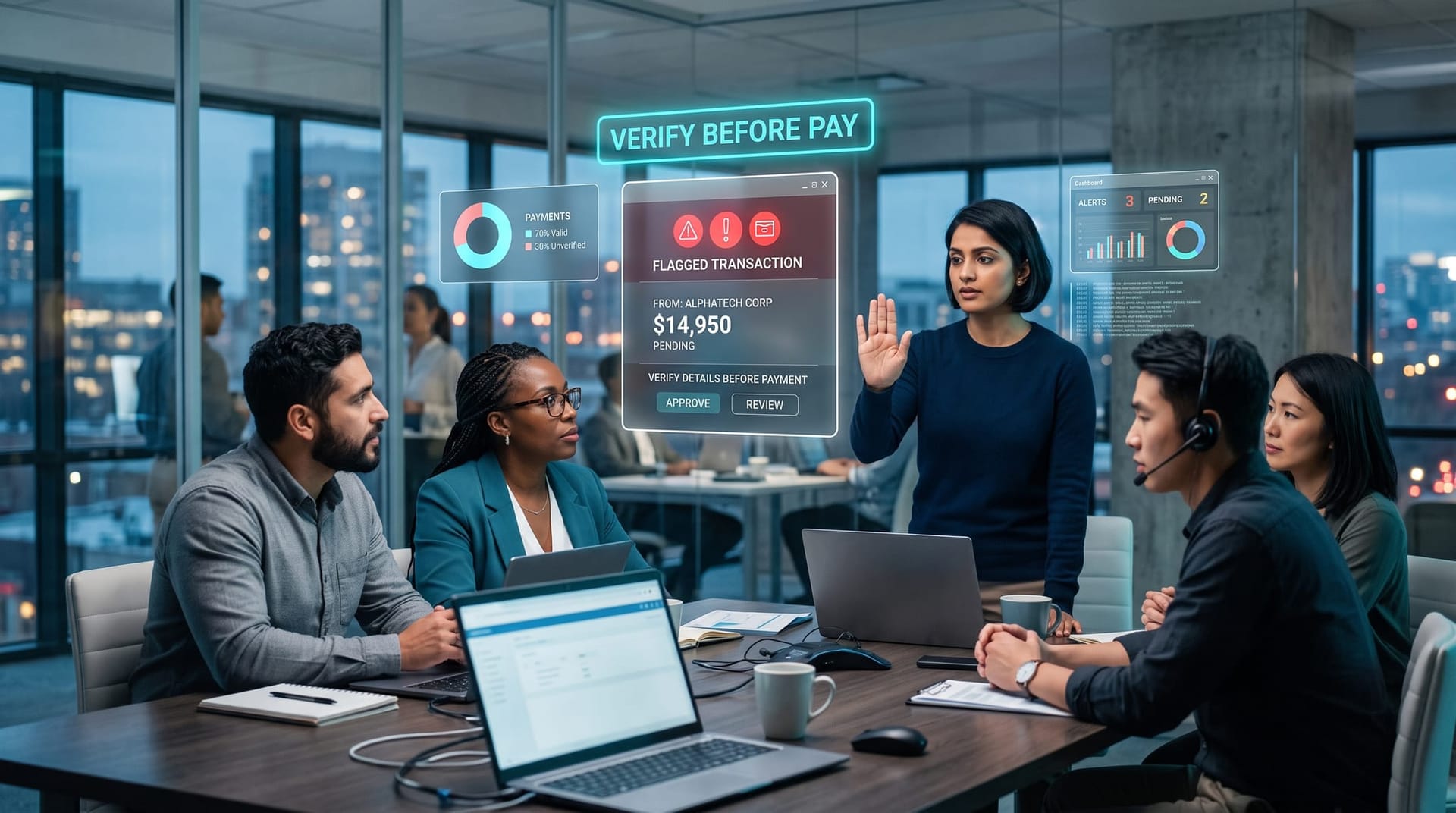
Here is the trap. The same capabilities that make a legitimate buying agent useful — it acts autonomously, at scale, using stored credentials — describe an attacker's dream tool almost word for word. And the financial-services industry knows it.
According to Accenture figures compiled in the same commercetools guide, 78% of financial institutions expect increased fraud linked to AI agents, and 87% of CTOs and payments leaders believe trust is the primary barrier to adopting agentic payments. That is not the profile of a technology everyone is comfortable with. It's the profile of an inevitability everyone is nervously preparing for.
For a mid-market business, the agent-driven threat shows up in two shapes:
- Inbound fraud that hides inside legitimate agent traffic. As agent checkouts become normal, “automation” stops being a reliable red flag. A misconfigured or hijacked agent, or a malicious one wearing a stolen token, can transact at machine scale before a human notices. Your fraud rules can no longer lean on “it's a bot” as the tell.
- Outbound social-engineering and deepfake schemes aimed at your team. The bigger near-term danger for many Indiana businesses isn't a rogue shopper — it's a synthetic voice or video instructing your accounts-payable clerk to approve a wire. We laid out the local version of this threat in the Fort Wayne deepfake business crisis playbook, and agentic payments raise the stakes: when machines are supposed to move money automatically, a fraudulent instruction has more cover to hide in.
The underlying vulnerability beneath both is ungoverned access — agents, tools, and integrations that can touch money or data without anyone having decided, in advance, exactly what they're allowed to do. That's the same root cause we've flagged repeatedly in our work on why shadow AI is your biggest data risk in 2026. Agentic payments don't create the governance gap; they make it expensive.
How Should Your Own AI Employees Transact? Scoped Credentials, Not Your Credit Card
So far we've talked about agents buying from you. Now flip it. If you deploy AI Employees — autonomous agents that research vendors, restock supplies, book services, or pay for tools — those agents need to buy things too. The wrong way to enable that is the way most people reach for first: hand the agent a corporate card number, or log it into a human's account with full authority.
Don't. An AI Employee with a human's complete payment authority is a single compromised prompt away from being a very efficient thief. The entire lesson of the networks' 2025 pivot is that the safe unit of trust is a scoped, attested, revocable credential — not a raw card number.
In practice, giving your own AI Employees a governed way to buy means:
- Single-purpose credentials. Each agent gets its own token or virtual card, scoped to a category, a vendor list, a spend cap, and a time window — the same primitives Mastercard, Visa, and Stripe now expose. If the agent only needs to buy software subscriptions under $200/month, that's all its credential can do.
- A gateway between the agent and the money. Rather than embedding secrets in the agent, route every transaction through a control layer that enforces policy, checks the request against what the agent was authorized to do, and logs it. This is the Secure AI Gateway model, and it's the outbound mirror of the inbound attestation the networks are building.
- Full auditability. Every agent-initiated purchase should produce a durable record: which agent, on whose authority, for what, under which limit. When something looks wrong, you can answer “what did it buy and why” in seconds, not days.
- Instant revocation. A scoped token you can kill in one click is the difference between a contained incident and a runaway one.
This is not exotic. It's the exact principle the payment networks just adopted, applied to your side of the ledger: never issue full authority when scoped authority will do.

What Northeast Indiana Businesses Should Do in the Next 12 Months
For business owners in Fort Wayne, Auburn, and across DeKalb and Allen counties, agentic payments will arrive quietly — as a processor update, a new checkbox in your Stripe or Square dashboard, a customer whose “assistant” placed the order. Here's a grounded 12-month posture rather than a panic.
Retail and eCommerce: Decide your accept-versus-block stance deliberately, not by default. If your payment provider rolls out agent-checkout support (Square and Stripe are moving fast — we covered a concrete local case in how Square lets Fort Wayne restaurants take orders inside ChatGPT), understand it before you toggle it. Turning it on can open a new sales channel; leaving your old bot-blocking rules untouched can silently reject those same customers.
Financial and professional services: Run a fraud-rule review this year. Ask your processor and bank point-blank how they distinguish a trusted agent from a malicious bot, and whether your current rules will reject legitimate agent transactions. Update your wire-approval process to assume synthetic voice and video are now cheap.
Home services and trades: You're more likely to use buying agents than receive them soon — an AI Employee that reorders parts or books subcontractors. Give it scoped credentials from day one.
The common move across all four: don't let agentic payments happen to your business. Decide your posture, review your fraud rules, and give any AI that spends money on your behalf a governed, auditable, single-purpose way to do it.
Bring AI Employees Into Your Business — With Guardrails Built In
The businesses that win the next two years won't be the ones that block every bot or the ones that trust every bot. They'll be the ones that can tell the difference — and that give their own AI Employees the scoped, auditable authority to act without handing over the keys to the vault.
That's exactly what we build at Cloud Radix. Our AI Employees come with credential isolation, policy enforcement, and full audit logging as standard equipment, not afterthoughts — so an agent can research, transact, and operate at machine speed while you keep human-grade control. If you're a Northeast Indiana business trying to figure out your accept-versus-block posture or how to let an AI Employee buy safely, let's map it to your actual payment stack. Talk to us about deploying AI Employees that give your team superpowers without giving up governance.
Frequently Asked Questions
Q1.Are AI agents at checkout considered fraud?
Not anymore. For decades, payment fraud systems treated automated checkout as presumptively fraudulent, but as of late 2025 the major networks reversed that stance. Mastercard, Visa, and Stripe all launched frameworks — agentic tokens, the Trusted Agent Protocol, and Shared Payment Tokens — specifically so merchants can accept legitimate AI buying agents while still blocking malicious bots. The distinction is now based on cryptographic authorization, not on whether the buyer is automated.
Q2.How do payment systems tell a legitimate AI agent from a malicious bot?
Through agent identity and scoped authorization rather than behavior alone. Legitimate agents carry cryptographically signed tokens that prove which agent is acting, on whose authority, and within what limits (spend caps, categories, time windows). Visa's Trusted Agent Protocol, for example, passes "Agent Intent," "Consumer Recognition," and payment data to the merchant. A malicious bot can't produce a valid, network-attested agentic token, which is what lets merchants recognize trusted agents and avoid blocking real customers.
Q3.Should my business accept payments from AI shopping agents?
For most merchants the emerging best practice is accept-and-verify rather than block-everything — but only after a deliberate fraud-rule review. Accepting agent checkout can open a new sales channel as tools like ChatGPT and shopping assistants place orders, but your existing bot-blocking rules may reject those legitimate transactions. Talk to your payment processor about their agentic-commerce support and confirm your fraud settings won't turn away real customers whose agents are buying on their behalf.
Q4.How big is agentic commerce actually going to get?
Forecasts vary in scale but agree on direction. Juniper Research projects $1.5 trillion in agentic commerce transaction value globally by 2030, while Gartner predicts 20% of digital commerce transactions will run through AI platforms and Bain & Company estimates a $300–500 billion US market by that year. The 2026 market is still largely in pilots, which makes this the preparation window rather than the panic window.
Q5.How should my company's own AI Employees make purchases safely?
Never give an AI agent a human's full payment authority or a raw corporate card number. Instead, issue each agent a scoped, single-purpose credential — limited by vendor, category, amount, and time — routed through a control layer (a Secure AI Gateway) that enforces policy, logs every transaction, and can be revoked instantly. This mirrors the exact tokenization approach the payment networks adopted in 2025 and keeps a compromised agent from becoming a costly one.
Q6.What is the biggest agentic-payment risk for a Fort Wayne or Northeast Indiana business?
For most small and mid-sized businesses in the region the near-term danger isn't a rogue shopping agent — it's social engineering that hides inside newly-automated money movement, including deepfake voice or video instructing staff to approve payments. Because machines are now expected to move money automatically, fraudulent instructions have more cover. Tightening wire-approval processes and assuming synthetic media is cheap are practical first steps for any Allen or DeKalb County operation.
Q7.Do I need new technology to prepare for agentic payments?
Not necessarily new payment hardware, but you do need to review and possibly reconfigure what you already have. Confirm whether your processor (Stripe, Square, or your bank) supports agentic tokens and how its fraud rules treat agent traffic. If you deploy AI Employees that spend money, you'll want credential-isolation and audit tooling in place before, not after, they start transacting.
Sources & Further Reading
- VentureBeat: venturebeat.com/security — Mastercard Spent Decades Training Its Fraud System to See Bots as Thieves. Now Bots Are the Ones Doing the Buying.
- Mastercard: mastercard.com/us/en/news-and-trends — Agentic token framework: Driving trusted AI transactions.
- Visa: investor.visa.com/news — Visa Introduces Trusted Agent Protocol: An Ecosystem-Led Framework for AI Commerce.
- Juniper Research: juniperresearch.com/press — Agentic Commerce Set to Generate $1.5 Trillion Globally by 2030, as Payments Infrastructure Leaders Revealed.
- Stripe: stripe.com/newsroom/news — Stripe launches the Agentic Commerce Suite to help every business thrive in the AI-enabled commerce era.
- Stripe Documentation: docs.stripe.com/agentic-commerce — Shared payment tokens.
- commercetools: commercetools.com/blog — Agentic Commerce Stats 2026: Enterprise Guide.
Ready to Let AI Employees Spend Safely?
We'll help your Northeast Indiana business set an accept-versus-block posture for buying agents and deploy AI Employees with credential isolation, policy enforcement, and full audit logging built in.
Schedule a Free ConsultationNo contracts. No pressure. Just an honest conversation about agentic payments and AI Employees.