For two years, the mental model for “AI at work” has been a chat box. You type a request, you wait, you read the answer, you type again. Every product demo, every screenshot, every training session reinforced it: AI is a thing you talk to.
On September 13, 2026, AWS quietly retired that model. It open-sourced Pizza Bot — described by MarkTechPost's coverage as “an open source inbox for AI agents that work in the background.” The tool had already been running inside Amazon, where earlier versions served more than 2,000 employees on tasks like meeting prep, email drafting, Slack summaries, CRM logging, and research. The interface isn't a chat window. It's an inbox — the same three-lane triage surface you already use for email.
That shift matters more than any single feature, and it lands squarely on what a business should actually be asking in 2026. The question is no longer “can AI draft the follow-up, prep the meeting, log the CRM note, summarize the thread?” The Amazon use-cases prove it can. The real question is operational: how does your team review and govern a fleet of background workers whose output shows up while everyone's doing something else? This is the operating model behind an AI Employees program, and Pizza Bot is the clearest public blueprint of it we've seen. Below, we translate its design into a vendor-neutral playbook any mid-market team can adopt — regardless of which tools you run.
Key Takeaways
- AWS open-sourced Pizza Bot (Apache 2.0), reframing AI work from a chat box you watch to an inbox you triage — with All, Unread, and Action lanes.
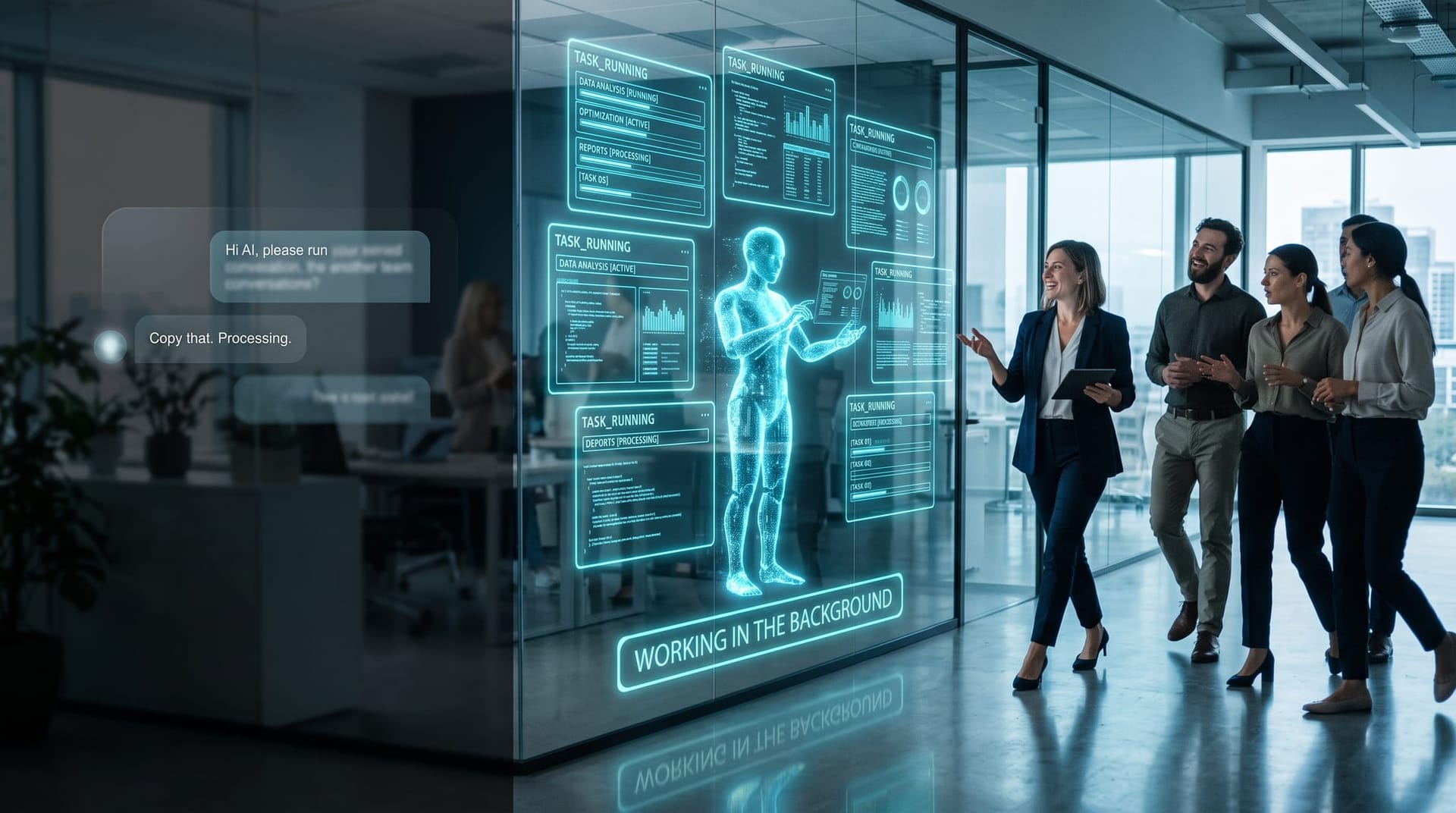
- Background agents run manually, on a cron schedule, or via webhook, and keep working after you disconnect — so the design problem shifts from “prompting” to reviewing.
- The durable pattern is a review queue plus an approval-tier policy: auto-run low-risk tools, require a human to approve anything that writes to a system of record or spends money.
- Adoption is outrunning governance — Deloitte finds most organizations still lack a mature model for controlling autonomous agents — which makes the review interface the part you can't skip.
- For lean Northeast Indiana teams, a governed inbox is what makes an AI Employee safe to actually turn on — and it's the sanctioned home that pulls work out of shadow AI.
What Did AWS Actually Release with “Pizza Bot”?
Strip away the odd name and Pizza Bot is a self-hosted application that lets AI agents do work in the background and surface the results for a human to review. According to the AWS Open Source Blog, it started as an internal Amazon side project — a CRM-logging bot that grew to more than 30 contributors and over 2,000 internal users before being released to the community under the Apache 2.0 license. Worth noting up front, and to AWS's credit they say so plainly: it's a community project, not a managed AWS service. There's no support commitment and no SLA. If you run it, you own operating, securing, backing up, and updating it.
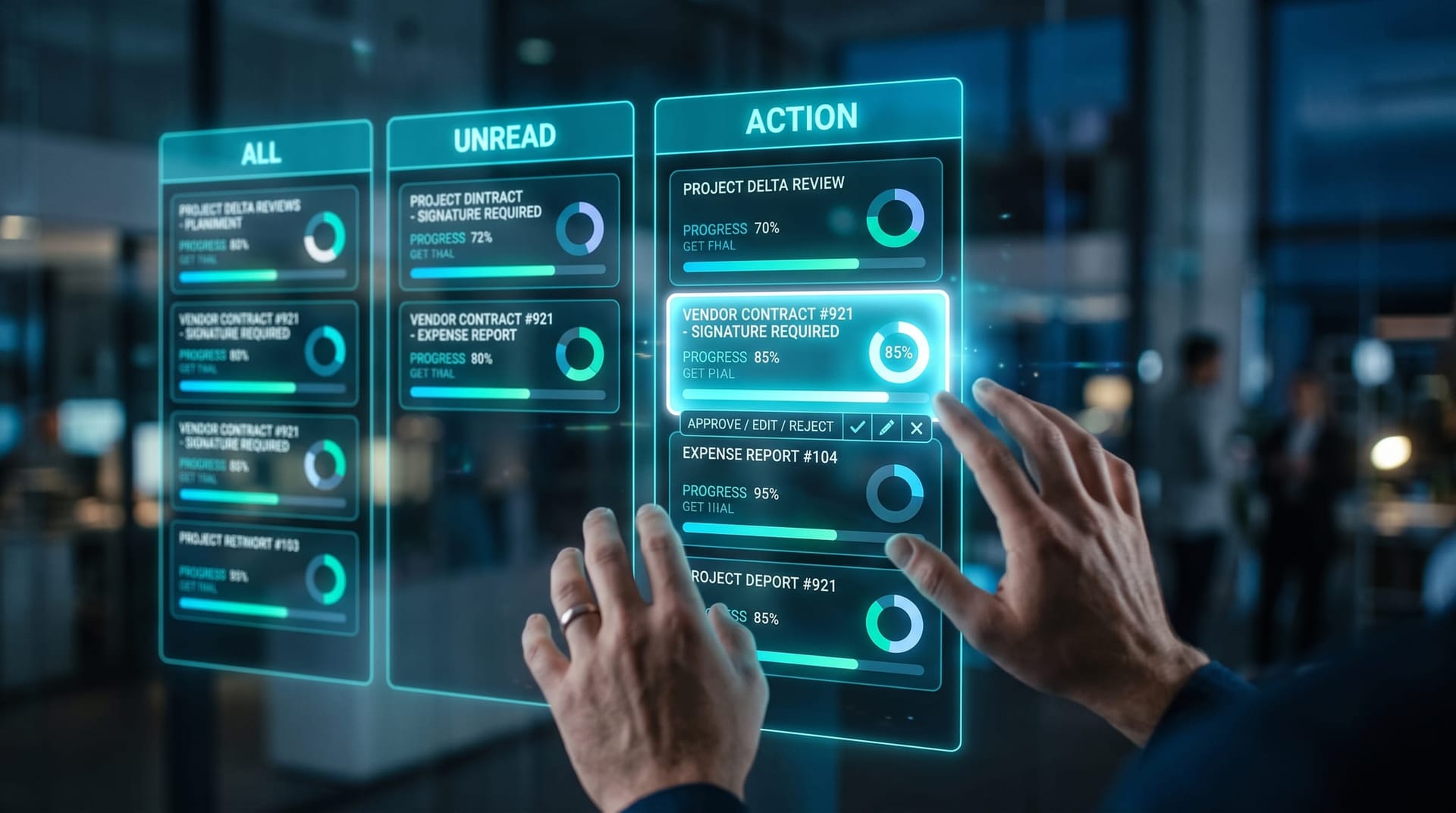
The mechanics are what make it interesting. Tasks can be kicked off three ways — manually, on a cron schedule, or by webhook — and they keep running after you close the app. Finished and in-progress work lands in three lanes you triage like email:
- All — the full thread history of everything an agent has done.
- Unread — completed work waiting for you to look at it.
- Action — work the agent paused because it needs your approval or input before it continues.
That last lane is the whole ballgame. For each tool an agent can use, you set a policy — configured through settings the project calls interruptOn and allowedDecisions — that determines whether a proposed action runs automatically or stops for a human. When it stops, you can approve it, edit the arguments before it runs, or reject it outright. That is a working, per-tool, human-in-the-loop control surface, shipped as open source, and it's the piece most mid-market AI deployments are missing.
Why Is an Inbox a Better Interface Than a Chat Box?
A chat box assumes you're present. It's synchronous: the agent waits for you, and you wait for it. That's fine for a one-off question and terrible for delegated work, because delegated work is asynchronous by nature — you hand it off precisely so you can go do something else. This is the same argument we made about the end of the chatbot era: the paradigm is shifting away from a conversation you have to babysit. Pizza Bot is the concrete operating mechanism that shift produces.
The difference isn't cosmetic. It changes throughput, oversight, and auditability all at once:
| Dimension | Chat box (synchronous) | Background inbox (asynchronous) |
|---|---|---|
| Latency model | You wait for the agent; the agent waits for you | Work runs while you're elsewhere; results queue up |
| Oversight model | Read every reply in real time as it streams | Triage a queue — glance at “done,” decide on “blocked” |
| Throughput | One conversation at a time, at human reading speed | Many tasks in parallel, on schedules and triggers |
| Audit trail | Scattered across chat sessions | One thread history per task, with approval decisions logged |
| Best-fit tasks | Quick questions, brainstorming, iteration | Recurring prep, drafting, logging, summarizing, research |
The reason this is urgent rather than merely elegant: adoption is sprinting ahead of control. In its 2026 State of AI in the Enterprise research, Deloitte's research reports that 74% of respondents expect their organizations to be using AI agents at least “moderately” by 2027, yet only 21% say they have a mature governance model in place for agentic AI. That gap — roughly four in five organizations scaling agents without mature oversight — is exactly the space a review-queue interface is built to close. The inbox isn't a nicer front end. It's where governance actually happens.
How Should Your Team Review a Fleet of Background Workers?
Here's the honest part: once you have several agents producing work in the background, “review” stops being a vague good intention and becomes a real operational discipline. You need a queue, and you need rules for what gets to run without you. Translating Pizza Bot's design into a vendor-neutral playbook, four practices carry over regardless of tooling.
1. Triage the queue like email. Separate “done, needs a glance” from “blocked, needs a decision.” The Unread lane is a scan; the Action lane is where your judgment is required. Most teams drown because they treat every agent output as equally urgent. It isn't. Clear Unread quickly; spend your attention on Action.
2. Set approval tiers by blast radius. Not every action deserves the same scrutiny. Auto-run genuinely low-risk, read-only tools — summarizing a thread, drafting text you'll review anyway, pulling research. Require a human to approve anything that writes to a system of record (your CRM, your accounting software, your ticketing system) or spends money or sends an external message. This mirrors how you'd onboard a new hire: trust grows with the reversibility of the task.
3. Decide when the agent should escalate — before it does. An approval tier is only as good as the trigger that fires it. We've written a full framework on when an AI Employee should stop and ask a human; the short version is that agents should look up on approval-required actions, on tasks outside their competence, on unusual variance, and on anything genuinely consequential. The Action lane is the queue those escalations flow into.
4. Distinguish the human interface from the machine one. This is where Pizza Bot is easy to misread. A supervisor layer over your agents is machine-to-machine — one agent overseeing others, catching errors programmatically. The inbox is person-to-fleet — the surface where you review and approve. You want both. The manager agent handles the checks a computer does well; the inbox handles the judgment calls a computer shouldn't make alone.
There's strong evidence this is where the market is heading. In its State of AI 2026 report, AvePoint's research found that 95.5% of organizations took at least one action to mitigate agent-related security risk after an incident — and adding human-in-the-loop controls was the most common response. Teams are learning, often the hard way, that the checkpoint before an action executes is the control that matters.

How Do You Keep Background Agents From Getting Locked to One Vendor?
A quiet but important part of the Pizza Bot design is portability. It runs on Amazon Bedrock, Anthropic, Google Gemini, OpenAI, OpenRouter, or a local Ollama model — and it reaches external tools through the Model Context Protocol (MCP), the open standard for connecting AI applications to data sources and tools, plus a sandboxed interpreter that has no network or filesystem access. State and data stay on infrastructure you control.
For a mid-market business, that posture is the whole point of doing this deliberately instead of accidentally. If your background workers are wired to exactly one model provider through a proprietary interface, you've traded a staffing dependency for a vendor dependency — and given up your leverage on price and continuity. Model- and tool-portability means you can swap the underlying model when a cheaper or better one ships, keep your data under your own roof, and route everything through one controlled path. That's the same discipline behind putting a gateway in front of your agents so you can cap runaway agent costs with a gateway and enforce policy in one place rather than reconfiguring five tools by hand.
One more design detail worth stealing: resumable, checkpointed work. Pizza Bot uses stateful execution (built on DeepAgents and LangGraph) so a half-finished task survives a restart, and — a small but telling choice — after downtime, missed cron intervals produce a single catch-up run instead of replaying every missed interval. A background workforce that floods you with duplicate work after an outage isn't leverage; it's a mess. Sane recovery behavior is part of what “production-ready” means.
What Are the Honest Limitations of the Inbox Model?
We recommend the background-inbox operating model, but it isn't free and it isn't magic. Being clear-eyed about the trade-offs is how you avoid the disappointment cycle.
First, self-hosting is real work. Because Pizza Bot ships without a managed service or SLA, someone on your side is responsible for running, patching, and securing it. For many small teams, that argues for a partner who operates the stack for you rather than a DIY deployment you can't maintain.
Second, an inbox can become a rubber stamp. If every low-value action lands in the Action lane, people start approving without reading — the opposite of oversight. Approval tiers exist precisely to keep the Action lane small and meaningful. Tune them, or the queue becomes theater.
Third, background autonomy raises the stakes on getting escalation right. An agent working while you sleep can do a lot of good and, if mis-scoped, a lot of quiet damage before anyone looks. That's why the same care you'd apply to a new employee's permissions applies here, and why you should keep human oversight after your AI makes a mistake rather than assuming the queue caught everything.
What Does the Background-Inbox Model Mean for a Fort Wayne Business?
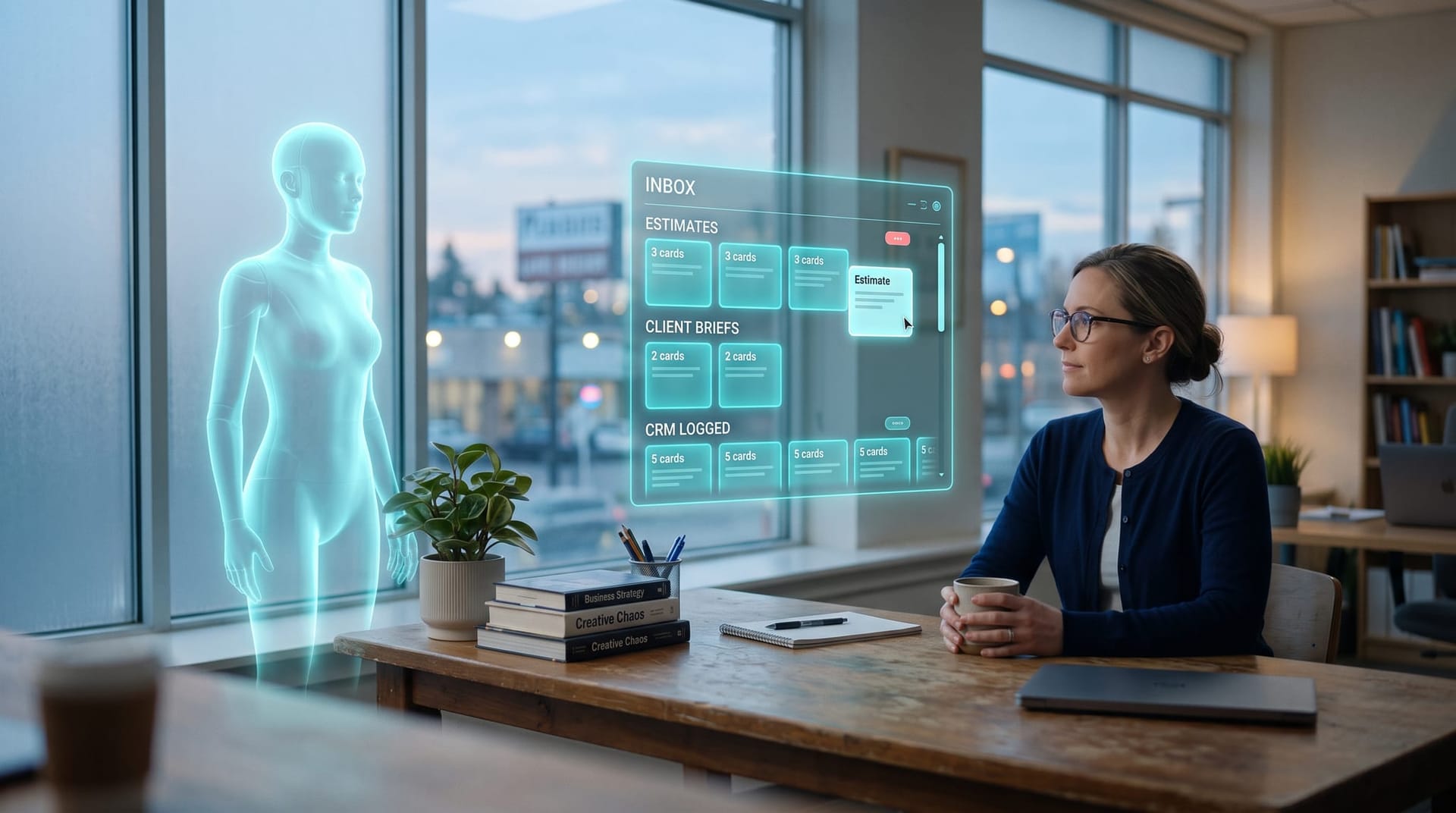
For a Fort Wayne or Northeast Indiana business — a professional-services firm, a manufacturer's back office, a home-services company, a DeKalb or Allen County SMB — the background-inbox model is what makes an AI Employee safe to actually turn on. A four-person office cannot watch a chat window all day. But it can clear an “Unread / Action” queue the way it already clears email: approve the drafted follow-ups over morning coffee, reject the one that misread a customer, edit the CRM note before it's saved.
Picture the concrete version. Overnight, an AI Employee preps tomorrow's estimates, drafts client-meeting briefs, and logs yesterday's calls to the CRM. By the time the owner sits down with coffee, the Unread lane holds finished work to skim and the Action lane holds three decisions that actually need a person. Fifteen minutes of triage replaces an hour of doing — and nothing hit a system of record without a human's nod. That's the review-queue-plus-approval-tier discipline behind our Fort Wayne AI Employees service, built for teams that don't have a spare person to babysit automation.
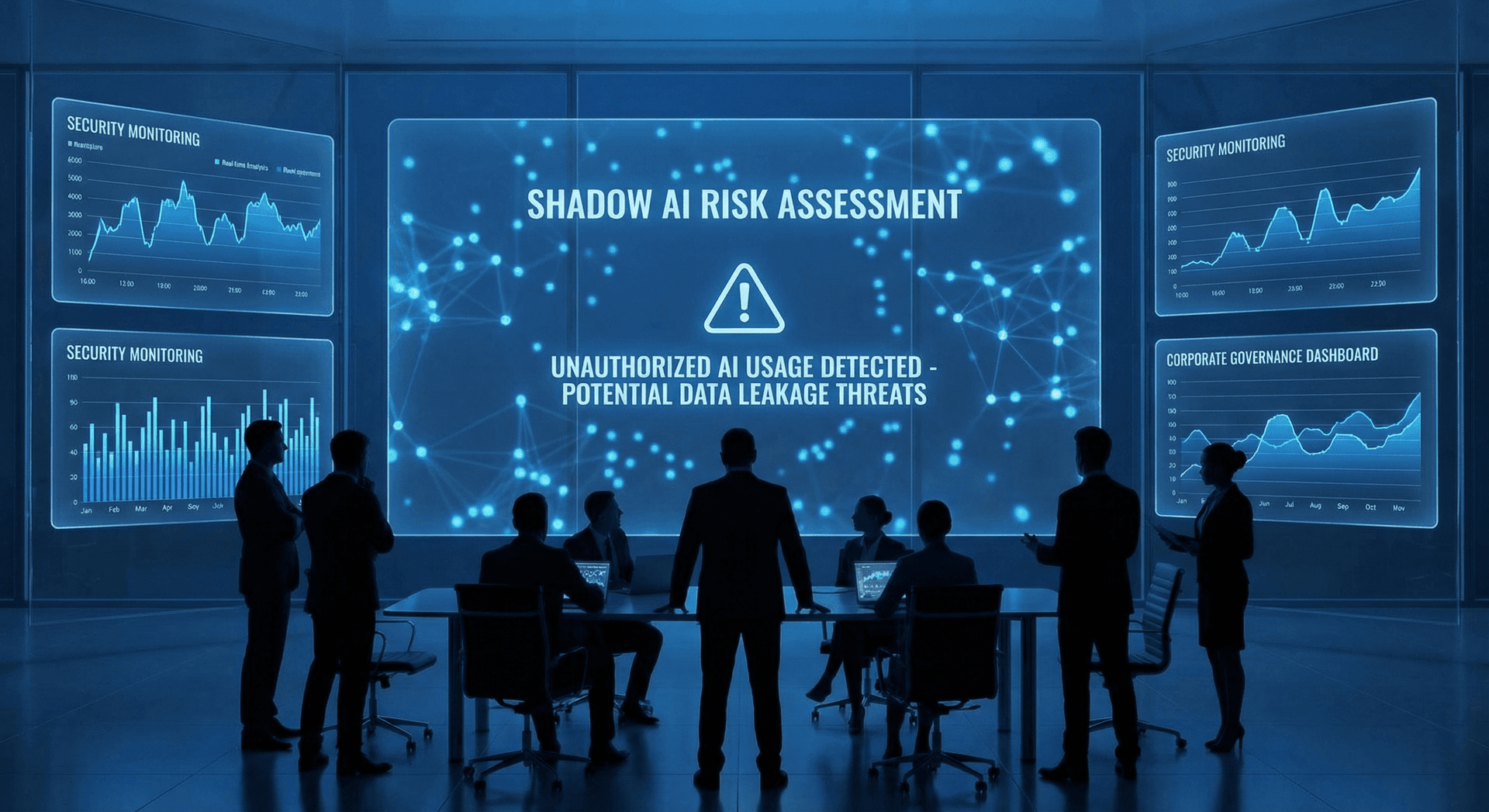
There's a shadow-AI payoff too. Right now, staff at plenty of local firms paste work into personal chatbots because there's no sanctioned place for AI output — and the numbers back that up. In one shadow-AI data roundup, Airia's research cites Microsoft's finding that 78% of workplace AI users bring their own tools outside IT approval, and Salesforce's that 27% of employees have entered confidential company data into public AI tools. A governed inbox is the sanctioned place — the one destination where AI work is produced, reviewed, and logged under your control instead of leaking into consumer apps you can't see.
Turn On AI Employees You Can Actually Govern
The lesson from Pizza Bot isn't “adopt this specific tool.” It's that the interface for delegated AI work has matured from a chat box you babysit to an inbox you govern — and that the review queue and approval tiers are the part you can't skip. If you've been waiting to deploy AI because you couldn't see how you'd keep it in bounds, this is the model that answers the question.
Cloud Radix builds AI Employees for mid-market businesses with the review queue and approval-tier discipline built in from day one — vendor-neutral, with your data under your control. If you want to see what a governed background workforce looks like for your team, let's map your first two or three delegated workflows and the approval tiers that keep them safe.
Frequently Asked Questions
Q1.What is AWS Pizza Bot?
Pizza Bot is an open-source (Apache 2.0), self-hosted application AWS released on September 13, 2026 that lets AI agents work in the background and surface their results in an email-style inbox. It began as an internal Amazon tool used by more than 2,000 employees for tasks like meeting prep, email drafting, and CRM logging. It is a community project, not a managed AWS service, so there is no support SLA.
Q2.How is a background AI inbox different from a chatbot?
A chatbot is synchronous — you type, you wait, you read, one exchange at a time. A background inbox is asynchronous: agents run on schedules, triggers, or manual starts and keep working after you disconnect, then queue finished work and pending decisions for you to triage. The inbox model handles many parallel tasks and produces a per-task audit trail, which a chat window does not.
Q3.What is a review queue and approval tier for AI agents?
A review queue is the interface where a fleet of AI agents delivers completed work and flags actions that need a human decision. Approval tiers are the rules that decide which actions run automatically and which pause for approval — typically auto-running low-risk read-only tasks while requiring a human to approve anything that writes to a system of record, sends an external message, or spends money.
Q4.Do I need human approval for every AI agent action?
No — and requiring it for everything usually backfires, because people start approving without reading. The goal is to size approval to the blast radius of the action: let genuinely low-risk, reversible actions run automatically, and reserve human approval for consequential or hard-to-reverse ones. That keeps the “needs a decision” queue small enough that each item actually gets attention.
Q5.Can background AI agents work with different AI models?
Yes. Tools like Pizza Bot are designed to run across multiple providers — Amazon Bedrock, Anthropic, Google Gemini, OpenAI, OpenRouter, or a local Ollama model — and to reach external tools through the open Model Context Protocol. That portability lets a business switch the underlying model as prices and capabilities change, and keep its data on infrastructure it controls rather than locked to one vendor.
Q6.How can a small Fort Wayne business use background AI agents safely?
Start with two or three recurring, low-risk workflows — overnight meeting prep, follow-up drafting, CRM logging — and run them through a review queue with clear approval tiers so nothing touches a system of record without a human's nod. For lean Northeast Indiana teams, that triage-over-coffee model replaces hours of manual work while keeping oversight intact, and it gives staff a sanctioned place for AI output instead of pasting company data into personal chatbots.
Sources & Further Reading
- MarkTechPost (Michal Sutter): marktechpost.com/2026/09/13/aws-introduces-pizza-bot — AWS Introduces Pizza Bot: An Open Source Inbox for Background AI Agents.
- AWS Open Source Blog: aws.amazon.com/blogs/opensource/introducing-pizza-bot — Introducing Pizza Bot, an open source inbox for AI agents that work in the background.
- Deloitte (State of AI in the Enterprise, 2026): deloitte.com/us/en/insights/topics/emerging-technologies/ai-agents-scaling-faster — Agentic AI is scaling faster than guardrails.
- AvePoint (State of AI 2026 Report): avepoint.com/blog/strategy-blog/human-in-the-loop-ai — Human-in-the-Loop AI: When (and Why) Machines Still Need a Person.
- Airia: airia.com/blog/shadow-ai-statistics-key-data-points-every-ciso-needs-in-2026 — Shadow AI Statistics: Key Data Points Every CISO Needs in 2026.
- Model Context Protocol: modelcontextprotocol.io/introduction — What is the Model Context Protocol (MCP)?
Turn On a Governed AI Workforce
We'll map your first two or three delegated workflows, set the approval tiers that keep them safe, and stand up a review queue your team can actually run — vendor-neutral, with your data under your control.
Schedule a Free ConsultationNo contracts. No pressure. Just an honest conversation about what would help your business.