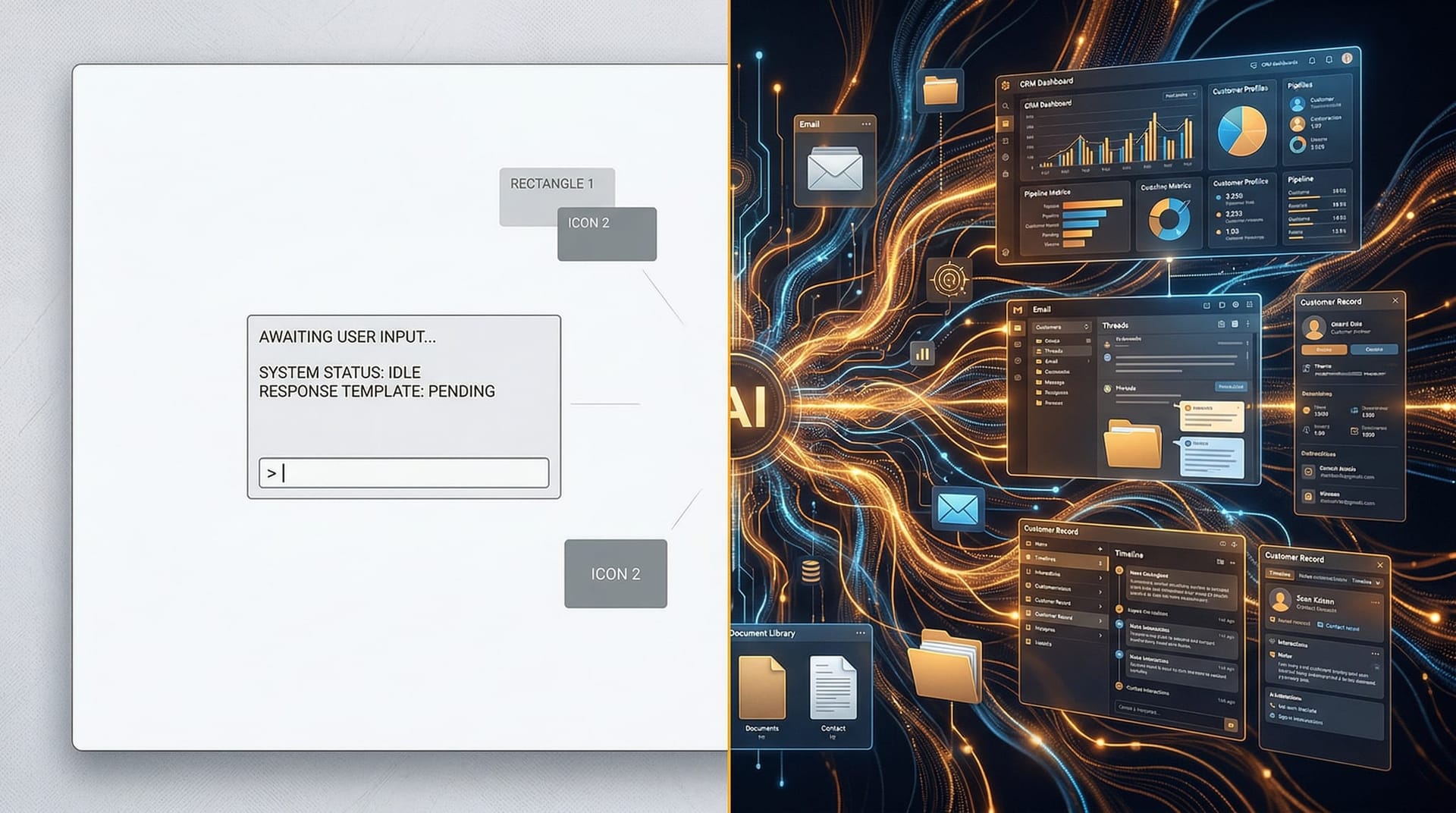
On September 17, 2026, Microsoft did something most technology vendors avoid: it published a candid, numbers-forward account of transforming itself with AI — and led with an admission that should make every business owner in Fort Wayne stop and reread it. Writing as Microsoft's EVP and Chief Strategy and Transformation Officer, Kathleen Hogan's field report states the quiet part plainly: “Access and usage do not equal transformation.” Or, as she put it more bluntly, “a tool licensed to over 200,000 people does not change how the work gets done.”
That is not a pitch for buying more Copilot seats. It is the opposite. It is the largest software company on earth telling you that the seats are the easy part, and the seats are not where the value lives. For a 10-to-200-person business in Northeast Indiana that will never have Microsoft's budget or AI research org, that admission is oddly liberating — because it means the thing that actually moves the needle is an operating-model decision, not a spending contest. You don't need Microsoft's scale to steal Microsoft's playbook.
Key Takeaways
- Microsoft's own transformation chief says buying AI licenses is not transformation — redesigning the work around AI is.
- Microsoft's reported results are concrete: deal close rates up 20%, revenue per account manager up 9.4%, and some planning cycles cut from ~10 days to under 2.5.
- The gap between adoption and results is industry-wide: McKinsey found only about a third of companies can tie any earnings impact to AI.
- The lever that closes the gap is workflow redesign plus role-scoped operators that actually run a process — not more chat windows.
- Microsoft's “three transformation recipes” translate directly to a distributor, a clinic, a law firm, or a manufacturer in Allen and DeKalb counties.
- The right first move for a local business is small and deliberate: pick one workflow that matters and put a single AI Employee on the whole thing.
What Did Microsoft Actually Admit About Its Own AI Rollout?
The headline confession is that access is cheap and transformation is not. Microsoft can license Copilot to hundreds of thousands of employees overnight; getting those employees to fundamentally change how a workflow runs is the hard, slow part. Hogan's phrasing — “Efficiency is the floor; capability is the ceiling” — reframes the entire conversation. Saving a few minutes per email is the floor. It is table stakes, and it is where almost everyone stops. The ceiling is doing work you simply could not do before.
This is the same trap we've written about as the AI capability overhang: most organizations already pay for far more AI capability than they use, because they bolt a chat window onto old habits and call it done. Microsoft is now confirming that pattern from the inside, at the largest possible scale. The company measured “access and usage” going up and “how the work gets done” staying flat — and named the disconnect out loud.
There is a second admission worth pinning up on the wall: “Adding agents to a broken process still leaves a broken process.” AI does not fix a bad workflow; it accelerates whatever workflow you point it at. If your intake process loses leads today, an AI that runs it faster loses leads faster. That single sentence is the reason “just add AI” initiatives stall — and it is exactly why we keep telling local owners the same thing we're about to repeat: start with the process, not the tool.

What Results Did Microsoft Get — And What Do They Look Like at Fort Wayne Scale?
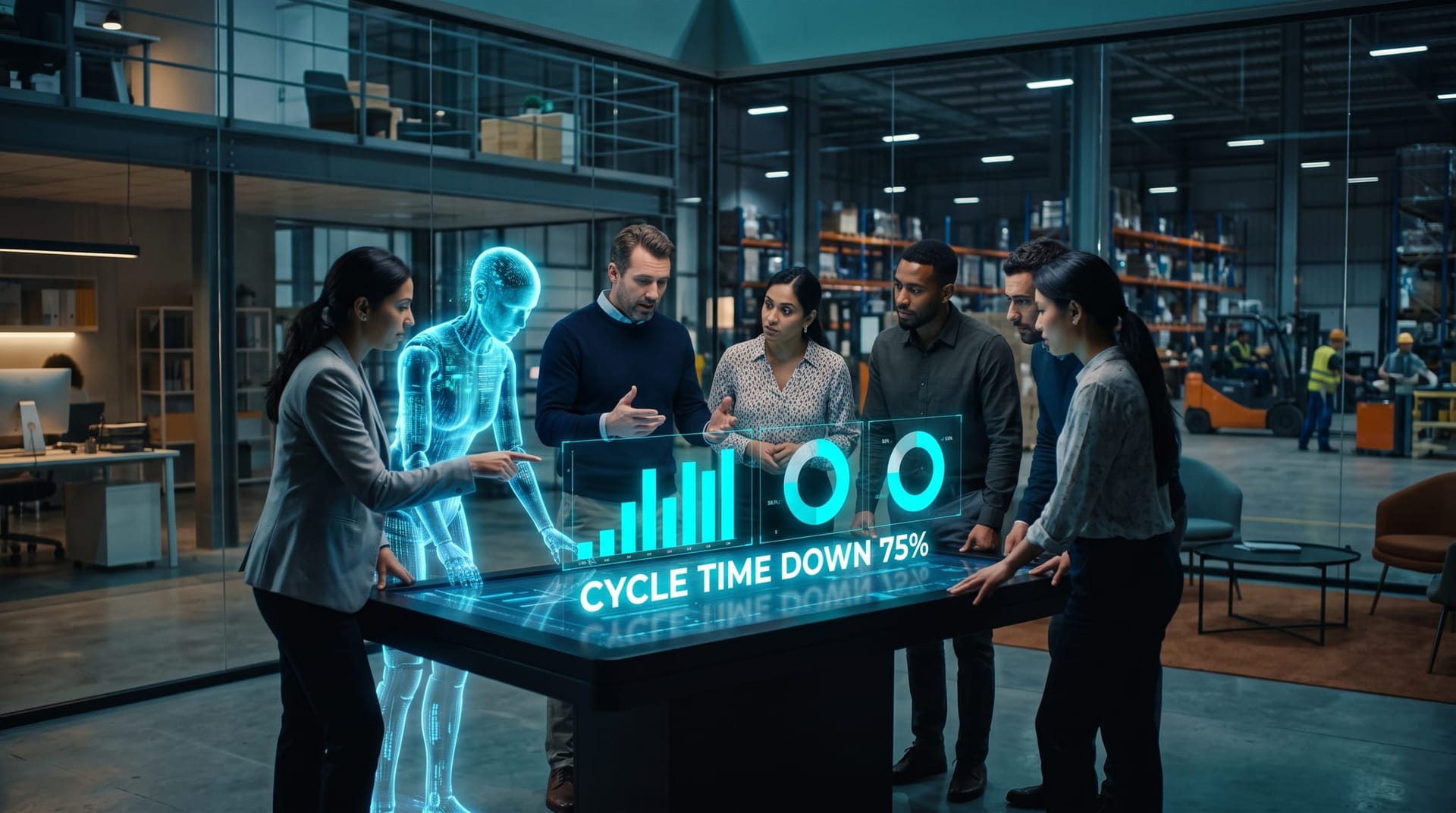
Hogan's report is unusual because it puts hard numbers next to the philosophy. Microsoft attributes a 20% increase in deal close rates to one sales team, a 9.4% rise in revenue per account manager, and a tripling of adoption of priority use cases in its sales group. On the operations side, selected supply-chain workflows saw cycle times fall by up to 75% — with some planning cycles dropping from roughly 10 business days to under 2.5, and demand-plan investigations that once took five to seven days completing in hours, sometimes under 20 minutes. Microsoft says it now runs 111 or more agents across its cloud supply-chain workflows, and that a nine-person team shipped the first release of its “Copilot Cowork” effort in 35 days.
Here is the full set of reported figures, all attributed to Microsoft's own account:
| Microsoft-reported metric | Result |
|---|---|
| Sales team deal close rate | +20% |
| Revenue per account manager | +9.4% |
| Adoption of priority use cases (sales) | Tripled |
| Supply-chain workflow cycle time | Up to −75% |
| Selected planning cycles | ~10 → under 2.5 business days |
| Demand-plan investigation time | 5–7 days → hours (some under 20 min) |
| Cloud supply-chain agents deployed | 111+ |
| First “Copilot Cowork” release | 35 days |
| AI users doing work they couldn't before | 58% (80% among advanced users) |
Now shrink the scale. A Fort Wayne distributor does not run 111 agents, but it does run a demand-planning cycle that eats a week of a purchasing manager's time — and cutting that to a day is the same kind of win Microsoft reported. A regional clinic does not have a global sales org, but it has an intake team whose close-rate on inbound appointment requests is very much a “deal close rate.” A DeKalb County law firm has a document-review process measured in days that maps cleanly to Microsoft's five-days-to-minutes investigation story. The numbers don't transfer; the pattern does. This is precisely the down-market translation we lay out in our small-business leverage playbook — enterprise leverage, applied at a scale you can actually staff.
One caution worth stating honestly: these are Microsoft's self-reported figures for selected teams and workflows, not audited, company-wide averages. Treat them as proof the ceiling is real and reachable — not as a guarantee of what any single local rollout will return.
What Are Microsoft's Three Transformation Recipes?
The most portable part of Hogan's report is a simple taxonomy. Microsoft describes three “transformation recipes,” and each one answers a different question a local owner is already asking.
- Persona Acceleration — transform a role. Take one job (a bookkeeper, an intake coordinator, an estimator) and rebuild how that person works with AI embedded in the flow, not sitting in a separate tab. For a Fort Wayne accounting firm, that's a season where every preparer works alongside an operator that drafts, reconciles, and flags exceptions.
- AI-Powered Process Redesign — transform a workflow that crosses roles. Microsoft's supply-chain results came from this recipe. Locally, it's the quote-to-cash cycle at a manufacturer or the lead-to-appointment path at a home-services company — end-to-end, not one step.
- AI-First Possibility — build something greenfield that wasn't practical before. This is the ceiling: a new service line, a same-day response capability, a 24/7 answer engine that a small team simply could not have staffed.
The recipe that fails is the invisible fourth one nobody names: buy licenses, hope for redesign. That is the seat-licensing trap Microsoft just disavowed. It's also why we've argued that generic AI tools fail where custom AI Employees don't — a generic chat assistant waits to be asked; a role-scoped operator owns the workflow, runs it on a schedule, and hands humans the exceptions. The difference between “Persona Acceleration” and “we bought Copilot” is whether the AI is in the process or beside it.

Why Do Most AI Rollouts Stall — And What Does the Data Say Fixes It?
Microsoft's confession isn't an outlier; it's the norm dressed up honestly. In its 2026 State of AI survey, McKinsey found that only about 37% of organizations could attribute any measurable EBIT impact to AI — a figure The Register reported as essentially unchanged from the prior year, with just 6% qualifying as true “AI high performers.” McKinsey's own framing is that “organizations' conviction in AI is growing faster than the immediate financial returns they can attribute to it.” Aggregating the same data, Beam.ai notes that a striking 94% of enterprises see no material earnings impact from their AI spend — but that agentic adopters hit 88% ROI in year one, against 74% for general gen-AI users. The pattern is unambiguous: agents that run work beat assistants that wait for prompts.
Why does the gap persist? Microsoft's broader research points at the organization, not the individual. In its Frontier Firm operating-model report, drawn from 20,000 workers across 10 countries, Microsoft found that organizational factors — culture, manager support, talent practices — account for roughly twice the AI impact of individual mindset, a 67%-to-32% split. Only 13% of workers said they were rewarded for reinventing how they work with AI, even as 65% feared falling behind without it. The WorkLab Work Trend Index puts just 19% of AI users in the “Frontier” zone where readiness and capability reinforce each other, with about half still “emergent.”
Hogan's own numbers reinforce the human lever: managers who visibly model AI use lifted their teams' reported value of agentic AI by 17 points and trust by 30 points, and teams with high psychological safety were 1.4 times more likely to be high-frequency users. Here's the part that's genuinely good news for a small business — in a 15-person company, the owner is that manager. You don't need a change-management department. You need one leader who uses the tools in the open. That's the difference between individual speedups and company results, which is the whole subject of our piece on why AI can make faster staff but not a faster company.

CI + AI = CA: How Do You Turn a Tool Into a Capability?
Microsoft's tidiest formula is “CI + AI = CA” — Continuous Improvement plus AI equals Capability Add. Continuous improvement was already a Midwestern manufacturing discipline long before AI; every plant floor in Northeast Indiana knows Kaizen. Microsoft's argument is that layering AI onto a genuine improvement loop doesn't just make the loop faster — it adds capabilities the team didn't have, letting people take on work that was previously impractical. Crucially, Hogan is emphatic that this is human-led: “AI should expand human capability while people retain meaningful control, judgment and accountability.”
That sentence is the entire design philosophy behind an AI Employee as we deploy it. It is not an autonomous black box you turn loose on your business, and it is not a chat window your team occasionally visits. It's a role-scoped operator that runs a defined workflow on a schedule, escalates the judgment calls to a human, and gets better as the loop tightens. That's the same execution gap we documented in turning AI pilots into AI Employees: the companies pulling ahead aren't the ones with the best strategy decks — they're the ones who moved from “we're testing AI” to “AI runs this now, and a person owns the exceptions.”
The mental shift is from tool to teammate with a job description. A tool sits idle until summoned and produces individual speedups that stay trapped at one desk. An operator with a defined role, inputs, outputs, and an escalation path produces company-level results — because the work happens whether or not someone remembered to open the app. That is the “how the work gets done” change Microsoft says the licenses alone never delivered.

What Should a Fort Wayne Business Do First?
Start smaller than you think, and more completely than you think. Pick one moment that matters — the after-hours lead that goes unanswered, the intake form that takes two days to route, the weekly report someone dreads — and redesign that entire workflow around a single AI Employee rather than sprinkling AI across ten tasks. Adoption locally is not the problem: small-business AI use has climbed sharply, reaching 58% of small firms in 2025, up from 23% in 2023, according to U.S. Chamber of Commerce data compiled by Capsule. Fort Wayne and Northeast Indiana owners are already using AI. What most haven't done — exactly as Microsoft warns — is let it change how the work actually runs.
The distributors, clinics, law firms, and manufacturers across Allen and DeKalb counties don't need a research lab or a 200,000-seat license. They need to choose one workflow, redesign it end to end, and put one operator on it with a human owning the calls that matter. If you want the step-by-step version tailored to owners here, our practical adoption playbook walks the same road at local scale.
Ready to Change How the Work Gets Done?
Microsoft spent a year proving that transformation isn't a license — it's a redesigned workflow with an operator running it and a human in control. That's exactly what Cloud Radix builds. Our AI Employee solutions start with one workflow that matters to your business, redesign it around a role-scoped, human-supervised operator, and measure the result the way Microsoft did — in cycle time, close rate, and capacity, not in seats sold. If you're a Fort Wayne or Northeast Indiana business tired of paying for AI you're barely using, let's find your one moment that matters and put an AI Employee on it. Steal Microsoft's operating model — on a Midwest budget.
Frequently Asked Questions
Q1.What is the main lesson from Microsoft's 2026 AI transformation report?
The central lesson is that “access and usage do not equal transformation.” Microsoft's chief strategy and transformation officer, Kathleen Hogan, wrote that licensing an AI tool to over 200,000 people did not by itself change how the work got done. Real results came only when the company redesigned entire workflows around AI rather than simply buying seats.
Q2.Can a small Fort Wayne business get the same results Microsoft did?
Not at the same scale, and the exact figures won't transfer. Microsoft's numbers — like a 20% jump in deal close rates or planning cycles cut from ~10 days to under 2.5 — come from selected enterprise teams. But the pattern travels: pick one workflow, redesign it end to end, and put a single AI operator on it. A distributor's week-long demand-planning cycle or a clinic's slow intake process are exactly the kind of targets where the approach applies.
Q3.What are Microsoft's three transformation recipes?
Microsoft names three: Persona Acceleration (rebuild how a single role works with AI embedded), AI-Powered Process Redesign (transform a workflow that crosses several roles), and AI-First Possibility (build something new that wasn't practical before). Each maps to a concrete local use case, from an accounting role to a quote-to-cash workflow to a new 24/7 service capability.
Q4.Why do most companies get little ROI from AI?
Because they buy AI access without redesigning the work. McKinsey's 2026 State of AI survey found only about 37% of organizations could attribute measurable earnings impact to AI. Microsoft's research points to organizational factors — culture, manager support, workflow design — mattering roughly twice as much as individual enthusiasm. Adding AI to a broken or unchanged process just runs that process faster, not better.
Q5.What is “CI + AI = CA”?
It's Microsoft's shorthand for Continuous Improvement plus AI equals Capability Add. The idea is that layering AI onto a genuine improvement loop doesn't just speed the loop up — it adds capabilities a team didn't have before, so people can take on work that was previously impractical, while retaining meaningful control and judgment.
Q6.How is an AI Employee different from a Copilot or ChatGPT license?
A license gives an individual a chat window they must remember to use, which tends to produce personal time-savings that stay at one desk. An AI Employee is a role-scoped operator that runs a defined workflow on a schedule, produces outputs whether or not anyone opens an app, and escalates the judgment calls to a human. That “the work happens automatically” difference is what turns individual speedups into company-level results.
Q7.Where should a Northeast Indiana business start with AI transformation?
Start with one workflow that matters — an unanswered after-hours lead, a slow intake process, a dreaded weekly report — and redesign that whole workflow around one AI Employee with a human owning the exceptions. Resist the urge to spread AI thinly across many tasks. Prove the model on a single high-value process, then expand using the same recipe.
Sources & Further Reading
- Microsoft (Kathleen Hogan): blogs.microsoft.com/blog/2026/09/17/what-weve-learned-from-microsofts-own-ai-transformation — What we've learned from Microsoft's own AI transformation.
- Microsoft: blogs.microsoft.com/blog/2026/05/05/how-frontier-firms-are-rebuilding-the-operating-model-for-the-age-of-ai — How Frontier Firms are rebuilding the operating model for the age of AI.
- Microsoft WorkLab: microsoft.com/en-us/worklab/work-trend-index — 2026 Work Trend Index: Agents, human agency, and the opportunity for every organization.
- The Register (on McKinsey 2026 State of AI): theregister.com/ai-and-ml/2026/08/25/mckinsey-says-enterprise-ai-is-finally-on-the-road-to-roi — McKinsey says enterprise AI is finally “on the road to ROI.”
- Beam.ai (analysis of McKinsey 2026 data): beam.ai/agentic-insights/agentic-ai-roi-gap-2026 — 94% Get No AI ROI. Agentic Adopters Hit 88% (2026).
- Capsule CRM (citing U.S. Chamber of Commerce): capsulecrm.com/blog/small-business-ai-adoption-statistics — Small business AI adoption statistics for 2026.
Find Your One Moment That Matters
Steal Microsoft's operating model on a Midwest budget. We'll help you pick one workflow, redesign it end to end, and put a human-supervised AI Employee on it — measured in cycle time and capacity, not seats sold.
Schedule a Free ConsultationNo contracts. No pressure. Just an honest conversation about the one process worth changing first.