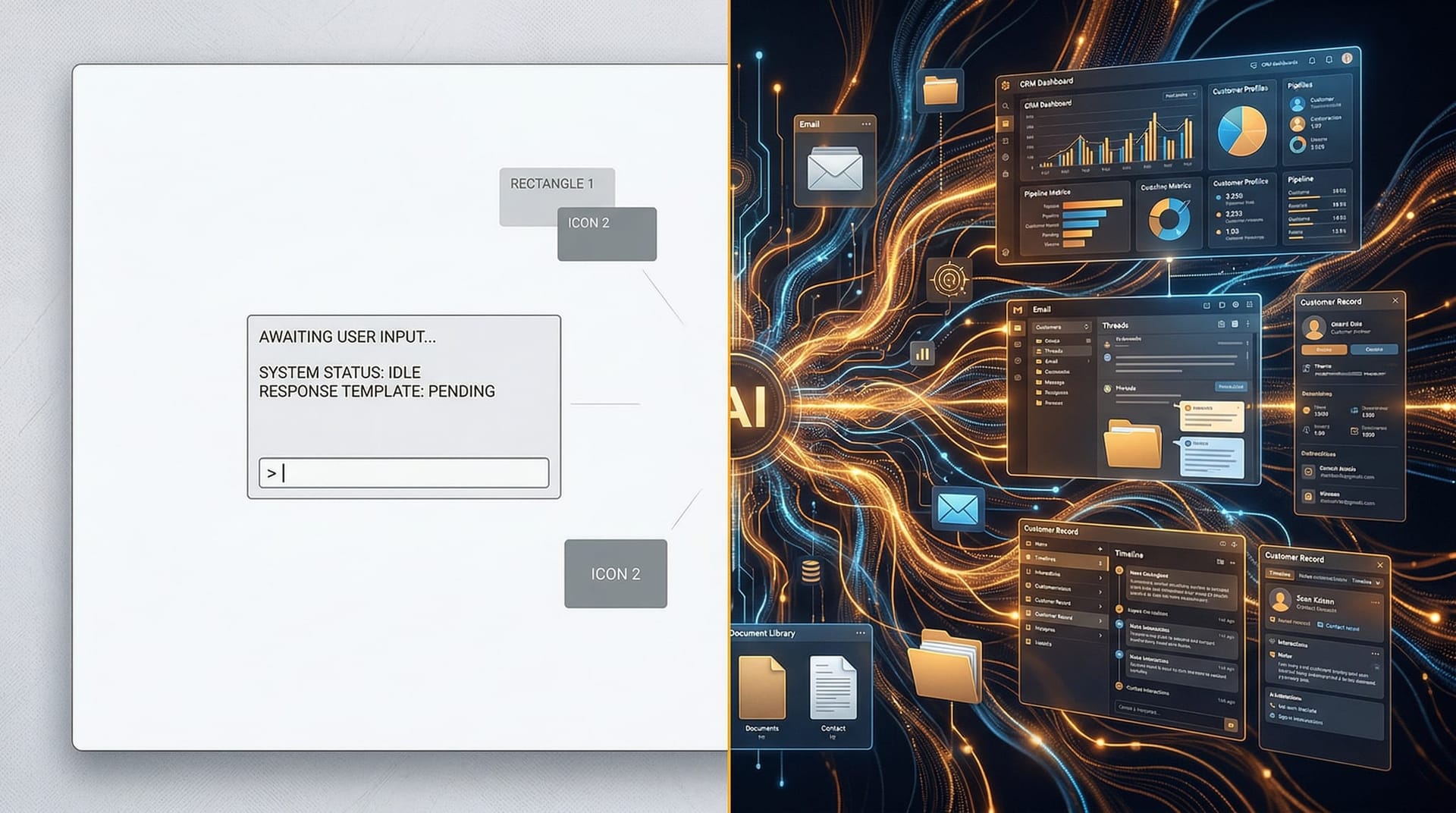
For three years, “AI for marketing” mostly meant a better generate button. You typed a prompt, the model handed back an image, a headline, or a draft, and a human still did everything else — the briefing, the resizing, the brand check, the routing, the publishing. On June 18, 2026, Adobe quietly moved the goalposts. According to Adobe's own announcement, its creative agent now spans Photoshop, Premiere, Illustrator, InDesign, and Frame.io, acting as “the connective layer across every stage of creative work” rather than a one-asset-at-a-time generator. As first reported by VentureBeat, the real story isn't a flashier generate button — it's the shift from generating media to orchestrating the whole production pipeline.
That distinction is the entire Cloud Radix thesis, and now the largest creative-software company on earth is selling it for us. The value was never the AI making a thing. The value is an AI Employee running the work end to end: brief, draft, on-brand variation, review, resize, publish — as a multi-step workflow instead of a person clicking through every step. For a Fort Wayne marketing or creative team that is good at the work but chronically short on hands, this is the most important change in the AI-for-marketing story so far. It's also the one with the sharpest downside if you skip the part everyone wants to skip: governance.
Key Takeaways
- Adobe moved from generation to orchestration. Its creative agent now runs multi-step jobs across Photoshop, Premiere, Illustrator, InDesign, and Frame.io — not just making single assets, but assembling, versioning, and prepping the whole production line.
- This is a bellwether, not a one-off. When the category leader reframes its tools around orchestration, every content and marketing platform follows. The teams that win redesign the workflow, not just the toolbar.
- The unlock for lean teams is delegation without headcount. An orchestrated content AI Employee handles intake → draft → on-brand variation → human approval → publish, so a small team can produce at a larger team's cadence.
- Humans still own the decision. In Adobe's own survey of creators, 85% said the final creative call should always remain theirs. Orchestration speeds the pipeline; it does not replace judgment.
- Orchestration without governance ships mistakes at machine speed. An ungoverned agent can publish off-brand, unreviewed, or rights-unsafe assets faster than anyone can catch them.
- The safe pattern is orchestration + a human review checkpoint + a Secure AI Gateway — not an agent with standing permission to post to your live website.
What Actually Changed: From Generating Assets to Orchestrating the Production Line?
The easiest way to understand Adobe's move is to look at what its agent now does inside each app, because the examples are concrete and ordinary — the exact tedium that eats a small marketing team's week. Per Adobe's release, in Premiere the assistant handles set-up work like “sorting assets into bins, batch renaming clips, identifying interview questions, adding markers or even assembling a working starting point.” In Illustrator it can generate “50 versioned files from a spreadsheet” and reorganize layers across a document. In InDesign it applies brand updates “across every layout including copy, styling and print-readiness checks.” In Photoshop it executes composite-wide tasks like swapping a background or resizing assets for every platform at once.
Notice what every one of those has in common: none of them is “make me a single beautiful image.” They're multi-step jobs with a beginning, a middle, and an end. That is orchestration. The model isn't just generating — it's sequencing the work the way a production coordinator would. David Wadhwani, president of Adobe's Creativity & Productivity business, framed it bluntly: “Every creative now has an agent capable of helping them execute across every app and platform where they work.”

Two numbers from Adobe's survey of more than 16,000 creators are worth holding onto, because they define the guardrails. Seventy-five percent now describe creative AI as “integrated or essential” to their work — adoption is no longer the question. But 85% said the final creative decision should always remain theirs. Read together, those figures describe exactly the posture a smart team should take: let the agent run the pipeline, keep your hands on the wheel. This is the same structural change we've written about in AI is quietly replacing the interface — the click-through screen is being replaced by an agent that does the clicking, while the human moves up to direction and sign-off.
Why Is Adobe a Bellwether for Every Marketing Tool?
It would be a mistake to read this as an Adobe story. It's a direction-of-travel story, and Adobe just happens to be the most visible vehicle. Three signals say the whole category is moving the same way, fast.
First, the infrastructure is being built for it. In March 2026, Adobe and NVIDIA announced a strategic partnership explicitly aimed at “agentic creative and marketing workflows,” with Adobe CEO Shantanu Narayen putting it plainly: “Content creation is exploding, and our partnership with NVIDIA is grounded in a shared vision to reinvent creative and marketing workflows with the power of AI.” When the chip maker and the software maker co-invest around the word workflows, the puck is heading toward orchestration.
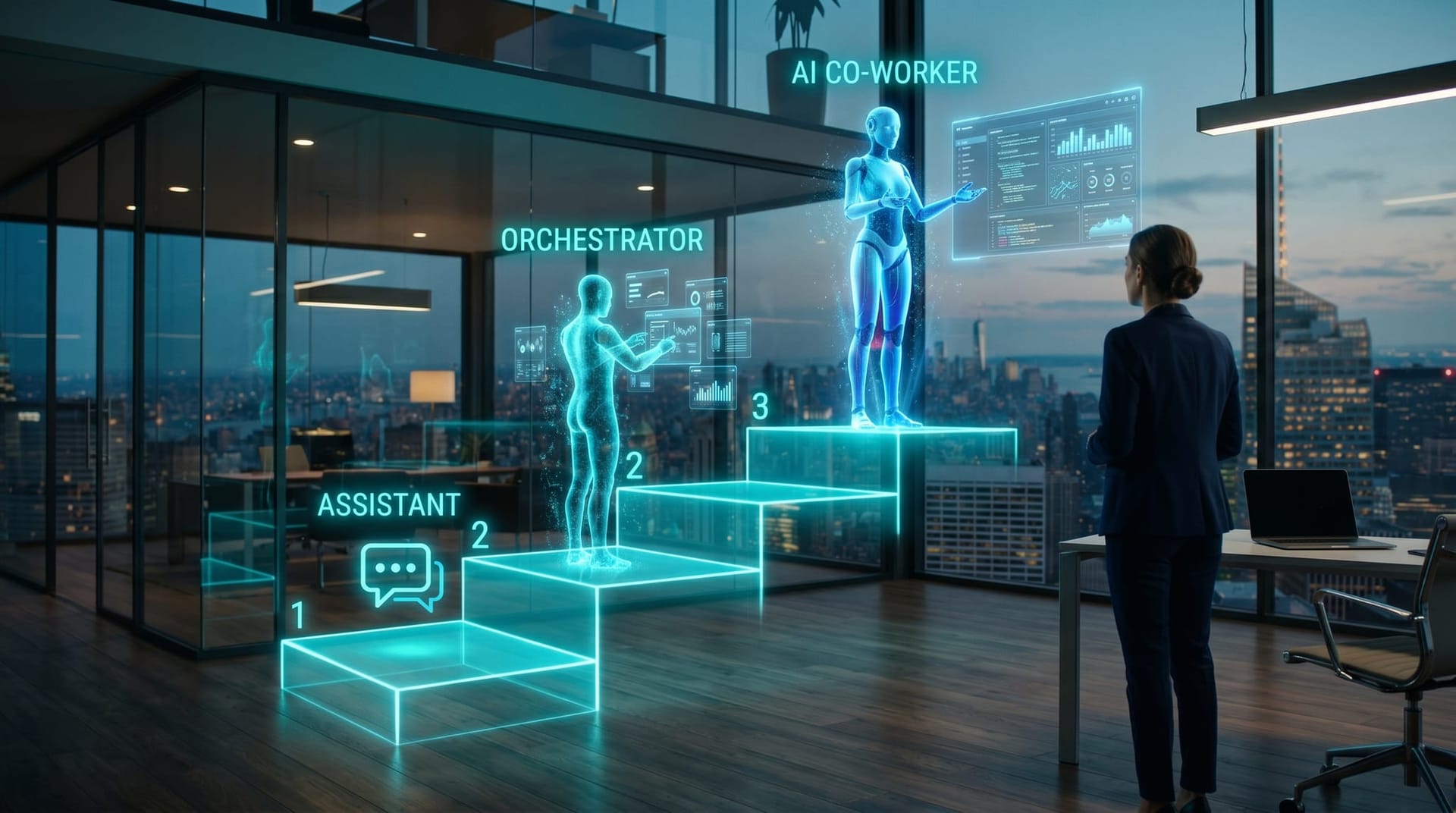
Second, analysts are naming the same arc. Covering Adobe's 2026 strategy, Constellation Research's Liz Miller described the trajectory as moving “from assistants that respond to prompts to orchestrated agents that automate tasks to full-fledged AI co-workers.” That's a three-stage ladder — assistant, orchestrator, co-worker — and most marketing teams are still standing on the bottom rung with a generate button. It mirrors the shift from reactive chatbots to proactive, initiative-taking agents we've tracked across other business functions.
Third, the demand forecast backs it up. Gartner predicts that 60% of brands will use agentic AI to deliver streamlined one-to-one customer interactions by 2028. You don't get to 60% of brands by selling slightly faster image generators. You get there by selling orchestration — agents that carry a piece of marketing work from intent to output. The honest takeaway for a Northeast Indiana team: the tools you license over the next 18 months will increasingly assume you want them to run multi-step jobs, whether or not you've designed your process for that.
What Does an Orchestrated Content AI Employee Actually Look Like for a Lean Team?
Here's where it gets practical, because a glass-walled enterprise demo is not the reality of a five-person marketing department in Auburn or Fort Wayne. You don't need Adobe's full enterprise stack or a dedicated AI-ops hire to get the benefit. What you need is to stop thinking in terms of a tool that generates assets and start thinking in terms of an AI Employee that orchestrates a production line you define.
A content AI Employee runs the same loop a coordinator would, but continuously and without getting tired:
| Stage | The old "generate button" way | The orchestrated AI Employee way |
|---|---|---|
| Intake | A person reads the request and manually kicks off work | The agent ingests the brief, request form, or calendar slot and starts the job |
| Draft | Human prompts a model, copies the output somewhere | The agent drafts copy and base assets against your brief and brand rules |
| Variation | Human resizes and re-edits for each channel by hand | The agent produces on-brand variations sized for each platform at once |
| Review | Often skipped when everyone's busy | The work is routed to a named human for approval — a required gate |
| Publish | Human logs in and posts everywhere | The agent stages the publish; the human releases it |
The difference isn't speed for its own sake. It's that the boring, error-prone connective work — the resizing, renaming, routing, and reformatting — moves to software, and your scarce human attention concentrates on the two stages that actually need taste and judgment: the brief and the approval. This is why a generic generate button fails where a custom AI Employee doesn't: a generic tool gives you a faster middle step, while an orchestrated AI Employee gives you the whole pipeline with your brand rules and your sign-off built in.

There's a catch that's easy to miss, and it determines whether this works: you can't just bolt an agent onto a messy, undocumented content process and expect orchestration to clean it up. If your current “process” is three people improvising in a group chat, an agent will simply improvise faster. The teams that get real leverage redesign the workflow around the agent instead of bolting it onto a broken process — they write down the brief format, the brand rules, and the approval gate first, then hand the orchestration to an AI Employee.
What's the Catch? Orchestration Without Governance Ships Mistakes at Machine Speed
This is the part of the pitch most vendors skip, so we'll say it directly: the same property that makes orchestration valuable — it runs many steps without a human in the loop — is exactly what makes it dangerous when ungoverned. A generate button produces one asset that a person looks at before doing anything with it. An orchestration agent can brief, draft, vary, and publish before anyone reviews a word. At machine speed, “oops, that was off-brand” becomes “oops, that off-brand, rights-unsafe, factually wrong asset is now live on every channel.”
The data says almost nobody is ready for this. In its 2026 agentic AI research, Gartner found that only about one in five organizations has a mature model for governing autonomous AI agents, and it estimates more than 40% of agentic AI projects could be canceled by 2027 — driven in part by unclear value, rising costs, and weak governance. Marketing is unusually exposed here, because its output is public by definition. A mis-orchestrated internal report is an embarrassment; a mis-orchestrated brand campaign is a public one.

The fix is not to avoid orchestration — that ship has sailed, and your competitors are boarding it. The fix is to wrap it in two things vendors rarely lead with:
- A human review checkpoint that the agent cannot bypass. Adobe's own creators agree with this: 85% said the final creative decision should stay with them. Design the workflow so “publish” is an action a named person takes, not a step the agent completes on its own. The agent can do everything up to the gate.
- A Secure AI Gateway between the agent and your real systems. The agent should reach brand assets, drafts, and a staging area — not your live CMS credentials, your customer list, or your ad accounts with standing permission. A gateway scopes what the agent can touch, logs what it did, and gives you an audit trail when someone asks “why did we post that?”
That combination — orchestrate the pipeline, gate the publish, scope the access — is the difference between an AI Employee that gives your team superpowers and one that gives your brand a liability at scale. We recommend treating the gateway and the human gate as non-negotiable prerequisites, not phase-two nice-to-haves.
How Should a Fort Wayne Marketing Team Actually Start?
Translate all of this to the reality on the ground in Northeast Indiana. Picture an Auburn or Fort Wayne marketing agency, an in-house team at a regional professional-services or home-services firm, or a manufacturer's lean marketing department. The common thread: a steady, never-ending demand for content — social posts, email, landing pages, local-SEO and answer-engine pages — and a headcount that was set years before anyone added “produce content at platform speed” to the job.
For that team, the orchestrated content AI Employee is a more honest answer than “hire two more people” or “buy another generate button.” Start narrow and concrete. Pick one repeatable production line you already run — say, your weekly local-SEO/AEO page or your recurring email — and document it: the brief format, the brand rules, the channels and sizes, and who signs off. Then hand that single line to an AI Employee that does intake → draft → on-brand variation → staged publish, with your human owning the approval gate. This is the same disciplined, narrow-first approach we lay out in our practical AI adoption playbook for Fort Wayne business owners: one process, fully orchestrated and governed, beats ten processes half-automated.

It's worth noting this isn't only a production play — it's an insight play, too. The same orchestration logic that runs your content line can run your research line, which is exactly the same logic behind AI synthetic audiences for local market research: an AI Employee that gathers, drafts, and routes findings for a human to judge. For a mid-market team in Allen or DeKalb County, the strategic point is the same in both cases — you stop buying tools that make individual steps faster and start building AI Employees that own whole, governed workflows.
Frequently Asked Questions
Q1.What is agentic creative production orchestration?
Agentic creative production orchestration is when an AI agent runs a multi-step content workflow — brief, draft, on-brand variation, resize, review, and publish — as a connected job rather than a human doing each step manually. Adobe's June 2026 expansion of its creative agent across Photoshop, Premiere, Illustrator, InDesign, and Frame.io is the most prominent example, shifting AI from generating single assets to coordinating the whole pipeline.
Q2.How is orchestration different from an AI generate button?
A generate button produces one asset and stops; a human still handles briefing, resizing, brand checks, routing, and publishing. Orchestration carries the work across all of those steps automatically. The practical effect for a lean team is that the boring connective tasks move to software, while human attention concentrates on the brief and the final approval.
Q3.Is it safe to let an AI Employee publish marketing content automatically?
Not without guardrails. The safe pattern is to let the agent run every step up to publishing, then require a named human to approve before anything goes live, and to route the agent's access through a Secure AI Gateway so it can't touch live credentials or customer data directly. Gartner found only about one in five organizations has a mature model for governing autonomous agents, so a deliberate review checkpoint is essential.
Q4.Do small Fort Wayne and Northeast Indiana marketing teams actually need this?
Lean teams arguably benefit most, because orchestration adds production capacity without adding headcount. The right starting point is narrow: pick one repeatable content line you already run, document its brief, brand rules, and approval step, and hand that single workflow to an AI Employee before expanding to others.
Q5.What does Adobe's move signal for other marketing tools?
It signals direction, not a one-off feature. Adobe's NVIDIA partnership, analyst commentary describing a move from assistants to orchestrated agents to AI co-workers, and Gartner's forecast that 60% of brands will use agentic AI by 2028 all point the same way. The tools mid-market teams license over the next 18 months will increasingly assume you want them to run multi-step jobs.
Q6.Will agentic orchestration replace human marketers?
No — it changes what they spend time on. In Adobe's survey of more than 16,000 creators, 85% said the final creative decision should always remain theirs. Orchestration removes the connective drudgery (resizing, renaming, routing) so marketers move up to direction, brand judgment, and sign-off, which is where human taste actually creates value.
Sources & Further Reading
- Adobe: news.adobe.com/news/2026/06/adobe-unveils-major-expansion — Adobe Unveils Major Expansion of Creative Agent Across Firefly and Creative Cloud Apps Including Photoshop and Premiere.
- VentureBeat: venturebeat.com/orchestration/adobe-embeds-agentic-ai-workflows-across-creative-cloud — Adobe embeds agentic AI workflows across Creative Cloud, shifting from media generation to production orchestration.
- Constellation Research: constellationr.com/insights/news/adobe-summit-2026-agentic-orchestration-cx-creative-workflows — Adobe Summit 2026: Agentic orchestration for CX, creative workflows.
- NVIDIA: nvidianews.nvidia.com/news/adobe-and-nvidia-partnership-creative-marketing-agentic-workflows — Adobe and NVIDIA Announce Strategic Partnership to Deliver the Next Generation of Firefly Models and Creative, Marketing and Agentic Workflows.
- Gartner: gartner.com/en/newsroom/press-releases/2026-01-15-gartner-predicts-60-percent-of-brands — Gartner Predicts 60% of Brands Will Use Agentic AI to Deliver Streamlined One-to-One Interactions by 2028.
- Gartner: gartner.com/en/articles/hype-cycle-for-agentic-ai — Hype Cycle for Agentic AI, 2026.
Ready to Build a Content AI Employee That Orchestrates the Whole Line?
A Cloud Radix content AI Employee runs your content production line end to end — intake, draft, on-brand variation, staged publish — behind a Secure AI Gateway, with a human approval checkpoint your team controls. You keep the taste and the sign-off; the AI Employee handles the connective work that's been quietly burning your team's hours.