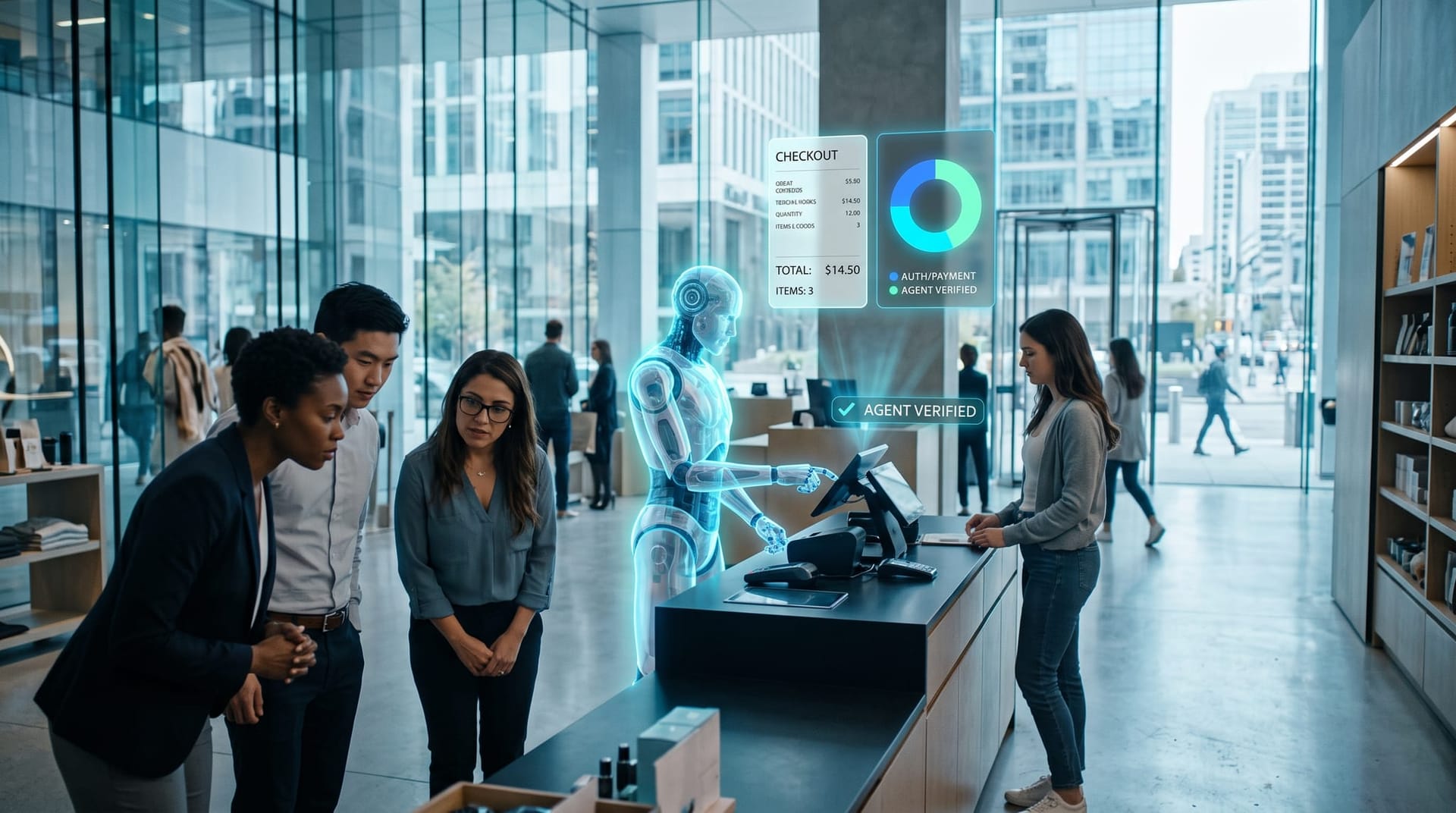
Everybody selling you on commerce AI right now is telling the same story: add an AI shopping assistant, get your products recommended by ChatGPT, show up when someone asks Perplexity where to buy. What almost nobody is telling you is the uncomfortable second half of that story — with the analytics you have today, you probably cannot prove any of it actually drove a sale.
The mechanics are simple and brutal. A shopper asks an AI assistant for a recommendation, gets pointed at your store, and then converts later — by walking into your Fort Wayne showroom, calling, or opening a new tab and searching your name. Your dashboard credits that sale to “direct,” “organic,” or “branded search.” The AI that started the whole journey gets zero credit. So you keep spending on AI visibility and answer-engine work with no honest read on whether it moves revenue, and no way to defend the budget when someone asks.
This is a measurement problem, not an AI problem. And it's fixable — without an enterprise analytics team. Below is a practical 2026 attribution playbook for a Northeast Indiana retailer, e-commerce seller, or home-services shop: what to instrument, what to stop trusting, and how an AI Employee can own the measurement loop so the answer stops being a guess.
Key Takeaways
- Roughly 70.6% of AI-driven traffic arrives with no referrer, so standard analytics dumps it into “direct” — undercounting AI's contribution by an estimated 3–4x.
- The channel flipped: Adobe found AI-referred retail shoppers converted 42% better than other visitors in March 2026, a reversal from converting roughly half as well a year earlier.
- Conversion multiples vary wildly by vertical — from a modest 1.3x for ecommerce brands to 5x-plus for B2B — so borrow the method, not someone else's headline number.
- You can close most of the gap with four cheap moves: a custom AI channel group, UTM tags on links you control, a post-purchase “how did you hear about us” question, and branded-search-lift monitoring.
- Stop trusting raw last-click, and never call correlation “incremental” without an actual holdout test.
Why Can't You Prove Your AI Is Driving Sales?
The core issue is a missing referrer. When a browser follows a normal web link, it usually tells your analytics where it came from. A lot of AI-assisted journeys never pass that signal — the person reads an answer inside ChatGPT and then types your name into a browser, or taps a link that strips the referrer. According to TapClicks' 2026 attribution analysis, citing Loamly's State of AI Traffic 2026, about 70.6% of AI-driven traffic arrives with no referrer header at all — which means GA4 and most platforms file it under “direct.” Only the remaining ~29% carries a recognizable AI referrer.
That single fact is why your reports feel wrong. If three out of four AI-influenced visits are invisible, your “direct” line is quietly absorbing the AI channel's real contribution. AdBeacon's ecommerce breakdown, pointing to Elogic Commerce research, puts the same 70.6% figure in blunt terms: standard GA4 undercounts AI's influence by roughly three to four times. It also flags the strange symptoms this creates. AdBeacon cites one Shopify Plus direct-to-consumer brand that saw an 18% organic-traffic drop in a quarter while revenue stayed flat — the missing traffic hadn't vanished, it had migrated to AI-driven discovery that the dashboard couldn't see. Backlinko, in the same write-up, documented a 15% click decline paired with a 54% jump in impressions, again traced to AI discovery happening before a direct search.
If you've watched your own store post softer organic numbers while sales held steady, this is a likely culprit. It's the flip side of the trend we covered in how AI agents are becoming your customers — the buyer's first touch is increasingly a machine, and the machine doesn't fill out your referrer field.

Is AI Traffic Actually Worth Measuring?
Fair question. If it's this hard to see, is it big enough to bother with? In 2024 the honest answer was “probably not yet.” In 2026 it is clearly yes, and the direction of the data is the whole point.
The sharpest signal comes from Adobe, which tracks over a trillion visits to U.S. retail sites. Per Search Engine Journal's summary of Adobe's Q2 report, AI-driven traffic to U.S. retailers grew 393% year over year in Q1 2026, and — the part that matters — AI-referred shoppers converted 42% better than visitors from other channels in March 2026. Twelve months earlier those same AI visitors had converted at roughly half the rate of everyone else. That's a complete inversion of the channel's value inside a year. Digital Commerce 360's coverage of Adobe's data adds the behavioral texture: AI-referred visitors spent 48% more time on site, viewed 13% more pages, were 12% less likely to bounce, and delivered 37% higher revenue per visit. Adobe's consumer survey in the same report found 79% of AI-shopping users felt more confident in a purchase after using an assistant, and 69% were less likely to return an item they bought with AI help.
Now the honesty caveat, because the internet is full of eye-popping conversion multiples that don't apply to a Fort Wayne boutique. The size of the AI advantage depends heavily on your vertical. Pixis' review of the conversion data pulls together several studies: an Opollo benchmark of 312 B2B tech firms found AI referrals converting at 14.2% versus 2.8% for Google organic, and RankScience reportedly confirmed a roughly 5x multiple across 12 million visits. But the same roundup cites Visibility Labs' study of 94 ecommerce brands, where ChatGPT referrals converted at 1.81% versus 1.39% for non-brand organic — a real but far more modest 1.3x edge. B2B SaaS sees giant multiples; retail sees a smaller, still-meaningful lift.
The most retail-relevant benchmark I found comes from Alhena's 12-month cohort study of 310 stores: large-language-model referrals converted at 2.68% during the reliable measurement window (October 2025 to April 2026), ranking fourth out of thirteen channels — above direct and paid ads. ChatGPT drove 96.1% of that referral volume, but Perplexity visitors, though scarcer, carried an 82% higher average order value ($129 versus $71). And shoppers who engaged with an on-site AI assistant converted at 4.3x the baseline rate.
| Source (study) | Segment | AI conversion | Baseline | Multiple |
|---|---|---|---|---|
| Adobe (via Search Engine Journal) | U.S. retail, Mar 2026 | 42% better than other channels | Other channels | ~1.4x |
| Alhena (310 stores) | Ecommerce, Oct 2025–Apr 2026 | 2.68% | Sitewide ~1.9% | ~1.4x |
| Visibility Labs (94 brands) | Ecommerce | 1.81% | 1.39% non-brand organic | ~1.3x |
| Opollo (312 firms) | B2B tech | 14.2% | 2.8% Google organic | ~5x |
The takeaway for a local seller: AI traffic is worth measuring, the retail lift is real but modest (call it ~1.3–1.5x, not 5x), and the only way to know your number is to instrument your store. This is exactly the discipline we push in the AEO Dominance Playbook — visibility without measurement is just spending in the dark.

What Should a Fort Wayne Retailer Actually Instrument?
You don't need a data science team. You need four things running consistently. Here's the practical stack, ordered by effort-to-payoff.
1. Build a custom AI channel group. Both TapClicks and Pixis recommend the same first move: create a channel in GA4 (or your analytics of choice) that matches referrer domains for the major assistants — chatgpt.com, openai.com, perplexity.ai, claude.ai, gemini.google.com, and copilot.microsoft.com. This won't catch the invisible 70%, but it stops the visible ~30% from hiding inside “referral” and gives you a real, if conservative, floor. Report it as its own line, never folded into direct or organic.
2. Tag every link you control with UTMs. This is the highest-leverage move and it's underrated. Alhena's platform data found that UTM-tagged ChatGPT visits outnumbered referrer-identified ones by roughly ten to one — meaning links you tag yourself recover far more AI traffic than passively waiting for referrers. Put consistent UTM parameters on anything you can influence: your Google Business Profile, product feeds, comparison pages, documentation, and any content an AI is likely to cite. When the assistant sends someone through a tagged link, you see it.
3. Ask the customer directly. The single most durable attribution tool predates the internet: a post-purchase “How did you hear about us?” question with an explicit “ChatGPT / an AI assistant / AI search” option. For a home-services company taking phone calls, that's one added question on the intake script. For an online shop, it's one field on the order-confirmation page or the first post-purchase email. Self-reported attribution is imperfect, but it's the only method that survives the missing-referrer problem entirely, and it captures the offline conversions — the person who asked an AI and then drove to your Auburn storefront.
4. Watch branded-search lift. Pixis makes the point that many AI-assisted journeys end in a branded search — the shopper discovers you via AI, then Googles your name. So monitor branded-search volume in Search Console alongside your AI referral line. When AI visibility work goes live and branded searches climb a few weeks later with no other explanation, that lift is a real (if indirect) signal. It's the same assisted-conversion pattern we mapped for Fort Wayne restaurants fielding ChatGPT orders: the AI starts the journey, a familiar channel closes it.
Alhena adds one methodology note worth stealing: when you join AI-classified sessions to orders, state your attribution window (same-session, 7-day, 30-day) and split by engine rather than lumping everything as “AI,” because ChatGPT and Perplexity behave like genuinely different channels with different order values. The same rigor we apply to internal ROI in the measurable value audit for AI Employees applies here to customer-facing spend.

What Should You NOT Trust?
Instrumenting well is half the job. The other half is refusing to fool yourself, and there are three traps.
Raw last-click. By construction, last-click attribution hands the sale to whatever channel touched the customer last — usually direct or branded search — and gives nothing to the AI assistant that started the journey. If last-click is your only lens, AI will always look worthless, no matter how much revenue it's actually seeding. That's not evidence AI doesn't work; it's evidence your model can't see it.
GA4's new AI channel, treated as complete. On May 13, 2026, per AdBeacon, Google Analytics 4 added a default “AI Assistant” channel to classify traffic from ChatGPT, Gemini, and similar platforms. That's genuine progress, but two limits matter: it's forward-only and cannot reclassify historical data before launch, and it only catches AI visits that arrive with a referrer GA4 recognizes — so the large share of no-referrer AI traffic still misfiles as direct. Use it, but don't mistake it for full coverage.
Correlation dressed up as causation. This is the discipline trap. Alhena is explicit that observational attribution — “AI referrals converted at 2.7%” — is not the same as proving AI caused incremental revenue, and cautions reserving incremental language for actual experiments. If you want a real causal read, run a lightweight holdout or geo test: turn AI-visibility effort up in one market and hold it flat in a comparable one, then compare. Marketing-mix modeling and incrementality testing, which AdBeacon lists among the serious methods, exist precisely because click data alone can't establish cause. A benchmark is only meaningful next to a baseline — as Alhena puts it, a 2.7% conversion rate means nothing until it sits beside your 1.9% sitewide average.
The parallel to watch: as more of your buyers arrive through AI-mediated and even agent-driven purchases — the shift we detailed in the agentic commerce intent-contracts playbook — last-click gets less trustworthy every quarter, not more.
How Can an AI Employee Own the Measurement Loop?
Here's the operational problem with everything above: it only works if someone does it every week. The UTM taxonomy drifts, the post-purchase responses pile up unread, nobody notices when AI referrals diverge from spend. Measurement dies from neglect, not from lack of tools.
That's the natural job for an AI Employee. Instead of a human trying to remember to reconcile channels each Monday, an autonomous agent can own the loop end to end: enforce a consistent UTM scheme on every outbound link, pull the AI-channel and branded-search numbers on a schedule, tally the post-purchase “how did you hear” responses, and ship a plain-English weekly attribution digest — this is what AI sent, this is what it converted, here's where AI-sourced revenue is diverging from AI spend. It can flag the anomalies a dashboard hides, like an 18%-style organic dip that's actually AI migration rather than lost demand. The measurement discipline stops depending on human diligence and becomes a standing process. That's the same operating model behind our Answer Engine Optimization service: get cited by the assistants, and prove what the citations are worth.

The Local Angle: Measurement Is Where Northeast Indiana Sellers Get an Edge
National retailers have analytics teams to wrestle this problem. A DeKalb County e-commerce seller, a boutique on Fort Wayne's Broadway, or an Allen County home-services company usually doesn't — which is exactly why disciplined measurement is a competitive advantage here, not a compliance chore.
Consider the three most common local cases. A Fort Wayne home-services company lives and dies by phone calls; adding one “how did you hear about us — was it an AI assistant?” line to the intake script captures conversions that no web analytics tool ever could, because the whole journey happened off-site. A DeKalb County online shop can implement the UTM-plus-custom-channel stack in an afternoon and finally see whether the AI-visibility work is seeding orders. A downtown boutique with foot traffic can pair a post-purchase question at the register with branded-search monitoring to catch the shopper who asked Perplexity for “best gift shop near Fort Wayne” and then drove in.
None of these require enterprise tooling. They require someone to set the system up once and keep it honest — which is the whole argument for handing the loop to an AI Employee. The sellers around Fort Wayne who can prove which spending drives revenue will out-invest the ones still guessing. We walked through the traffic-to-conversion side of this in Fort Wayne AI search traffic and conversion; attribution is the missing other half.
Stop Guessing What Your AI Is Worth
If you're spending on AI visibility, an AI shopping assistant, or answer-engine work and you can't say — in dollars — what it returned, you're not doing anything wrong that a week of setup won't fix. The gap is real, the tools are cheap, and the discipline is learnable.
Cloud Radix builds AI Employees that own this exact loop for Northeast Indiana businesses: consistent tagging, weekly attribution digests, and honest flags when AI-sourced revenue drifts from AI spend. If you'd rather know than guess, talk to us about Answer Engine Optimization and measurement — we'll help you instrument the store, read the numbers straight, and stop paying for a channel you can't see.
Frequently Asked Questions
Q1.Why does AI-driven traffic show up as “direct” in my analytics?
Because most AI-assisted visits arrive without a referrer header. TapClicks, citing Loamly's State of AI Traffic 2026, found roughly 70.6% of AI-driven traffic carries no referrer, so analytics tools default it to “direct.” The shopper often reads an AI answer and then types your name into a browser, which strips the original source entirely.
Q2.How can a Fort Wayne small business measure whether AI is actually driving sales?
Start with four low-cost moves: build a custom AI channel group in GA4 matching assistant domains, add UTM tags to every link you control, ask customers “how did you hear about us?” with an AI option at checkout or on the phone, and monitor branded-search lift in Search Console. Together these recover most of the AI traffic that standard reports miss.
Q3.Does AI search traffic convert better than regular traffic?
Usually yes, but the size of the edge depends on your industry. Adobe reported AI-referred U.S. retail shoppers converting 42% better than other visitors in March 2026, while Visibility Labs found a more modest 1.3x edge for ecommerce brands and Opollo saw roughly 5x for B2B tech. Measure your own store rather than assuming someone else's multiple.
Q4.Is Google Analytics 4's new AI Assistant channel enough on its own?
No. GA4 added an AI Assistant channel on May 13, 2026, which is helpful, but AdBeacon notes it is forward-only (it can't reclassify older data) and only catches AI visits that arrive with a referrer GA4 recognizes. The large share of no-referrer AI traffic still lands in “direct,” so you need UTM tagging and post-purchase surveys to fill the gap.
Q5.What's the difference between attribution and incrementality?
Attribution tells you which channel a converting customer touched; incrementality tells you whether that channel actually caused revenue you wouldn't have gotten otherwise. Alhena cautions against calling observational attribution “incremental.” To prove causation, run a holdout or geo test — turn AI effort up in one market, hold it flat in a comparable one, and compare the results.
Q6.Can an AI Employee handle attribution measurement automatically?
Yes. An AI Employee can enforce a consistent UTM scheme, pull AI-channel and branded-search data on a schedule, tally post-purchase attribution responses, and deliver a weekly digest flagging where AI-sourced revenue diverges from AI spend. That turns measurement from a task someone forgets into a standing, reliable process.
Q7.How do AI shopping assistants change attribution for offline sales?
They make self-reported attribution essential. When a shopper asks an AI assistant and then calls or visits a physical store, no web analytics tool can see that journey. A single “how did you hear about us?” question — on the phone script or at the register — is the only reliable way to capture those AI-influenced offline conversions.
Sources & Further Reading
- Search Engine Journal: searchenginejournal.com/lessons-learned-from-adobes-2026-q2-ai-traffic-report — Lessons Learned From Adobe's 2026 Q2 AI Traffic Report.
- TapClicks: tapclicks.com/blog/how-to-track-ai-referral-traffic-and-fix-your-marketing-attribution-in-2026 — How to Track AI Referral Traffic and Fix Your Marketing Attribution in 2026.
- AdBeacon: adbeacon.com/llm-discovery-attribution-gap-ecommerce — Your Customers Are Discovering You in ChatGPT: The LLM Discovery Attribution Gap.
- Pixis: pixis.ai/blog/why-ai-search-traffic-converts-at-4-5x-what-the-data-actually-shows — Why AI Search Traffic Converts at 4–5x: What the Data Actually Shows.
- Alhena: alhena.ai/blog/ai-search-revenue-attribution — AI Search Revenue Attribution: How to Tie ChatGPT and Perplexity Traffic to Sales.
- Digital Commerce 360: digitalcommerce360.com/2026/04/23/ecommerce-trends-ais-key-conversion-metric-is-improving — Ecommerce Trends: AI's key conversion metric is improving.
Stop Guessing. Start Measuring.
Cloud Radix builds AI Employees that instrument your store, run the attribution loop every week, and tell you — in dollars — what your AI visibility is actually worth. Serving Fort Wayne, Auburn, and Northeast Indiana.