
Every AI vendor pitch you'll hear this year climbs the same ladder: more autonomy, fewer humans, “set it and forget it.” So it should get your attention that one of the most risk-obsessed institutions on Earth just published a result running the other direction. Morgan Stanley cut its riskiest reconciliation work roughly in half — and the way it got there, per VentureBeat's reporting, was by making its agents less autonomous, not more.
That's not a retreat from AI. It's the most sophisticated deployment pattern in the story: autonomy treated as a dial you set per task, per risk level, per track record — not a destination you race toward because a vendor's roadmap says so. The bank's system handles more work than ever. Humans just stay exactly where the blast radius says they should.
I've spent years building and securing AI systems, and this is the piece of the Morgan Stanley story I want every business owner to steal: not the technology, the decision framework. Because “how much should I trust it?” is the question behind every stalled AI project I've ever been asked to rescue — and it turns out the answer is not a feeling. It's a dial with rungs, and you can write down the rules for climbing them.
Key Takeaways
- Morgan Stanley's FIXR agent system cut profit-and-loss reconciliation from about 6 hours to 2–3 hours per book — roughly 1,500 hours saved weekly across ~100 controllers — while keeping a human review on every recommendation.
- The design is deliberately less autonomous: the team limits how much of the workflow depends on model judgment at all, converting proven patterns into prescribed, deterministic rules — cheaper in tokens, tighter in controls.
- The industry backdrop argues for exactly this caution: a recent survey of 157 enterprises found 66% deploying without human review (or building toward it) while only 5% fully trust the automated evaluations behind those decisions.
- Autonomy is a dial with four rungs — draft-only, approve-each-action, autonomous-with-audit, fully autonomous — and the right rung is set by blast radius, not vendor enthusiasm.
- You earn each rung with evidence: accuracy on the previous rung, a clean audit trail, and a boring month. Never with a demo.
- With the right architecture, moving the dial is a configuration change, not a rebuild — which is how Cloud Radix deploys AI Employees behind approval gates.
What Did Morgan Stanley Actually Do?
The workflow in question is profit-and-loss reconciliation — one of banking's most accuracy-critical, deadline-driven jobs. Controllers must match data across finance, risk, operations, and trade-capture systems daily; hundreds of thousands of attributes can fail to match, producing “breaks” that have to be investigated before morning deadlines. Get it wrong and you're misstating P&L at a global bank. This is what “riskiest job” means: maximum blast radius per mistake.
Morgan Stanley's internal agentic system, called FIXR, attacks the breaks with a very specific division of labor. Agents analyze each break, propose resolutions based on learned rules, and interpret past controller guidance. Controllers — the humans — review, approve, or correct every recommendation, and their decisions feed back into the system. When a break type gets resolved the same way repeatedly, FIXR converts that pattern into a fixed rule the system applies deterministically, rather than leaving it to model judgment forever.
The results, per VentureBeat: reconciliation time dropped from about 6 hours to 2–3 hours per book, saving roughly 1,500 hours per week across approximately 100 controllers. Morgan Stanley Managing Director Todd Johnson put it plainly: “It's much more like a co-worker than a copilot.”

Two design choices deserve special attention, because they invert the standard vendor pitch:
First, prescription beats improvisation. Johnson's team deliberately limited how much of the workflow depends on the model's judgment at all: “If you have an opportunity to make things very prescribed and repeatable, that's cheaper in terms of token consumption, it's more repeatable in terms of controls.” The model earns its keep on the novel breaks; the known patterns get codified and taken away from the model.
Second, accountability never leaves. The governance principle quoted in the reporting: “There always has to be human accountability, even if there's a degree of automation.” Notice that this isn't the same as a human rubber-stamping everything forever — it's a human owning the outcome while the ratio of automated-to-reviewed work shifts with evidence.
None of this is because Morgan Stanley is timid about agents. The same bank is preparing to open its wealth-management funnel to AI agents, per CNBC. It moves fast where the dial says fast is safe — and slow where a wrong answer costs real money. That's the whole framework in miniature.
Why Is “More Autonomy” the Wrong Default?
Because the industry's confidence is running far ahead of its verification. A July 2026 VB Pulse survey of 157 enterprise respondents found what its authors call an evaluation gap: 66% of enterprises already permit some production deployment without human review or are building systems intended to do so within 12 months — while only 5% say they fully trust the automated evaluations that would justify those release decisions. Half of respondents had shipped AI features that passed internal evaluations and still caused customer-facing failures; a quarter had it happen more than once. As the piece puts it, removing the human from the loop doesn't remove uncertainty — it “converts uncertainty into an automated production decision.”
The cost and accuracy backdrop is no friendlier. At VentureBeat's AI Impact event, Red Hat's Brian Gracely laid out the real cost, security and culture problems behind enterprise agents: agentic AI usage runs orders of magnitude higher than the chatbot era, making cost a first-order concern — and the default of throwing the most capable model at every task is exactly the wrong instinct. His right-sizing line is worth taping to the wall: “If I'm simply trying to resolve an insurance claim, I don't need to know about the history of Western civilization in my model.”
The security surveys complete the picture. Okta's AI Agents at Work 2026 research found 92% of executives reporting widespread or moderate agent use — and 58% reporting an AI-related security incident or close call in the past twelve months. Gravitee's State of AI Agent Security 2026 report, surveying more than 900 executives and practitioners, found 81% of teams past the planning phase but only 14.4% with full security approval for every agent in production, and over half of agents operating without security oversight or logging.
Put plainly: the market is granting autonomy on enthusiasm and revoking it after incidents. Morgan Stanley granted it on evidence and never had to revoke it. We've written before about the 85/5 AI agent deployment ceiling — the trust gap is the thing that stalls deployments. The autonomy dial is how you get through it without either freezing or gambling.

What Is the AI Agent Autonomy Dial?
Here's the framework, stripped to something a mid-market owner can actually run. Autonomy is a ladder with four rungs. Every task an AI Employee touches gets assigned a rung — not per vendor, not per department, per task.
| Rung | What the AI does | What the human does | Right for |
|---|---|---|---|
| 0 — Draft only | Produces work product; touches nothing | Reviews and executes everything | New deployments, novel task types |
| 1 — Approve each action | Prepares and queues actions | Approves or corrects each one before it fires | Outbound anything: emails, quotes, filings |
| 2 — Autonomous with audit | Acts on its own, logs everything | Reviews the trail on a schedule; spot-checks | Proven internal tasks: research, triage, reporting |
| 3 — Fully autonomous | Acts via fixed, deterministic rules | Owns the outcome; handles exceptions | Codified patterns with a long clean history |
The rung a task starts on is set by blast radius — the cost of the worst plausible wrong action, not the average one. A mislabeled research summary is annoying; a wrong payment or a wrong number sent to a client is a fire. The question is never “how good is the model?” It's “what does one bad output cost, and who catches it first?”
A few examples of how that maps in practice:
| Worst plausible wrong action | Blast radius | Where the dial starts |
|---|---|---|
| Wrong internal draft | Minutes of cleanup | Rung 2, quickly |
| Wrong email to a customer | A relationship, maybe a contract | Rung 1, until the correction rate says otherwise |
| Wrong invoice, payment, or regulatory filing | Dollars and legal exposure | Rung 1 with a named approver; rung 3 only for portions converted into fixed rules — exactly the FIXR pattern |
Notice what Morgan Stanley's design does in these terms: it runs rung 1 as the learning loop and uses the evidence from it to promote specific, narrow patterns — not the whole system — to rung 3 as deterministic rules. Autonomy is granted to patterns, not to the agent wholesale. That's the subtlety the “full autonomy” pitch skips.
To be clear about what this post is not: it's not about multi-model routing pipelines with human checkpoints — we covered that architecture in IBM's Bob and human checkpoints in production AI — and it's not about agents supervising other agents, which we mapped in the manager-agent supervisor layer. Those are architectures. The dial is the decision framework that tells you how much rope any of those architectures should get, and who decides.

How Do You Earn the Next Rung?
With evidence, never enthusiasm. The promotion rule we recommend — and use in our own deployments — looks like this:
- Define the accuracy bar before you start. What correction rate on the current rung would make you comfortable reducing review? Write the number down first, so a good demo can't move it.
- Run the current rung long enough to be boring. A month of rung-1 approvals with a falling correction rate is evidence. A week of impressive outputs is an anecdote. The metrics that matter are the ones we detailed in measuring AI Employee performance: correction rate, exception rate, time-to-catch when something's wrong.
- Promote the narrowest slice that earned it. Not “the agent is trustworthy now” — rather “these three break types, these two email templates, this one report” move up a rung. Everything else stays put.
- Keep a demotion trigger. One customer-facing failure, or a correction-rate spike, drops the affected task back a rung automatically. No meeting required. The evaluation-gap survey's 50%-passed-evals-then-failed statistic is what happens when promotion is a one-way door.
This also settles the budget argument. Deterministic rules and tight scopes aren't just safer — they're cheaper, as both Morgan Stanley's token math and Red Hat's cost warnings show. The dial saves you money at exactly the rungs where it saves you risk.

Where Should a Northeast Indiana Firm Set the Dial?
For the Fort Wayne, Auburn, and broader Northeast Indiana businesses we work with, here's the honest month-one-versus-month-six picture.
Month one: everything customer-facing starts at rung 1. Your AI Employee drafts the follow-up emails, the quote responses, the intake summaries — and a named person approves each send. Internal research and document triage can start at rung 0–1 and move to rung 2 within weeks, because the blast radius is small and the audit trail catches drift. You will feel like the approvals are overhead. They're not — they're the training data for the promotion decision, exactly like Morgan Stanley's controllers.
Month six: the pattern library has formed. Recurring quote types, standard scheduling flows, and routine status updates have earned rung 2 or graduated to fixed-rule rung 3. Novel situations still route to a human. Your review time has dropped from “every action” to “a weekly trail review plus exceptions” — which is the same shape as 6 hours becoming 2–3.
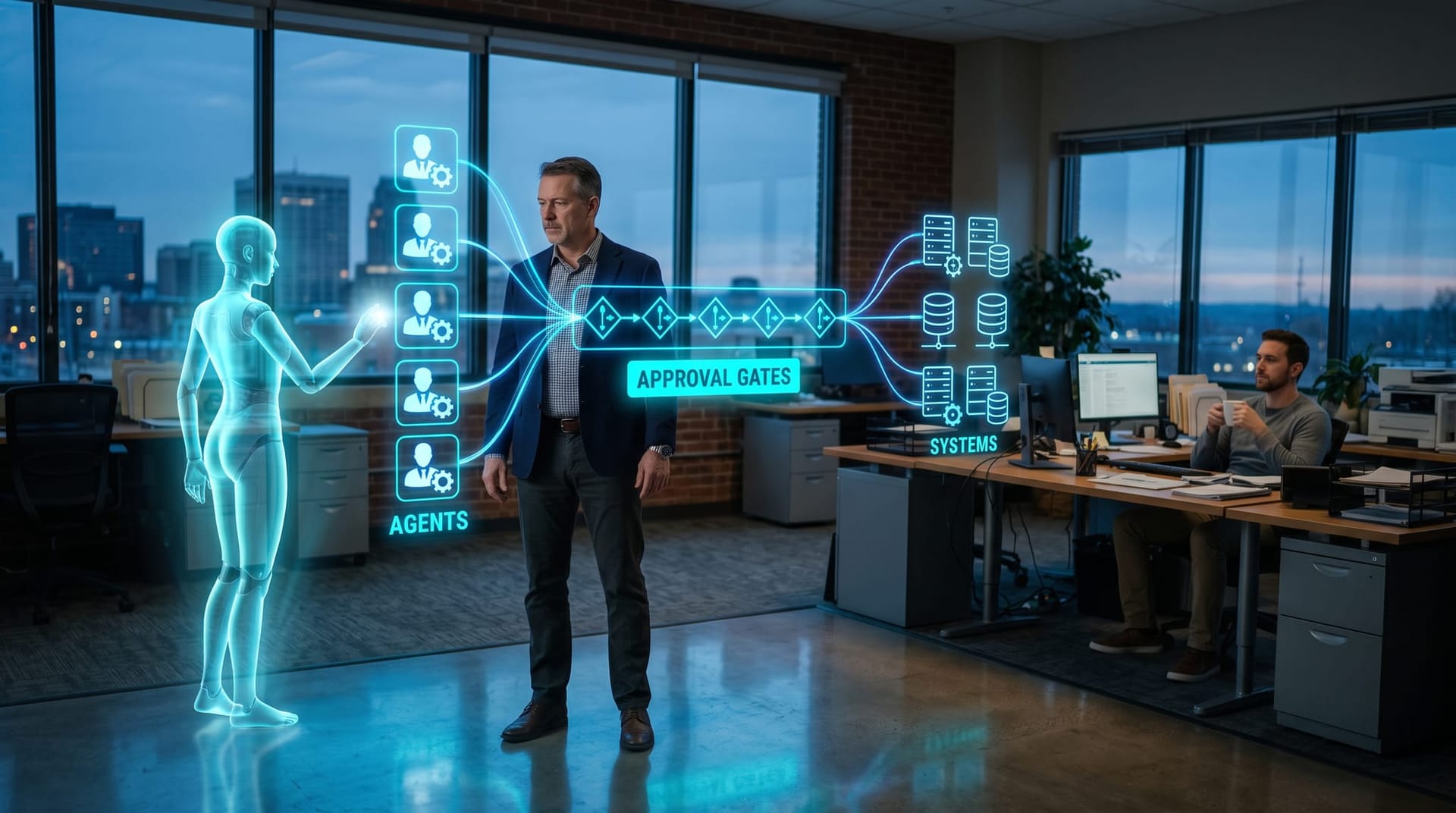
The architectural point that makes this workable: with Cloud Radix deployments, the dial is a configuration setting, not a rewrite. Our Secure AI Gateway sits between your AI Employees and your systems, so approval gates, scopes, and logging are enforced at the gateway — moving a task from rung 1 to rung 2 is a policy change, not an engineering project. That's also your defense against the statistic that should bother you most from the surveys above: over half of deployed agents running with no oversight or logging at all. If the audit trail is built into the pipe, rung 2 is actually safe to grant.
Set the Dial With Us
If you're weighing your first AI Employee — or you've deployed one and you're stuck arguing about how much to trust it — this is exactly the conversation Cloud Radix runs in week one. We'll map your tasks against blast radius, set starting rungs, and wire the approval gates so autonomy grows on evidence instead of vibes. See how it works or contact us to talk through your dial settings.
Frequently Asked Questions
Q1.What did Morgan Stanley's FIXR system actually accomplish?
FIXR cut profit-and-loss reconciliation from roughly 6 hours to 2–3 hours per book, saving about 1,500 hours per week across approximately 100 controllers, according to VentureBeat. Agents analyze reconciliation breaks and propose resolutions, humans review every recommendation, and repeated patterns get converted into fixed deterministic rules instead of being left to live model judgment.
Q2.Why would making AI agents less autonomous improve results?
Because reliability, cost, and control all improve when known patterns run deterministically and human review concentrates on novel cases. Deterministic rules don't hallucinate and cost almost nothing in tokens; model judgment stays where it adds value. It also builds the evidence trail that justifies expanding automation later — the opposite of granting broad autonomy up front and revoking it after an incident.
Q3.What is an AI autonomy ladder or autonomy dial?
It's a risk-tiered framework with four rungs: draft-only, human-approves-each-action, autonomous-with-audit-trail, and fully autonomous via fixed rules. Each task is assigned a rung based on blast radius — the cost of the worst plausible wrong action — and tasks earn promotion with measured evidence like falling correction rates, never with impressive demos.
Q4.How much human oversight do most companies actually apply to AI agents?
Less than the risk warrants. A June 2026 VB Pulse survey found 66% of enterprises permit production deployment without human review or are building toward it, while only 5% fully trust their automated evaluations. Gravitee's 2026 report found just 14.4% of organizations have full security approval for all live agents, and over half of agents run without security oversight or logging.
Q5.Where should a Fort Wayne small business set the autonomy dial for its first AI Employee?
Start customer-facing tasks at approve-each-action: the AI drafts, a named person approves each send. Start internal research and triage at draft-only or approve-each, promoting to autonomous-with-audit within weeks as correction rates fall. By month six, recurring proven patterns typically earn autonomy while novel situations still route to a human — the same month-one-to-month-six arc we walk Northeast Indiana businesses through above.
Q6.Does dialing autonomy down defeat the purpose of AI automation?
No — Morgan Stanley's numbers show the opposite. The constrained design still halved the work. The dial doesn't cap the value; it sequences it, so automation expands at the rate your evidence supports. Deployments that skip this step tend to join the 50% that passed internal evaluations and then failed in front of customers.
Sources & Further Reading
The reporting and research behind this framework, in order of relevance:
- VentureBeat: venturebeat.com/orchestration/morgan-stanley-cut-its-riskiest-reconciliation-job-in-half — Morgan Stanley cut its riskiest reconciliation job in half — by making its agents less autonomous (June 30, 2026).
- VentureBeat: venturebeat.com/security/the-real-cost-security-and-culture-problems-behind-enterprise-ai-agents — The real cost, security and culture problems behind enterprise AI agents (July 7, 2026).
- VentureBeat: venturebeat.com/orchestration/enterprise-ai-is-entering-an-evaluation-gap — Enterprise AI is entering an evaluation gap: Agents are gaining autonomy faster than companies can verify them (July 10, 2026).
- CNBC: cnbc.com/2026/06/03/ai-agents-morgan-stanley-wealth-management-funnel — Morgan Stanley will soon open its trillion-dollar wealth management funnel to AI agents (June 3, 2026).
- Okta: okta.com/newsroom/articles/ai-agents-at-work-2026-agentic-enterprise-security — AI Agents at Work 2026: Securing the agentic enterprise (January 15, 2026).
- Gravitee: gravitee.io/blog/state-of-ai-agent-security-2026-report — State of AI Agent Security 2026 Report: When Adoption Outpaces Control (February 4, 2026).
Set Your Autonomy Dial on Evidence, Not Vibes
We will map your tasks against blast radius, set starting rungs for your first AI Employee, and wire the approval gates so autonomy grows at the rate your correction rates actually support.
Schedule a Free ConsultationNo contracts. No pressure. Just an honest conversation about what would help your business.