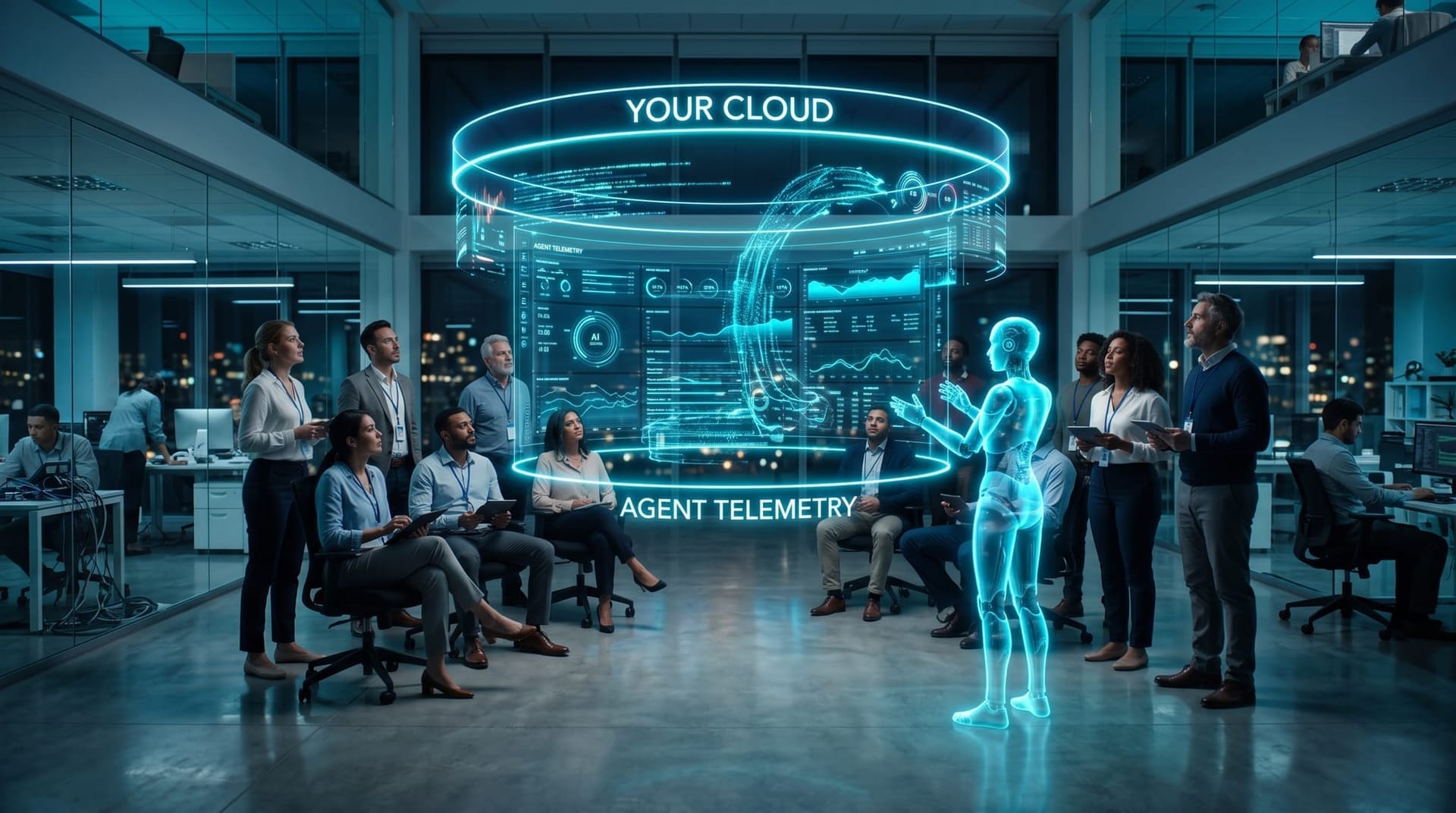
Here's a question most business owners have never been asked: when your AI agents work, where do their notes go?
Every time an AI agent runs, it generates telemetry — a running record of what it was asked, what it answered, which tools it called, how long it took, and how much it cost. That telemetry is gold for keeping agents reliable. It's also, quietly, some of the most sensitive data your business produces, because it can contain the full text of prompts and responses — the actual questions your team asks and the actual answers your agents give. And the moment you bolt on a typical third-party monitoring tool to watch your agents, a copy of that record starts flowing out to a SaaS vendor's servers.
Nobody signed off on that. It's just the default. In late July, the observability company Groundcover made the argument out loud — as VentureBeat reported, the company's position is that AI-agent telemetry should never leave your own cloud in the first place. That framing is worth taking seriously, because it names a data-residency exposure most organizations have created without realizing it.
Key Takeaways
- AI agent telemetry can include full prompt and response content — not just metrics — which makes it some of your most sensitive operational data.
- Most monitoring tools ship that telemetry to a third-party SaaS backend by default, creating a data-residency exposure you likely never explicitly approved.
- “Bring your own cloud” (BYOC) architectures keep the data plane inside your environment while a vendor manages only the interface — data stays in your AWS, Azure, or GCP account.
- Observability is fundamentally a governance problem, and audit trails only help you if you control where they live.
- Route agent monitoring through a Secure AI Gateway so you get visibility without leaking operational data to outside vendors.
We've written before about using AI to watch your systems — the always-on AI observability for cloud systems angle. This is the mirror image of that story. Here the question isn't “can AI help me monitor?” It's “who gets a copy of everything my agents see while I monitor them?”
What Is AI Agent Telemetry, and Why Is It So Sensitive?

Agent telemetry is the observability data that lets you understand what an autonomous AI agent actually did. Atlan defines AI agent observability as “the ability to see, understand, and explain what enterprise AI agents are doing across systems with enough detail to debug issues, enforce guardrails, and prove compliance.” That's a good goal. The catch is in how much it captures.
Modern agent monitoring goes far beyond a latency graph. According to Braintrust's 2026 buyer's guide, a full trace records “duration, LLM duration, time to first token, LLM calls, tool calls, errors... prompt tokens, cached tokens, completion tokens, reasoning tokens, estimated cost” — plus “full prompts, retrieved context, tool call inputs/outputs, and intermediate reasoning steps.” Arize's guide describes the same reality: useful traces capture “the user or system input, model operations, retrieved context, tool calls and results, memory reads and writes.”
Read those lists again with your own business in mind. “Full prompts” might be a customer's account details, a patient question, a legal matter, or a proprietary manufacturing spec your agent was asked to analyze. “Retrieved context” might be the internal document the agent pulled to answer. “Tool call inputs” might be the exact query your agent ran against your CRM or database. This isn't metadata. It's the substance of your operations, captured verbatim — which is exactly why Arize recommends teams “redact or tokenize PII, credentials, retrieved documents, and tool outputs before export when possible.”
That word — export — is the whole issue. In the default model, this data leaves your building.
Why Does Most Agent Monitoring Quietly Leave Your Network?
The reason is convenience, and it's a real benefit, not a trap. The classic SaaS observability model, as Braintrust describes it, is “sign up, integrate via SDK or the AI gateway, start capturing traces immediately. No servers to manage or databases to provision.” You point your agents at a vendor's endpoint and the dashboards light up. For a busy team, that's genuinely attractive.
But the trade is that your telemetry — prompts, responses, and all — is processed and stored on the vendor's infrastructure. Braintrust is candid that self-hosting has real costs (“updates, security patches, scaling infrastructure”), which is why so many teams accept the SaaS default. The problem is that the default was designed for convenience, not for data residency, and most owners never made a conscious decision about it.
This is the same pattern we flagged in our AI sub-processor data-exposure audit: a tool you added for one good reason quietly became a new place your data lives. And it compounds a trend we've written about separately — AI agents rebuilding data silos — because now a copy of your operational record sits in yet another external system you don't fully control. Every extra copy is extra attack surface and extra compliance scope.
There's also a subtler reason the exposure creeps in unnoticed: the volume of telemetry is enormous, and it's often captured by default. Groundcover's documentation notes that, by default, all AI spans are retained without sampling — prioritizing complete visibility over data minimization. That's a reasonable engineering choice for debugging, but it means the “keep everything” setting and the “send everything out” setting frequently ship together. The richer your agent monitoring gets, the more sensitive material accumulates in whatever system holds it. If that system is a vendor's cloud, your exposure grows every day the agents run — not because anything went wrong, but because the tooling is doing exactly what it was configured to do.
What Does “Keep Telemetry in Your Cloud” Actually Mean?

The alternative that Groundcover champions is a “bring your own cloud” (BYOC) architecture, and it's worth understanding concretely because the phrase gets thrown around loosely. In a BYOC model, the data plane — where telemetry is stored and processed — lives inside an isolated account in your cloud environment, while the vendor runs only a separate, network-isolated control plane for the user interface.
Per Unite.AI's reporting on Groundcover's $100 million Series C, this means logs, metrics, traces, and events stay within customer infrastructure rather than being transferred to vendor-operated servers, with on-premises and air-gapped deployments also supported. The company's own AI observability documentation states the principle bluntly: “All data stays in your infrastructure with BYOC; groundcover never processes your AI data outside your environment.” Groundcover uses an eBPF sensor — a low-level Linux mechanism that observes activity without code changes — to turn agent calls into traces, and CEO Shahar Azulay frames the pitch as combining eBPF “with the endless power of BYOC for observability.”
To be balanced: BYOC isn't unique to one vendor, and it isn't free. As Braintrust notes, several platforms now offer a “dedicated data plane in your AWS/GCP/Azure while using the managed” UI, and Arize similarly documents “hybrid, or fully self-hosted deployment choices” with options to keep “raw trace and evaluation data within their environment.” The point isn't which logo you pick. The point is that keeping telemetry in your own boundary is now an available, mature choice — and for regulated businesses, it should be the default one.
How Do You Decide? A Quick Telemetry-Residency Test
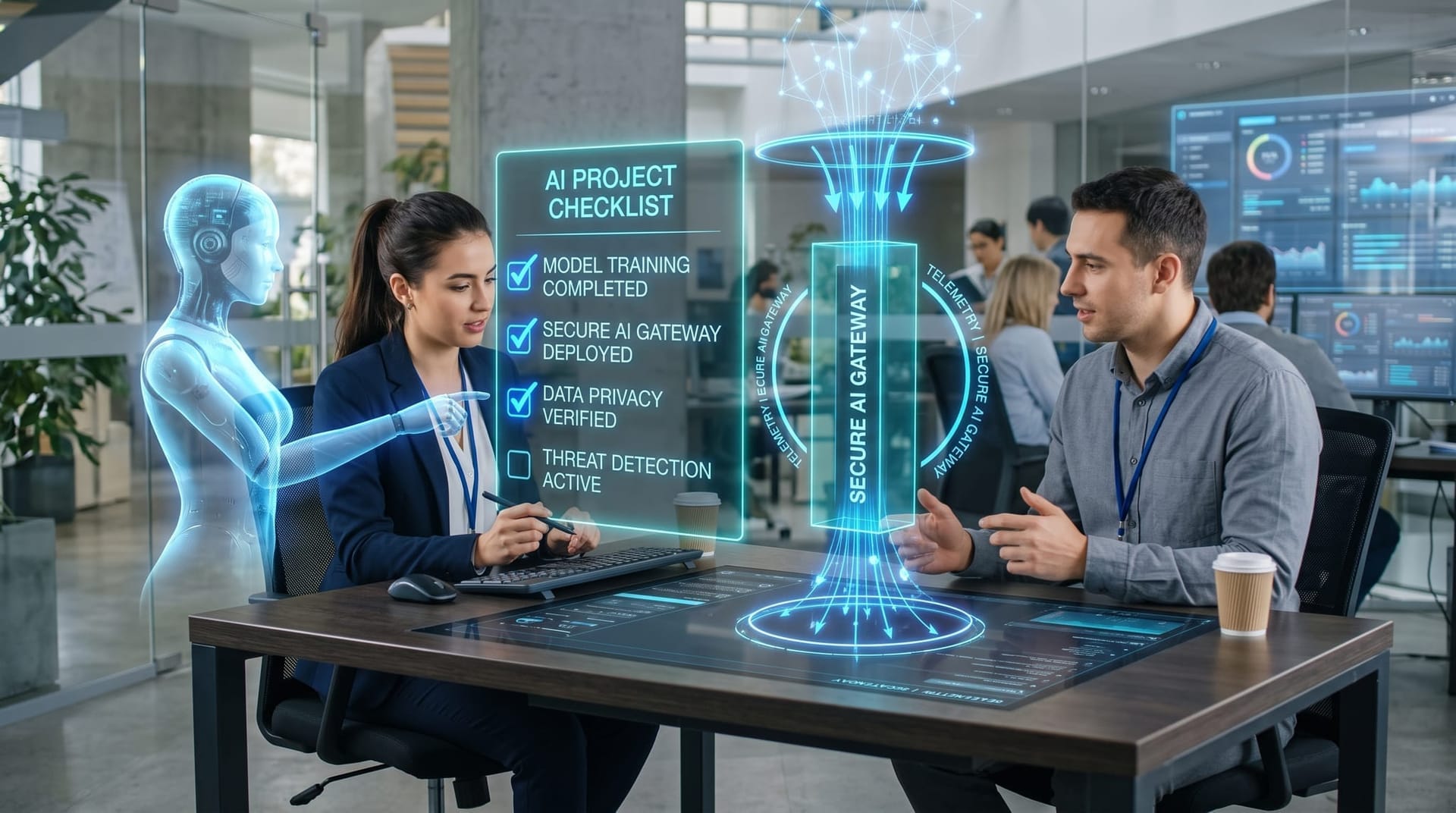
You don't need to be an infrastructure expert to make a good call here. Before you adopt or renew an agent-monitoring tool, work through these questions:
| Question | Why It Matters |
|---|---|
| Does telemetry include full prompts and responses? | If yes, you're storing verbatim operational and possibly regulated data. |
| Where is that data processed and stored? | "Vendor's cloud" means your data leaves your boundary; "your cloud (BYOC)" means it doesn't. |
| Can you keep the data plane in your own account? | Determines whether residency is architectural or just a policy promise. |
| Is PII redacted before anything is exported? | Redaction-before-export shrinks exposure if data does leave. |
| Who can access the raw traces, and is it logged? | Governance depends on scoped, audited access, not blanket vendor access. |
| Does it route through a control plane you govern? | A gateway lets you enforce all of the above as policy. |
The through-line is governance. As Atlan frames it, this kind of agent risk “isn't a model problem — it is a context and governance problem” — and the goal is audit trails where “every agent action is logged with the context, policies, and data assets that governed it.” Atlan goes further, describing contextual logging that enriches every event with lineage, quality signals, policies, and ownership data, so that observability tied to a governed context graph can actually surface risks like unauthorized data access. That's a compelling vision. But notice what it requires: the richer and more governance-aware your telemetry becomes, the more it needs to stay somewhere you control, because it now encodes not just what your agents did but which policies and data assets governed them.
An audit trail only helps you if you control where it lives. A compliance record sitting in a third party's system is a record you can't fully vouch for — and if that vendor has an incident, your governance data is caught up in it. This is the same logic behind a proper data sovereignty audit: control follows custody. You cannot outsource custody and keep control.
Where the Secure AI Gateway Comes In
A Secure AI Gateway is the practical way to make “keep it in your cloud” a standing rule rather than a per-tool negotiation. When your agents' traffic — and their telemetry — flows through a gateway you control, you get one place to decide what's captured, where it's stored, who can see it, and what's allowed to leave. Monitoring becomes something you enforce, not something a vendor's default configures for you.
That's the difference between visibility and exposure. You still get the dashboards, the traces, the cost and latency insight that make agents reliable. You just stop paying for them in leaked operational data. It's the same control-plane thinking behind using an AI gateway as a control plane to govern agents and cap runaway costs — observability is simply one more thing the gateway governs. For any business deploying AI Employees at scale, that control plane is what keeps “more agents” from meaning “more places your data lives.” Our broader approach to AI security treats telemetry residency as a first-class decision, not an afterthought.
What This Means for Northeast Indiana Businesses

For businesses across Fort Wayne, Allen County, and DeKalb County, telemetry residency isn't an abstract IT preference — it maps directly onto rules you already live under. A Northeast Indiana healthcare practice running AI agents against patient interactions cannot casually let verbatim prompts flow to a third-party SaaS backend; that's HIPAA scope walking out the door. A local law firm's agent telemetry can contain privileged matter details. A regional bank or insurance office answers to auditors who will ask exactly where their data is processed. And our manufacturers — the backbone of the DeKalb and Allen County economy — often run agents against process data and IP they'd never knowingly ship to an outside server.
For these organizations, keeping agent telemetry in-boundary turns a compliance risk into a competitive proof point. A Fort Wayne firm that can tell a client, an auditor, or an insurer “our AI monitoring data never leaves our own cloud” is in a stronger position than a competitor who has to check with a vendor first. The technology to do this is available today; what's usually missing is the decision to require it. That decision is the cheap part — and it's where we start with every Northeast Indiana client.
It's worth being honest about the trade-off, because pretending there isn't one helps no one. Keeping the data plane in your own environment means owning a little more infrastructure, and the pure-SaaS route will always be marginally faster to switch on. But for a regulated Midwest business, that convenience is borrowed against a liability you may not see until an audit or a breach notification forces the question. In our experience, the right sequencing for a Fort Wayne or DeKalb County team is to decide the residency requirement first, then choose the tool that satisfies it — not to adopt the easiest tool and try to bolt residency on afterward. The order matters, because retrofitting custody onto data that has already been flowing to an outside vendor is far harder than requiring it from day one.

Keep Your Agents' Notes in Your Building
If you're running — or planning — AI agents, the smartest next move is a short telemetry-residency review: what your monitoring tools capture, where that data goes, and whether any of it should be leaving your network at all. Cloud Radix runs that review for Fort Wayne and Northeast Indiana businesses and stands up a Secure AI Gateway so observability data stays in your cloud by design. You keep full visibility into your agents — and full custody of what they see. Get in touch to scope a telemetry-residency review for your team.
Frequently Asked Questions
Q1.What is AI agent telemetry?
AI agent telemetry is the observability data generated when an autonomous AI agent runs — including latency, token usage, cost, tool calls, and often the full text of prompts and responses. It's essential for keeping agents reliable, but because it can capture verbatim operational data, it's also among the most sensitive information your business produces.
Q2.Why is it a problem if my monitoring tool sends telemetry to a third-party SaaS?
Because that telemetry can include full prompts, retrieved documents, and tool outputs — potentially regulated or proprietary data. When a monitoring tool exports it to a vendor's servers by default, your sensitive operational record now lives in an external system you don't fully control, expanding both your attack surface and your compliance scope, usually without an explicit decision.
Q3.What does BYOC (bring your own cloud) mean for AI observability?
BYOC means the data plane — where telemetry is stored and processed — stays inside your own cloud account (AWS, Azure, or GCP), while the vendor operates only a separate control plane for the interface. As Groundcover's documentation puts it, your AI data is never processed outside your environment. It gives you SaaS-style dashboards while keeping the underlying data in your boundary.
Q4.Can I get AI agent monitoring without sending data to an outside vendor?
Yes. Multiple 2026 platforms now offer BYOC, hybrid, or fully self-hosted deployments that keep raw traces in your environment, and you can route monitoring through a Secure AI Gateway you control. The trade-off is some added infrastructure responsibility, but for regulated businesses the residency benefit typically outweighs the convenience of a pure-SaaS backend.
Q5.Does keeping telemetry in my own cloud help with compliance?
It helps significantly. Frameworks like HIPAA and standard data-residency requirements care about where sensitive data is processed and stored. Keeping agent telemetry in your own environment means audit trails and prompt/response records stay under your custody, which is far easier to defend to a regulator or auditor than data sitting in a third party's infrastructure.
Q6.How does a Secure AI Gateway help keep agent telemetry in-boundary?
A Secure AI Gateway acts as a control plane for your agents' traffic and telemetry, giving you one place to enforce what's captured, where it's stored, who can access it, and what's allowed to leave your network. It turns 'keep telemetry in our cloud' from a per-tool negotiation into a standing, enforced policy across every agent you run.
Sources & Further Reading
- VentureBeat: venturebeat.com/data — How is your enterprise tracking AI agent telemetry? Groundcover thinks it should never leave your cloud.
- Unite.AI: unite.ai — groundcover Raises $100 Million Series C to Scale AI-Era Observability Platform.
- groundcover: docs.groundcover.com/capabilities/ai-observability — AI Observability documentation.
- Braintrust: braintrust.dev/articles — AI observability tools: A buyer's guide to monitoring AI agents in production (2026).
- Atlan: atlan.com/know/ai-agent-observability — AI Agent Observability: A Complete Guide for 2026 & Beyond.
- Arize: arize.com/blog — 14 Best AI Agent Observability Tools in 2026.
Scope a Telemetry-Residency Review
Find out what your AI monitoring tools capture, where that data goes, and how to keep every agent's telemetry inside your own cloud — before an audit or a breach notification asks the question for you.