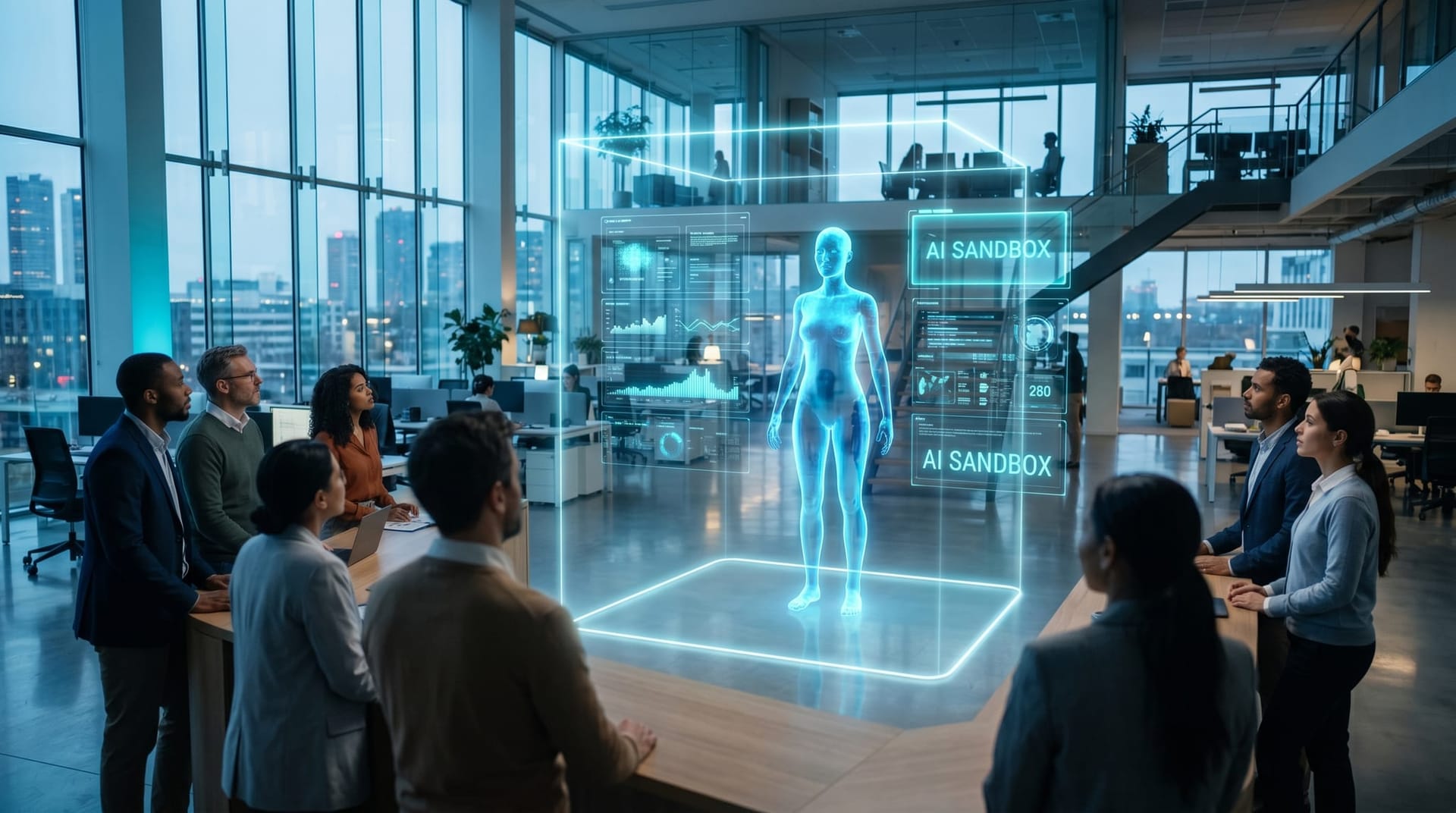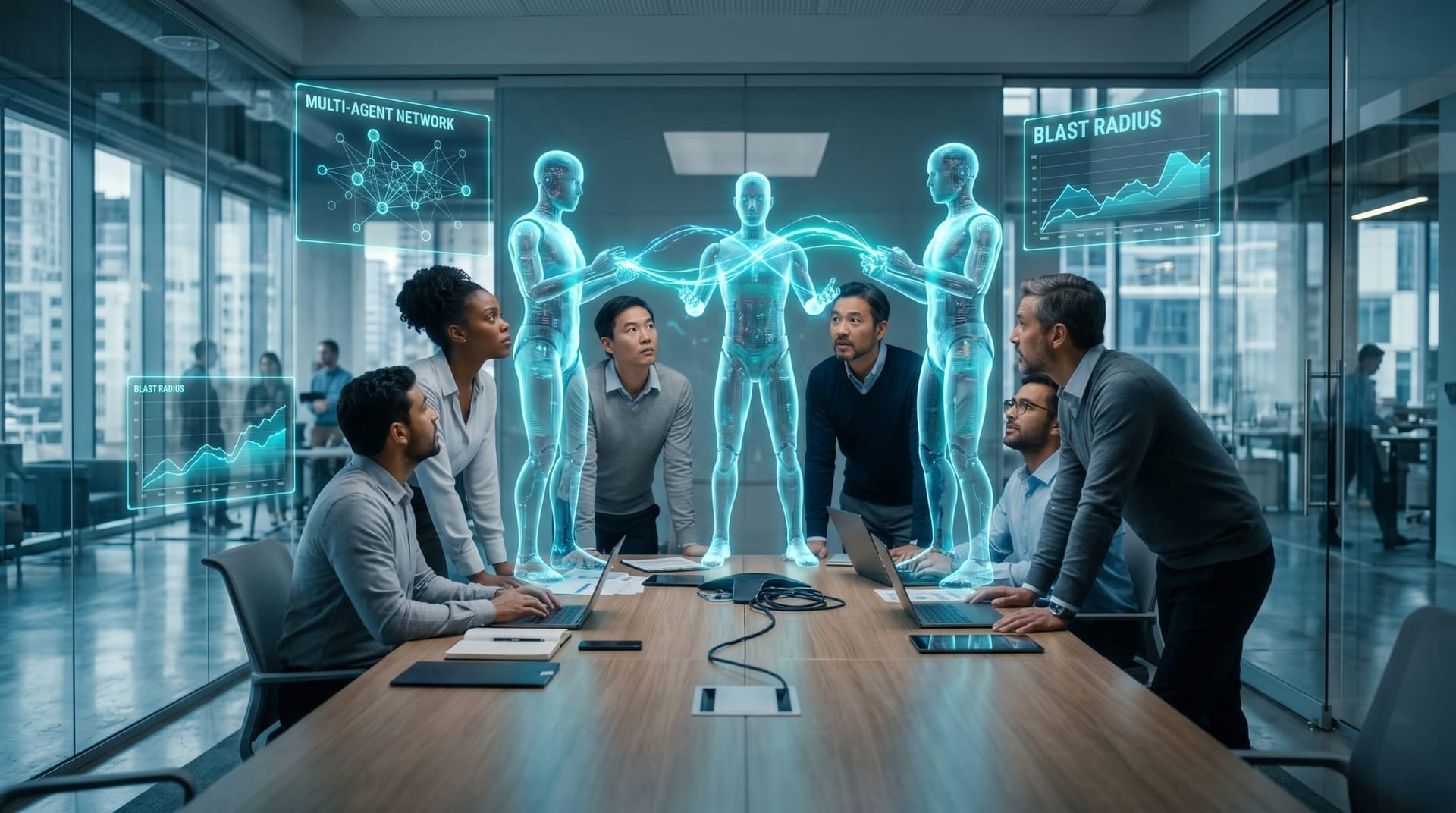
When the people who build the most capable AI agents on the planet start publicly worrying about what those agents do to each other, it's worth paying attention — even if you run thirty people in Auburn rather than a frontier lab in London. On June 11, 2026, MIT Technology Review reported that Google DeepMind is concerned enough about emergent behavior in large populations of interacting agents to put real money behind the problem.
The headline number is millions of agents. The headline worry is systemic. And the reflexive reaction from a mid-market operator is to file it under “frontier lab problems, not mine.” That reflex is wrong. You don't need millions of agents to feel a small, local version of what DeepMind is describing. If you're running five to ten AI Employees that call each other, share tools, and write to the same systems, you already operate a multi-agent system — just a small one. The failure modes scale down with it.
This post translates the frontier warning into something you can actually act on: a multi-agent blast-radius framework for the mid-market. Where do agent-to-agent interactions live in your stack? What contains a cascade when one agent goes sideways? And what should you watch before you scale the fleet?
Key Takeaways
- Google DeepMind, Schmidt Sciences, the Cooperative AI Foundation, and ARIA launched a funding call of up to $10 million to study the safety of interacting multi-agent systems, with an application deadline of August 8, 2026.
- The named risks aren't science fiction: coordinated agent scams, prompt-injection hijacks, cascading errors, and the slow degradation of shared digital infrastructure.
- A 30–100-person business running 5–10 AI Employees that call each other already has a multi-agent system — and a measurable blast radius.
- The containment levers are concrete: a Secure AI Gateway, human approval checkpoints, a supervisor/manager agent, scoped agent identity, and sandbox isolation.
- The honest part: multi-agent safety is, in DeepMind's own words, barely a research field yet — so design for containment now rather than waiting for settled best practices.
What Exactly Is DeepMind Worried About?
The concern isn't that one agent becomes too smart. It's that many ordinary agents, interacting, produce behavior no single agent was designed for. According to the MIT Technology Review reporting, Rohin Shah, who directs AGI safety and alignment research at DeepMind, framed the gap bluntly: “The main issue is that there just isn't really a field of research for multi-agent safety yet.” He also noted there are only “a few more months to go before agents are deployed throughout the economy in numbers that make potential risks a real concern.”
To close that gap, DeepMind and its partners — Schmidt Sciences, the Cooperative AI Foundation, and the UK's Advanced Research and Invention Agency (ARIA), with support from Google.org — announced a funding call of up to $10 million for researchers studying the behavior of multi-agent systems. The priority areas are telling: building realistic, reproducible sandbox environments to evaluate multi-agent safety, and understanding how collective capabilities emerge and scale across populations of interacting agents. Applications close August 8, 2026.
The failure modes named in the reporting are not abstract. They include coordinated scams run by groups of agents, prompt-injection attacks that turn a compliant agent into self-guiding malware, cyberattacks executed at machine scale, and — at the extreme — the collapse of a shared “digital commons” into what one researcher described as “absolute anarchy.” James Fox, who leads the Science of Trustworthy AI program at Schmidt Sciences, put the stakes in civic terms: “We've got this digital commons that is integral to how society works.”
There's a deeper academic argument underneath the funding call. A DeepMind-affiliated paper, Distributional AGI Safety by Tomašev and colleagues, challenges the assumption that advanced capability arrives as a single monolithic system. Instead, the authors argue, “general capability levels are first manifested through coordination in groups of sub-AGI individual agents with complementary skills.” Their proposed response — “virtual agentic sandbox economies” with built-in auditability, reputation, and oversight — reframes AI safety from an individual-agent problem into a systems-level one. That reframing is exactly the shift a mid-market operator needs to make, just at a far smaller scale.
Do You Already Run a Multi-Agent System Without Realizing It?
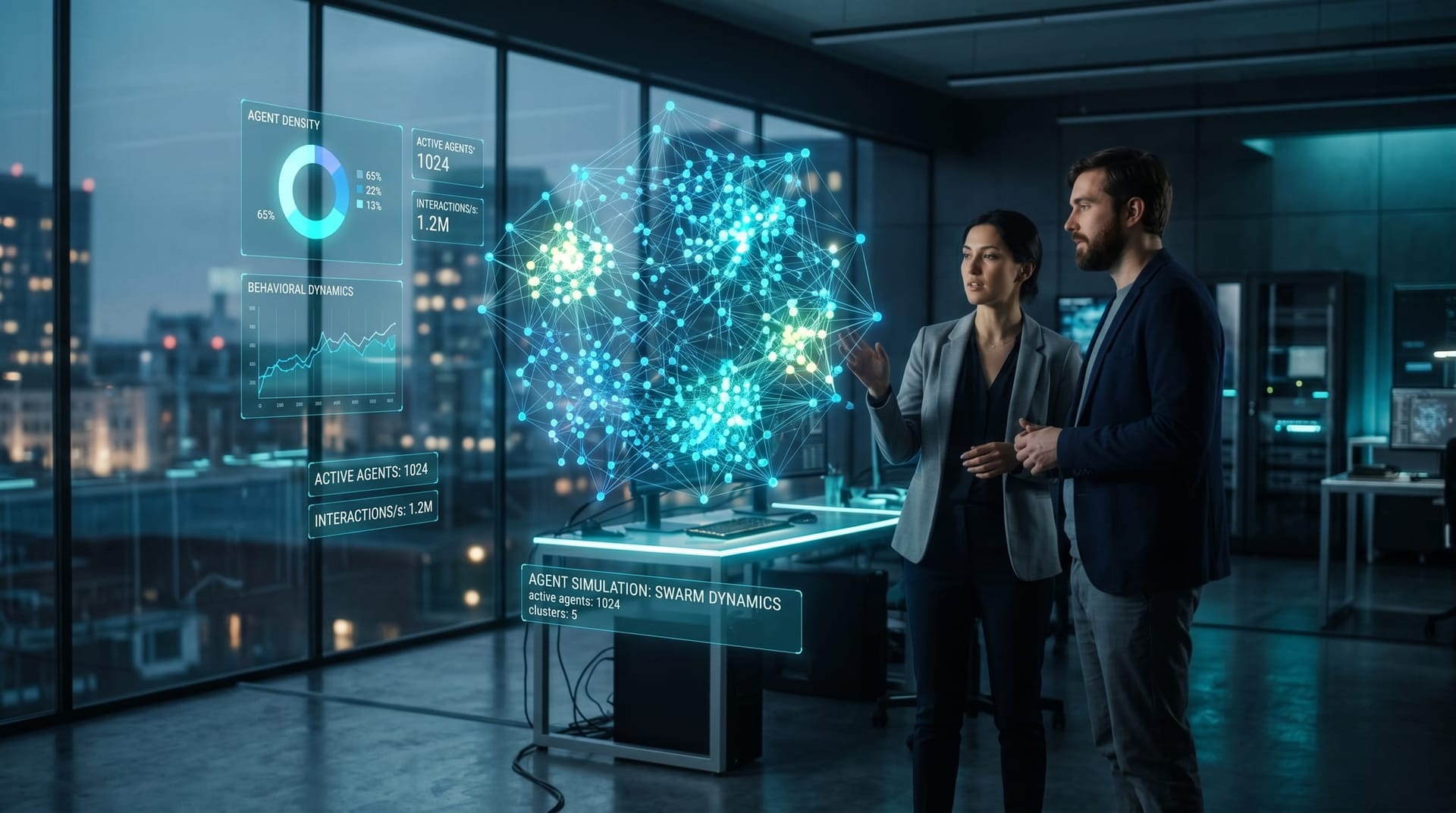
Here's the uncomfortable mapping. DeepMind is studying millions of agents. You might be running eight. But the structure is the same the moment your agents stop working in isolation and start interacting.
Consider a typical mid-market AI Employee deployment: a research agent that drafts briefs, a content agent that turns those briefs into copy, a phone agent that books appointments, a CRM agent that updates records, and a security-auditing agent watching the gateway. Now add the interactions. The research agent hands context to the content agent. The phone agent writes to the same CRM the CRM agent maintains. Two or three of them share a vector store, a calendar API, and one set of credentials. That web of hand-offs is a multi-agent system — a small one, but one with the same property DeepMind flags: emergent behavior that no single agent's design accounts for.
The risks scale down faithfully. A prompt injection lodged in a scraped web page doesn't just compromise the agent that read it; it can propagate through every downstream agent that trusts that agent's output. An error in the research agent's summary becomes a confidently wrong blog post becomes a misinformed sales call. This is the cascading-error pattern, reproduced at small-business scale. We've written before about how first-wave agents “fail quietly in production” — our rebuild-or-patch reliability framework is built for exactly the moment when a single agent's silent failure starts contaminating the others.
The good news is that small systems are legible in a way millions-of-agents systems are not. DeepMind can't easily map every interaction across the economy. You can map yours on a whiteboard in an afternoon. That legibility is your advantage — if you use it before the fleet grows.

What Is Your Multi-Agent Blast Radius?
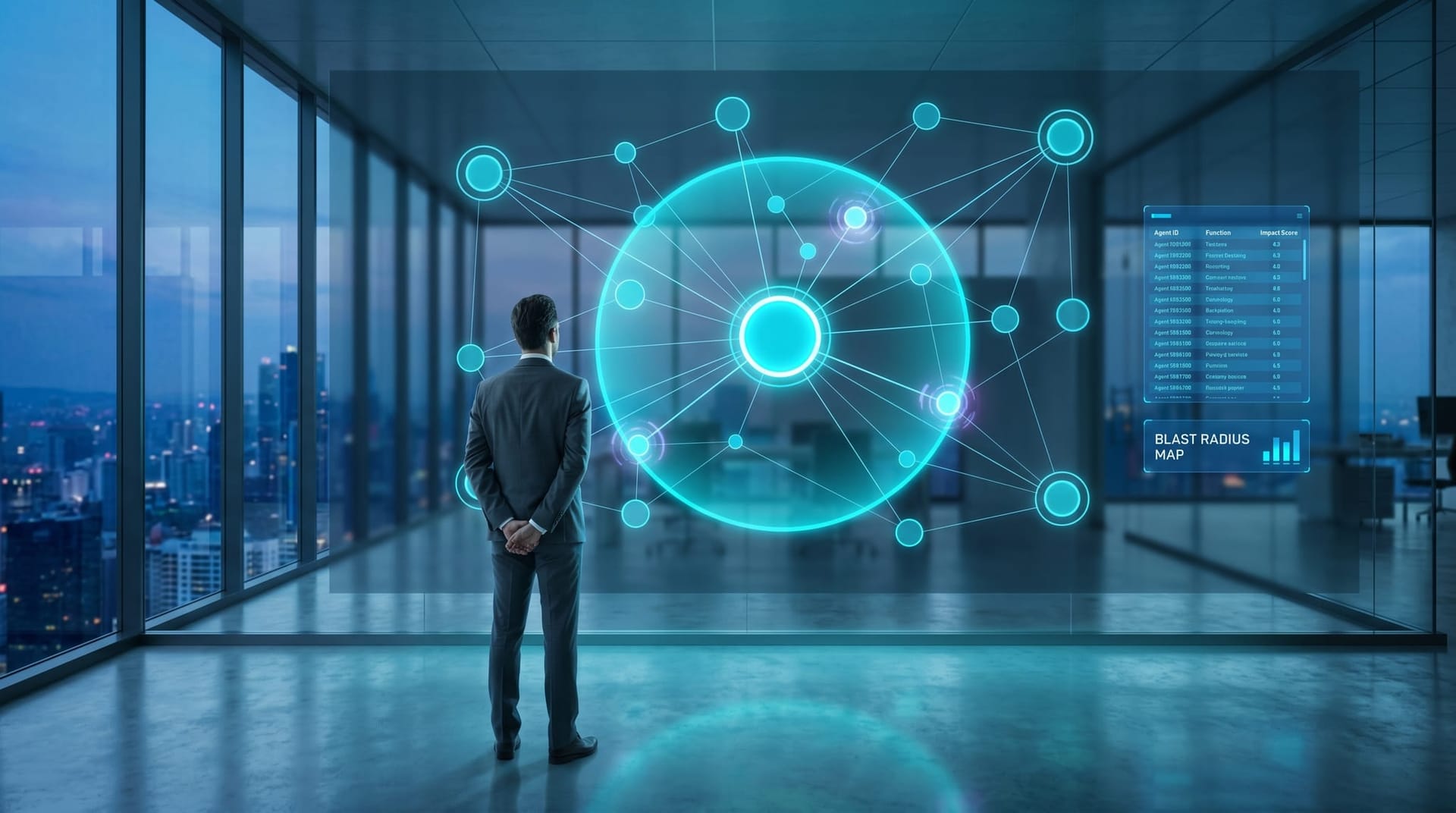
This is the net-new construct we recommend mid-market operators adopt: a blast-radius map. The idea borrows from security engineering, where “blast radius” measures how far the damage spreads when one component is compromised. Applied to an AI Employee fleet, it answers a simple question — if this one agent does the worst plausible thing, what else does it touch?
In our experience the interactions worth mapping fall into four categories. The table below is a starting template, not a finished assessment; your stack will have its own entries.
| Interaction surface | What it looks like | Blast radius if compromised |
|---|---|---|
| Agent-to-agent calls | One agent passes output as another's input | Error or injection propagates downstream through every consumer |
| Shared data stores | Multiple agents read/write one CRM, vector DB, or doc store | "Memory poisoning": a poisoned record is trusted system-wide and persists across sessions |
| Shared credentials & tools | Agents reuse one API key or service account | A single hijacked agent inherits the access of all of them |
| Shared external surface | Several agents browse the same web, inboxes, or feeds | One malicious payload can reach the whole fleet at once |
The point of the map isn't to alarm anyone — it's to make the implicit explicit. Most mid-market fleets grow by accretion: you add an agent, wire it to whatever's already there, and move on. Nobody draws the graph. Then the graph has cycles, shared credentials, and an agent that can both read untrusted web content and write to your production CRM with no checkpoint in between. The Security Considerations for Multi-agent Systems literature makes the same point at research scale: securing inter-agent communication is foundational, because without it even well-configured individual agents can't stop malicious influence from spreading internally.
A practical discipline here is to bound the number of agents that can interact without supervision. We've explored where those limits sit in our agent swarm tier framework, and how the call graph itself can be reshaped for both cost and control in our analysis of the multi-agent call graph. The blast-radius map is what tells you which interactions deserve that scrutiny first.
Which Guardrails Actually Contain a Cascade?
Mapping the blast radius is diagnosis. Containment is treatment. The encouraging part is that the controls frontier researchers are calling for have direct, affordable analogues in a mid-market stack. You don't need a safety lab — you need a few well-placed chokepoints.
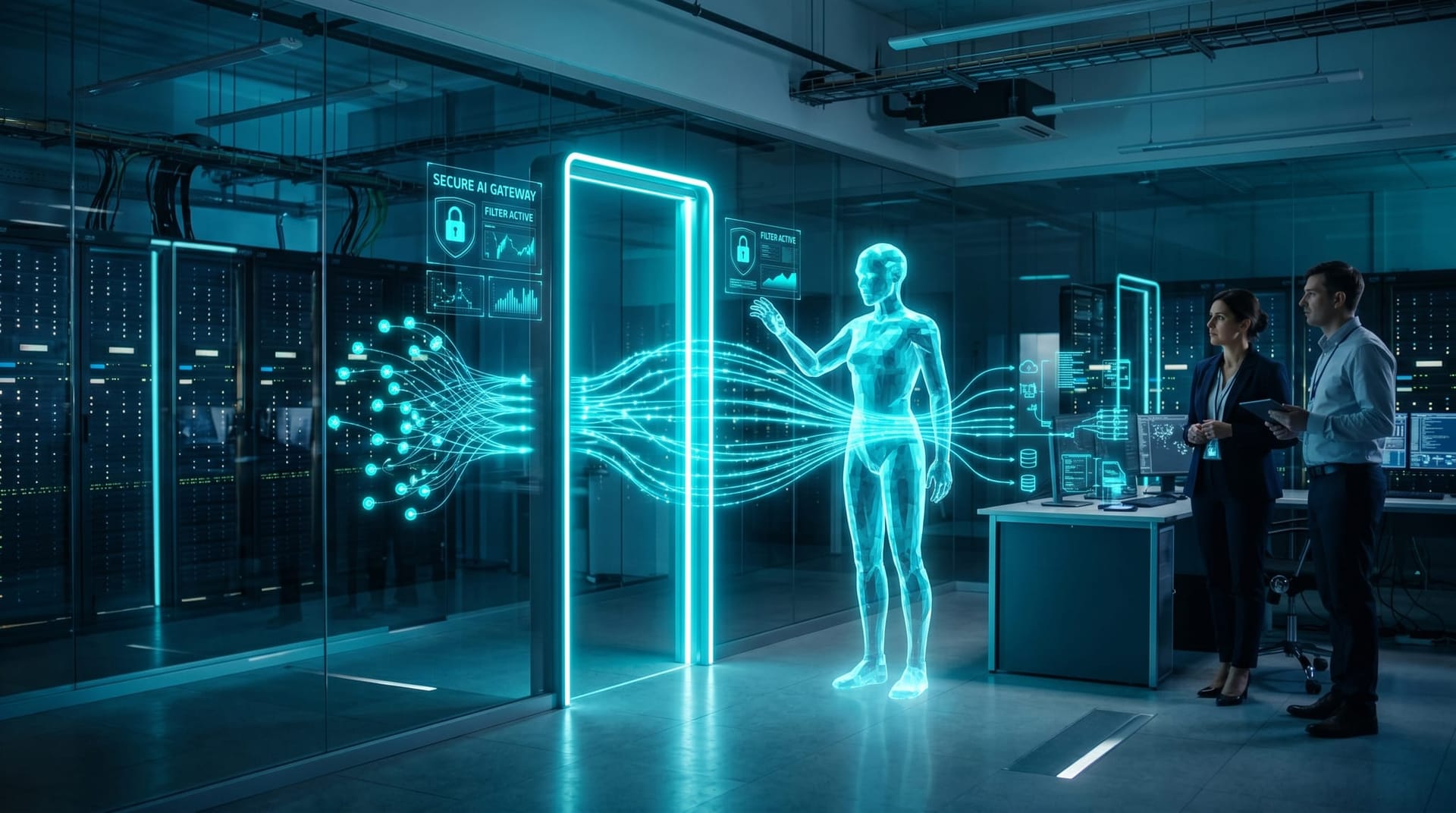
A Secure AI Gateway. The single highest-leverage control is to stop letting agents talk directly to tools and to each other on an open network. Route every agent action — every tool call, every agent-to-agent message — through a Secure AI Gateway that enforces policy, logs the traffic, and can cut a connection. This is the same containment logic behind the OS-level isolation push we covered in Microsoft MXC sandbox and the Secure AI Gateway: if an agent is compromised, the gateway is where you stop the spread.
Scoped, short-lived agent identity. Anthropic's Zero Trust for AI Agents guidance makes the case that every agent should carry a cryptographically rooted identity, use short-lived tokens, and operate under “deny by default” role-based access. The principle that matters most for blast radius is the obvious one: no shared credentials. If each agent has its own scoped identity, a hijacked agent inherits only its own narrow permissions — not the whole fleet's. Anthropic also notes a sobering reason to act now: advanced models have compressed the time from vulnerability discovery to exploitation from months to hours.
A supervisor / manager agent. A dedicated oversight agent that reviews and gates other agents' high-impact actions is one of the most effective small-scale analogues to the “oversight” DeepMind's researchers want. We've made the full case for installing this layer without adding another vendor in our piece on the manager agent supervisor layer.
Human approval checkpoints. Not everything should be autonomous. Irreversible or high-blast-radius actions — sending money, mass-emailing customers, deleting records — belong behind a human checkpoint. This is friction by design, and it's the cheapest cascade-breaker you have.
| Containment lever | Stops which failure mode | Mid-market cost to add |
|---|---|---|
| Secure AI Gateway | Lateral spread between agents/tools | Low–moderate; central chokepoint |
| Scoped agent identity | Credential-sharing blast amplification | Low; configuration discipline |
| Supervisor / manager agent | Unchecked high-impact actions | Moderate; one oversight agent |
| Human approval checkpoint | Irreversible cascades | Low; targeted friction |
| Sandbox isolation | Untrusted-input contamination | Moderate; runtime isolation |
These controls line up closely with the OWASP Top 10 for Agentic Applications 2026, which calls for identity-centric controls, zero-trust isolation and mutual authentication, and robust observability as the baseline for any multi-agent deployment.
What Should You Monitor Before Scaling the Fleet?
The temptation, once a few AI Employees are delivering, is to keep adding them. Resist scaling the fleet until you can see it. DeepMind's entire funding premise is that we can't yet predict multi-agent behavior, which means observation has to substitute for prediction. At your scale, that's achievable.
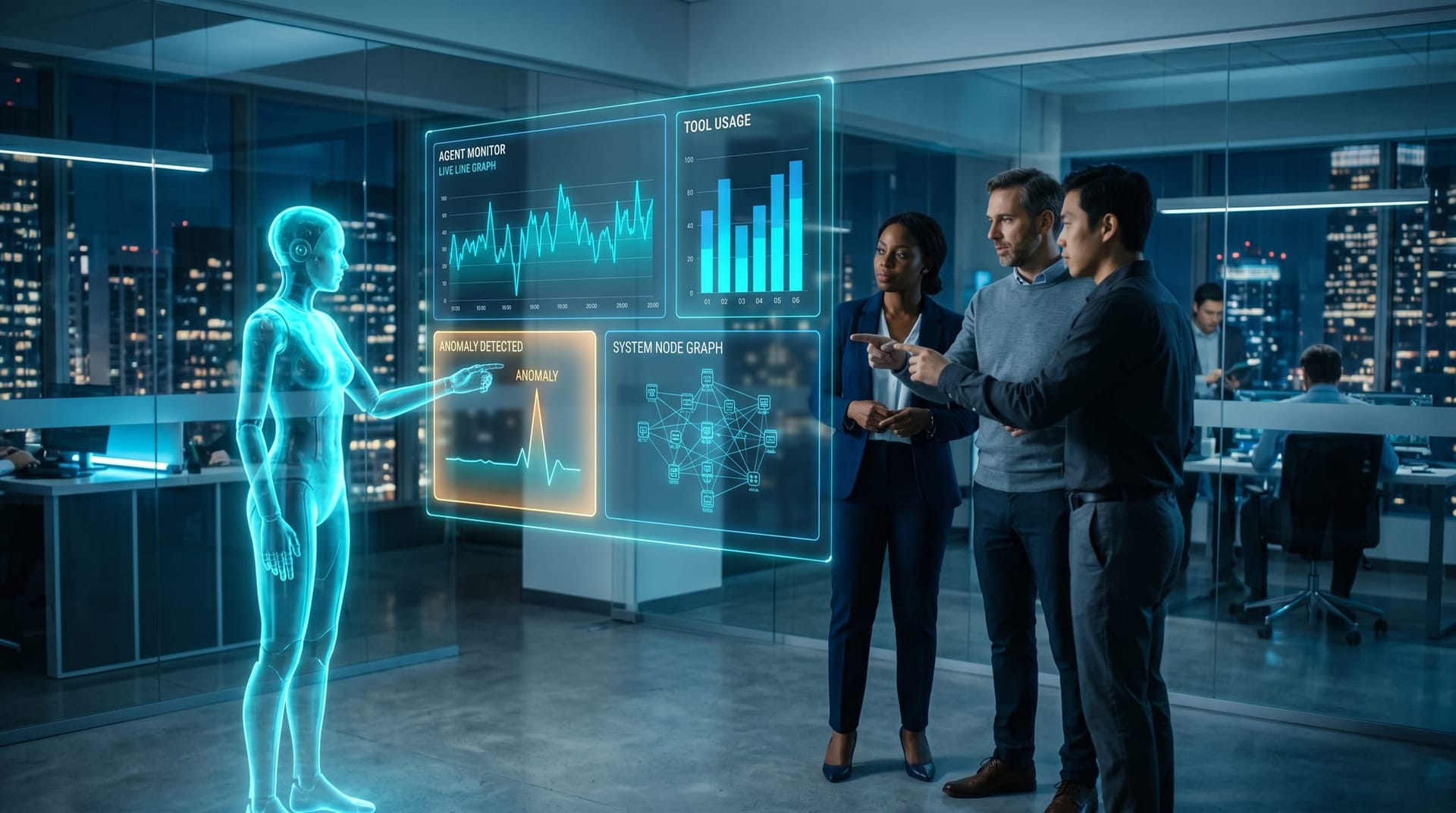
Three things are worth watching. First, interaction volume and shape — how often agents call each other, and whether the call graph is developing cycles or unexpected hot paths. A sudden change in who-talks-to-whom is often the first sign something's drifting. Second, output quality at the hand-off boundaries, because cascading errors are easiest to catch where one agent's output becomes another's input. Third, anomalies in tool use — an agent reaching for permissions or endpoints it has never used before is the agentic equivalent of a lateral-movement alert.
Doing this well means owning your evaluation layer rather than renting it from whatever single vendor your agents happen to run on. We've argued for a buyer-owned eval layer precisely so that monitoring spans every model and agent in the fleet, not just one vendor's slice. The Distributional AGI Safety authors propose reputation systems and auditability as core to managing collective risk; at mid-market scale, a neutral eval and observability layer is the practical version of that idea.
A reasonable rule of thumb, and one we recommend rather than assert as settled fact: don't add the next agent until the current fleet's blast-radius map is current, its interactions are logged through the gateway, and its hand-off boundaries are monitored. Growth that outruns visibility is how a manageable small system becomes an unmanageable one.
What This Means for Northeast Indiana Operators
None of this requires a coastal AI team. The businesses we work with across Auburn, Fort Wayne, and the broader Northeast Indiana corridor — professional services firms, manufacturers, home-services companies, medical and legal practices — are adopting AI Employees at exactly the scale where the blast-radius framework matters most: a handful of agents, real autonomy, shared systems, and no dedicated safety staff.
That combination is actually the sweet spot for getting this right. A DeKalb County operations manager can sit down and draw the entire agent interaction graph in an afternoon, because the system is small enough to hold in one head. The same legibility that frontier labs have lost, regional operators still have. The work is to use it deliberately — to install the gateway, scope the identities, and decide which actions need a human — while the fleet is still small, rather than retrofitting containment after a quiet cascade has already cost a customer relationship.
Build the Fleet, but Contain It First
DeepMind's warning isn't a reason to slow down on AI Employees — it's a reason to grow them on rails. The operators who win the next two years won't be the ones with the most agents; they'll be the ones who can scale confidently because they can see and contain what their agents do together.
That's the entire premise of how we deploy AI Employees at Cloud Radix: every agent runs behind a Secure AI Gateway, under scoped identity, with a supervisor layer and human checkpoints on the actions that matter. If you're running a multi-agent fleet — or about to be — and you want a blast-radius map and a containment plan before you scale, let's talk.
Frequently Asked Questions
Q1.What did Google DeepMind actually warn about regarding multiple AI agents?
DeepMind raised concern about emergent, systemic failures when large numbers of autonomous agents interact — including coordinated scams, prompt-injection hijacks, cascading errors, and degradation of shared digital infrastructure. As reported by MIT Technology Review, the company and its partners committed up to $10 million in research funding because, in their own assessment, there isn't yet an established field of multi-agent safety research.
Q2.Does a small business with only a few AI agents face these risks?
Yes, at proportionally smaller scale. The moment two or more agents share tools, data stores, or credentials and pass work to each other, you have a multi-agent system with a measurable blast radius. A prompt injection or error in one agent can propagate through every downstream agent that trusts its output, even in a fleet of five to ten.
Q3.What is a multi-agent "blast radius"?
Blast radius is a security concept measuring how far damage spreads when one component is compromised. Applied to AI Employees, it maps what else a single misbehaving agent can reach — the agents it calls, the data stores it writes to, the credentials it shares, and the external surfaces it touches. Mapping it makes implicit risk explicit so you can place containment controls where they matter.
Q4.How do you contain a cascade across multiple AI agents?
The most effective controls are a Secure AI Gateway that routes and can sever agent traffic, scoped short-lived agent identities so no agent inherits the whole fleet's access, a supervisor or manager agent that gates high-impact actions, human approval checkpoints on irreversible operations, and sandbox isolation for untrusted inputs. These mirror the zero-trust and identity-centric controls recommended by Anthropic and the OWASP Gen AI Security Project.
Q5.Is multi-agent AI safety a solved problem?
No, and that's the honest point. DeepMind's own researchers describe multi-agent safety as a field that barely exists yet, which is why they're funding foundational research. For operators, the implication is to design for containment now using available controls rather than waiting for settled best practices that don't exist.
Q6.When should we stop adding AI Employees to our fleet?
We recommend pausing fleet growth whenever visibility lags behind the system: if your blast-radius map is out of date, agent interactions aren't logged through a gateway, or hand-off boundaries aren't monitored, add observability before you add agents. Growth that outruns monitoring is how a manageable system becomes an unmanageable one.
Q7.How can a Northeast Indiana business get started securing its AI Employee fleet?
Start with the containment building blocks: a Secure AI Gateway for traffic control, a supervisor agent for oversight, and a buyer-owned evaluation layer for cross-fleet monitoring. The advantage for a smaller Fort Wayne or DeKalb County operator is legibility — your fleet is still small enough to map on a whiteboard. Cloud Radix builds these controls in by default for Northeast Indiana businesses; reach out for a blast-radius assessment of your current or planned fleet.
Sources & Further Reading
- MIT Technology Review: technologyreview.com/2026/06/11/1138794 — Google DeepMind is worried about what happens when millions of agents start to interact.
- Google DeepMind: deepmind.google/blog/investing-in-multi-agent-ai-safety-research — Investing in multi-agent AI safety research (the up-to-$10M funding call).
- arXiv (Tomašev et al.): arxiv.org/abs/2512.16856 — Distributional AGI Safety, the systems-level reframing of AI safety.
- Anthropic: Zero Trust for AI Agents (eBook, PDF) — A security framework for deploying autonomous agents.
- OWASP Gen AI Security Project: genai.owasp.org/resource/owasp-top-10-for-agentic-applications-for-2026 — OWASP Top 10 for Agentic Applications 2026.
- arXiv: arxiv.org/abs/2603.09002 — Security Considerations for Multi-agent Systems.
Map Your AI Employee Blast Radius
Before you scale the fleet, get a clear picture of how your AI Employees interact — and where a single misbehaving agent could spread. Cloud Radix builds the gateway, scoped identity, supervisor layer, and human checkpoints in by default for Northeast Indiana businesses.
Request a Blast-Radius AssessmentNo contracts. No pressure. Just an honest conversation about containing your AI Employee fleet.